Fauci, A. S. & Folkers, G. K. Pandemic preparedness and response: lessons from COVID-19. J. Infect. Dis. 228, 422–425 (2023). Article PubMed Google Scholar Rappuoli, R., Alter, G. & Pulendran, B. Transforming vaccinology. Cell 187, 5171–5194 (2024). Article CAS PubMed PubMed Central Google Scholar Pulendran, B., Li, S. & Nakaya, H. I. Systems vaccinology. Immunity
Fauci, A. S. & Folkers, G. K. Pandemic preparedness and response: lessons from COVID-19. J. Infect. Dis. 228, 422–425 (2023).
Google Scholar
Rappuoli, R., Alter, G. & Pulendran, B. Transforming vaccinology. Cell 187, 5171–5194 (2024).
Google Scholar
Pulendran, B., Li, S. & Nakaya, H. I. Systems vaccinology. Immunity 33, 516–529 (2010).
Google Scholar
Pulendran, B. & Davis, M. M. The science and medicine of human immunology. Science https://doi.org/10.1126/science.aay4014 (2020).
Tomalka, J. A., Suthar, M. S., Deeks, S. G. & Sekaly, R. P. Fighting the SARS-CoV-2 pandemic requires a global approach to understanding the heterogeneity of vaccine responses. Nat. Immunol. 23, 360–370 (2022).
Google Scholar
Pulendran, B. Learning immunology from the yellow fever vaccine: innate immunity to systems vaccinology. Nat. Rev. Immunol. 9, 741–747 (2009).
Google Scholar
Pulendran, B. Systems vaccinology: probing humanity’s diverse immune systems with vaccines. Proc. Natl Acad. Sci. USA 111, 12300–12306 (2014).
Google Scholar
Plotkin, S. A. Updates on immunologic correlates of vaccine-induced protection. Vaccine 38, 2250–2257 (2020).
Google Scholar
Bernstein, A., Pulendran, B. & Rappuoli, R. Systems vaccinomics: the road ahead for vaccinology. Omics 15, 529–531 (2011).
Google Scholar
Querec, T. et al. Yellow fever vaccine YF-17D activates multiple dendritic cell subsets via TLR2, 7, 8, and 9 to stimulate polyvalent immunity. J. Exp. Med. 203, 413–424 (2006).
Google Scholar
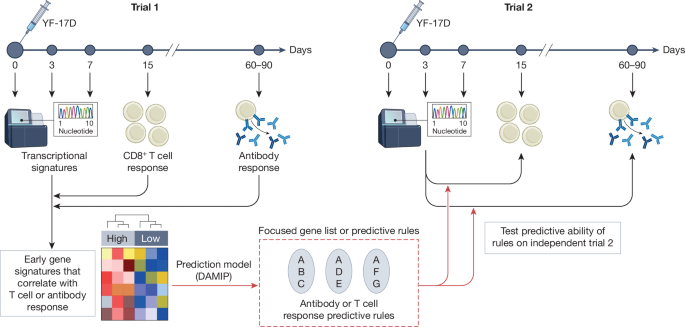
Querec, T. D. et al. Systems biology approach predicts immunogenicity of the yellow fever vaccine in humans. Nat. Immunol. 10, 116–125 (2009). This study demonstrated the first proof of concept using machine learning that early blood transcriptional signatures can predict the magnitude of adaptive immune responses to vaccination in humans, establishing a foundational principle of systems vaccinology.
Google Scholar
Gaucher, D. et al. Yellow fever vaccine induces integrated multilineage and polyfunctional immune responses. J. Exp. Med. 205, 3119–3131 (2008). This work revealed that vaccination induces integrated, multilineage immune responses, highlighting the coordinated activation of innate and adaptive immunity.
Google Scholar
Hinnebusch, A. G. The eIF-2 alpha kinases: regulators of protein synthesis in starvation and stress. Semin. Cell. Biol. 5, 417–426 (1994).
Google Scholar
Ravindran, R. et al. Vaccine activation of the nutrient sensor GCN2 in dendritic cells enhances antigen presentation. Science 343, 313–317 (2014).
Google Scholar
Ravindran, R. et al. The amino acid sensor GCN2 controls gut inflammation by inhibiting inflammasome activation. Nature 531, 523–527 (2016).
Google Scholar
Cornelis, R., Chang, H. D. & Radbruch, A. Keeping up with the stress of antibody production: BAFF and APRIL maintain memory plasma cells. Curr. Opin. Immunol. 71, 97–102 (2021).
Google Scholar
Nakaya, H. I. et al. Systems biology of vaccination for seasonal influenza in humans. Nat. Immunol. 12, 786–795 (2011). This study extended systems vaccinology to influenza vaccination, identifying early transcriptional predictors of antibody responses across independent cohorts across multiple flu seasons.
Google Scholar
Nakaya, H. I. et al. Systems analysis of immunity to influenza vaccination across multiple years and in diverse populations reveals shared molecular signatures. Immunity 43, 1186–1198 (2015).
Google Scholar
Li, S. et al. Molecular signatures of antibody responses derived from a systems biology study of five human vaccines. Nat. Immunol. 15, 195–204 (2014). This work introduced blood transcriptional modules as a scalable framework to identify shared and vaccine-specific molecular programs underlying immune responses.
Google Scholar
Bucasas, K. L. et al. Early patterns of gene expression correlate with the humoral immune response to influenza vaccination in humans. J. Infect. Dis. 203, 921–929 (2011).
Google Scholar
Li, S. et al. Metabolic phenotypes of response to vaccination in humans. Cell 169, 862–877.e17 (2017). This study introduced a multiscale, multifactorial response network framework to integrate multi-omics data across vaccines and identified SREBP-driven cholesterol biosynthesis as a key regulator of humoral immune responses, which was later experimentally validated in ref. 92.
Google Scholar
Furman, D. et al. Apoptosis and other immune biomarkers predict influenza vaccine responsiveness. Mol. Syst. Biol. 9, 659 (2013).
Google Scholar
Furman, D. et al. Systems analysis of sex differences reveals an immunosuppressive role for testosterone in the response to influenza vaccination. Proc. Natl Acad. Sci. USA 111, 869–874 (2014).
Google Scholar
Tsang, J. S. et al. Global analyses of human immune variation reveal baseline predictors of postvaccination responses. Cell 157, 499–513 (2014). This study demonstrated that baseline immune variation across individuals can predict responsiveness to vaccination, establishing the importance of pre-vaccination immune state.
Google Scholar
Brodin, P. et al. Variation in the human immune system is largely driven by non-heritable influences. Cell 160, 37–47 (2015). This study showed that environmental factors dominate over genetic influences in shaping human immune variation, providing a framework for understanding heterogeneity in vaccine responses.
Google Scholar
Nakaya, H. I. et al. Systems biology of immunity to MF59-adjuvanted versus nonadjuvanted trivalent seasonal influenza vaccines in early childhood. Proc. Natl Acad. Sci. USA 113, 1853–1858 (2016).
Google Scholar
Muyanja, E. et al. Immune activation alters cellular and humoral responses to yellow fever 17D vaccine. J. Clin. Invest. 124, 3147–3158 (2014).
Google Scholar
Kazmin, D. et al. Systems analysis of protective immune responses to RTS,S malaria vaccination in humans. Proc. Natl Acad. Sci. USA 114, 2425–2430 (2017).
Google Scholar
Caskey, M. et al. Synthetic double-stranded RNA induces innate immune responses similar to a live viral vaccine in humans. J. Exp. Med. 208, 2357–2366 (2011).
Google Scholar
Voigt, E. A. et al. Sex differences in older adults’ immune responses to seasonal influenza vaccination. Front. Immunol. 10, 180 (2019).
Google Scholar
Fourati, S. et al. Pre-vaccination inflammation and B-cell signalling predict age-related hyporesponse to hepatitis B vaccination. Nat. Commun. 7, 10369 (2016).
Google Scholar
Fourati, S. et al. Pan-vaccine analysis reveals innate immune endotypes predictive of antibody responses to vaccination. Nat. Immunol. 23, 1777–1787 (2022). This study, together with the accompanying analysis by ref. 33 from the Human Immunology Project Consortium, integrated transcriptional data across 28 studies of 13 vaccines to define pre-vaccination innate immune endotypes and a vaccination-induced plasmablast signature that predict antibody responses across vaccines at scale.
Google Scholar
Hagan, T. et al. Transcriptional atlas of the human immune response to 13 vaccines reveals a common predictor of vaccine-induced antibody responses. Nat. Immunol. 23, 1788–1798 (2022).
Google Scholar
Tomalka, J. A. et al. The transcription factor CREB1 is a mechanistic driver of immunogenicity and reduced HIV-1 acquisition following ALVAC vaccination. Nat. Immunol. 22, 1294–1305 (2021).
Google Scholar
Kotliarov, Y. et al. Broad immune activation underlies shared set point signatures for vaccine responsiveness in healthy individuals and disease activity in patients with lupus. Nat. Med. 26, 618–629 (2020). This study identified a shared baseline immune activation signature that predicts both vaccine responsiveness and disease activity, establishing the concept of an immune set point in human immunity.
Google Scholar
Sparks, R. et al. Influenza vaccination reveals sex dimorphic imprints of prior mild COVID-19. Nature 614, 752–761 (2023).
Google Scholar
Brook, B. et al. The BNT162b2 mRNA vaccine demonstrates reduced age-associated TH1 support in vitro and in vivo. iScience 27, 111055 (2024).
Google Scholar
Diray-Arce, J. et al. Bacille Calmette-Guerin vaccine reprograms human neonatal lipid metabolism in vivo and in vitro. Cell Rep. 39, 110772 (2022).
Google Scholar
HIPC-CHI Signatures Project Team and HIPC-I Consortium. Multicohort analysis reveals baseline transcriptional predictors of influenza vaccination responses. Sci. Immunol. https://doi.org/10.1126/sciimmunol.aal4656 (2017).
Kardava, L. et al. Early human B cell signatures of the primary antibody response to mRNA vaccination. Proc. Natl Acad. Sci. USA 119, e2204607119 (2022).
Google Scholar
Furman, D. et al. Cytomegalovirus infection enhances the immune response to influenza. Sci. Transl. Med. 7, 281ra243 (2015).
Google Scholar
Diray-Arce, J. et al. The Immune Signatures data resource, a compendium of systems vaccinology datasets. Sci. Data 9, 635 (2022).
Google Scholar
Arunachalam, P. S. et al. Systems vaccinology of the BNT162b2 mRNA vaccine in humans. Nature 596, 410–416 (2021). This study provided comprehensive systems-level analysis of an mRNA COVID-19 vaccine in humans and, together with subsequent mechanistic studies in mice (ref. 44), linked early innate immune signatures to the magnitude and quality of adaptive responses, establishing a framework for understanding mRNA vaccine immunogenicity.
Google Scholar
Li, C. et al. Mechanisms of innate and adaptive immunity to the Pfizer-BioNTech BNT162b2 vaccine. Nat. Immunol. 23, 543–555 (2022).
Google Scholar
Hu, M. et al. Altered baseline immunological state and impaired immune response to SARS-CoV-2 mRNA vaccination in lung transplant recipients. Cell Rep. Med. 6, 102050 (2025).
Google Scholar
Hagan, T. et al. Antibiotics-driven gut microbiome perturbation alters immunity to vaccines in humans. Cell 178, 1313–1328 (2019). Building on earlier systems analyses linking TLR5-associated transcriptional signatures to vaccine responses and mechanistic studies identifying microbiota-derived flagellin as an endogenous adjuvant, this study provided causal evidence in humans that perturbation of the gut microbiome alters immune and metabolic responses to vaccination.
Google Scholar
Feng, Y. et al. Antibiotic-induced gut microbiome perturbation alters the immune responses to the rabies vaccine. Cell Host Microbe 33, 705–718 (2025).
Google Scholar
Moncunill, G. et al. Antigen-stimulated PBMC transcriptional protective signatures for malaria immunization. Sci. Transl. Med. https://doi.org/10.1126/scitranslmed.aay8924 (2020).
Spreng, R. L. et al. Identification of RTS,S/AS01 vaccine-induced humoral biomarkers predictive of protection against controlled human malaria infection. JCI Insight https://doi.org/10.1172/jci.insight.178801 (2024).
Mule, M. P. et al. Integrating population and single-cell variations in vaccine responses identifies a naturally adjuvanted human immune setpoint. Immunity 57, 1160–1176 (2024).
Google Scholar
Moncunill, G. et al. Transcriptional correlates of malaria in RTS,S/AS01-vaccinated African children: a matched case-control study. eLife https://doi.org/10.7554/eLife.70393 (2022).
Muir, R. et al. Schistosoma mansoni infection alters the host pre-vaccination environment resulting in blunted Hepatitis B vaccination immune responses. PLoS Negl. Trop. Dis. 17, e0011089 (2023).
Google Scholar
Apps, R. et al. Acute and persistent responses after H5N1 vaccination in humans. Cell Rep. 43, 114706 (2024).
Google Scholar
Cortese, M. et al. System vaccinology analysis of predictors and mechanisms of antibody response durability to multiple vaccines in humans. Nat. Immunol. 26, 116–130 (2025). This study identified a platelet-associated transcriptional signature that predicts antibody durability across multiple vaccines and revealed a mechanistic role for megakaryocyte–plasma cell interactions.
Google Scholar
Cotugno, N. et al. Pre-vaccination immune markers predict response to BNT162b2 mRNA vaccine in vulnerable groups—the CONVERS project, report from a pediatric tertiary hospital. Vaccine 49, 126778 (2025).
Google Scholar
Riemann, L. et al. Blood transcriptome profiling reveals distinct gene networks induced by mRNA vaccination against COVID-19. Eur. J. Immunol. 54, e2451236 (2024).
Google Scholar
Ryan, F. J. et al. Bifidobacteria support optimal infant vaccine responses. Nature 641, 456–464 (2025).
Google Scholar
Ryan, F. J. et al. A systems immunology study comparing innate and adaptive immune responses in adults to COVID-19 mRNA and adenovirus vectored vaccines. Cell Rep. Med. 4, 100971 (2023).
Google Scholar
Bonaguro, L. et al. A guide to systems-level immunomics. Nat. Immunol. 23, 1412–1423 (2022).
Google Scholar
Shinde, P. et al. A multi-omics systems vaccinology resource to develop and test computational models of immunity. Cell Rep. Methods 4, 100731 (2024).
Google Scholar
Grifoni, A. et al. Cutting edge: transcriptional profiling reveals multifunctional and cytotoxic antiviral responses of Zika virus-specific CD8+ T cells. J. Immunol. 201, 3487–3491 (2018).
Google Scholar
Shinde, P. et al. Putting computational models of immunity to the test-An invited challenge to predict B. pertussis vaccination responses. PLoS Comput. Biol. 21, e1012927 (2025).
Google Scholar
Placa, D. R. et al. Immunological signatures unveiled by integrative systems vaccinology characterization of dengue vaccination trials and natural infection. Front. Immunol. 15, 1282754 (2024).
Google Scholar
Vianello, E. et al. Global blood miRNA profiling unravels early signatures of immunogenicity of ebola vaccine rVSVDeltaG-ZEBOV-GP. iScience 26, 108574 (2023).
Google Scholar
Rechtien, A. et al. Systems vaccinology identifies an early innate immune signature as a correlate of antibody responses to the ebola vaccine rVSV-ZEBOV. Cell Rep. 20, 2251–2261 (2017).
Google Scholar
Aydillo, T. et al. Transcriptome signatures preceding the induction of anti-stalk antibodies elicited after universal influenza vaccination. npj Vaccines 7, 160 (2022).
Google Scholar
Zhu, H. et al. Molecular correlates of vaccine-induced protection against typhoid fever. J. Clin. Invest. https://doi.org/10.1172/JCI169676 (2023).
Khan, A. et al. A systems vaccinology approach reveals the mechanisms of immunogenic responses to hantavax vaccination in humans. Sci. Rep. 9, 4760 (2019).
Google Scholar
Tsang, J. S. Utilizing population variation, vaccination, and systems biology to study human immunology. Trends Immunol. 36, 479–493 (2015).
Google Scholar
Ravichandran, S. et al. Distinct baseline immune characteristics associated with responses to conjugated and unconjugated pneumococcal polysaccharide vaccines in older adults. Nat. Immunol. 25, 316–329 (2024).
Google Scholar
Killingley, B. et al. Safety, tolerability and viral kinetics during SARS-CoV-2 human challenge in young adults. Nat. Med. 28, 1031–1041 (2022).
Google Scholar
Porter, C. K., Thura, N., Ranallo, R. T. & Riddle, M. S. The Shigella human challenge model. Epidemiol. Infect. 141, 223–232 (2013).
Google Scholar
Merkel, T. J. & Halperin, S. A. Nonhuman primate and human challenge models of pertussis. J. Infect. Dis. 209, S20–S23 (2014).
Google Scholar
Chen, W. H. et al. Single-dose live oral cholera vaccine CVD 103-HgR protects against human experimental infection with Vibrio Cholerae O1 El Tor. Clin. Infect. Dis. 62, 1329–1335 (2016).
Google Scholar
Jin, C. et al. Efficacy and immunogenicity of a Vi-tetanus toxoid conjugate vaccine in the prevention of typhoid fever using a controlled human infection model of Salmonella Typhi: a randomised controlled, phase 2b trial. Lancet 390, 2472–2480 (2017).
Google Scholar
Kester, K. E. et al. Randomized, double-blind, phase 2a trial of falciparum malaria vaccines RTS,S/AS01B and RTS,S/AS02A in malaria-naive adults: safety, efficacy, and immunologic associates of protection. J. Infect. Dis. 200, 337–346 (2009).
Google Scholar
Ramanathan, R., Stibitz, S., Pratt, D. & Roberts, J. Use of controlled human infection models (CHIMs) to support vaccine development: US regulatory considerations. Vaccine 37, 4256–4261 (2019).
Google Scholar
Plotkin, S. A. Correlates of protection induced by vaccination. Clin. Vaccine Immunol. 17, 1055–1065 (2010).
Google Scholar
Suscovich, T. J. et al. Mapping functional humoral correlates of protection against malaria challenge following RTS,S/AS01 vaccination. Sci. Transl. Med. https://doi.org/10.1126/scitranslmed.abb4757 (2020). This study demonstrated that Fc-mediated antibody effector functions, including phagocytosis and cytotoxicity, are key correlates of protection, highlighting the importance of antibody quality beyond neutralization titres.
Irvine, E. B. et al. Humoral correlates of protection against Mycobacterium tuberculosis following intravenous BCG vaccination in rhesus macaques. iScience 27, 111128 (2024).
Google Scholar
Boudreau, C. M. et al. Antibody-mediated NK cell activation as a correlate of immunity against influenza infection. Nat. Commun. 14, 5170 (2023).
Google Scholar
Jin, C. et al. Vi-specific serological correlates of protection for typhoid fever. J. Exp. Med. https://doi.org/10.1084/jem.20201116 (2021).
Ashraf, U. et al. Afucosylation of anti-dengue IgG is associated with enhanced susceptibility to dengue virus infection postvaccination. Sci. Transl. Med. 17, eadx7231 (2025).
Google Scholar
de Jong, S. E., Olin, A. & Pulendran, B. The impact of the microbiome on immunity to vaccination in humans. Cell Host Microbe 28, 169–179 (2020).
Google Scholar
Oh, J. Z. et al. TLR5-mediated sensing of gut microbiota is necessary for antibody responses to seasonal influenza vaccination. Immunity 41, 478–492 (2014).
Google Scholar
Shaffer, S. R. et al. The impact of COVID-19 on health anxiety and perceived stress among persons with IBD: a population-representative study. J. Can. Assoc. Gastroenterol. 6, 244–254 (2023).
Google Scholar
Pichichero, M. E., Xu, L., Gonzalez, E., Pham, M. & Kaur, R. Variability of vaccine responsiveness in young children. J. Infect. Dis. 229, 1856–1865 (2024).
Google Scholar
Yan, Z. et al. Aging and CMV discordance are associated with increased immune diversity between monozygotic twins. Immun. Ageing 18, 5 (2021).
Google Scholar
Linnik, J. E. & Egli, A. Impact of host genetic polymorphisms on vaccine induced antibody response. Hum. Vaccines Immunother. 12, 907–915 (2016).
Google Scholar
Tan, P. L., Jacobson, R. M., Poland, G. A., Jacobsen, S. J. & Pankratz, V. S. Twin studies of immunogenicity—determining the genetic contribution to vaccine failure. Vaccine 19, 2434–2439 (2001).
Google Scholar
Schaid, D. J. et al. Heritability of vaccine-induced measles neutralizing antibody titers. Vaccine 35, 1390–1394 (2017).
Google Scholar
Luo, W. et al. SREBP signaling is essential for effective B cell responses. Nat. Immunol. 24, 337–348 (2023).
Google Scholar
Black, S., Nicolay, U., Del Giudice, G. & Rappuoli, R. Influence of statins on influenza vaccine response in elderly individuals. J. Infect. Dis. 213, 1224–1228 (2016).
Google Scholar
Bhattacharya, D. Instructing durable humoral immunity for COVID-19 and other vaccinable diseases. Immunity 55, 945–964 (2022).
Google Scholar
Amanna, I. J., Carlson, N. E. & Slifka, M. K. Duration of humoral immunity to common viral and vaccine antigens. N. Engl. J. Med. 357, 1903–1915 (2007).
Google Scholar
Gu, X. X. et al. Waning immunity and microbial vaccines—workshop of the National Institute of Allergy and Infectious Diseases. Clin. Vaccine Immunol. https://doi.org/10.1128/CVI.00034-17 (2017).
Kasturi, S. P. et al. Programming the magnitude and persistence of antibody responses with innate immunity. Nature 470, 543–547 (2011).
Google Scholar
Kasturi, S. P. et al. 3M-052, a synthetic TLR-7/8 agonist, induces durable HIV-1 envelope-specific plasma cells and humoral immunity in nonhuman primates. Sci. Immunol. https://doi.org/10.1126/sciimmunol.abb1025 (2020).
Hahn, W. O. et al. Use of 3M-052-AF with Alum adjuvant in HIV trimer vaccine induces human autologous neutralizing antibodies. J. Exp. Med. https://doi.org/10.1084/jem.20240604 (2024).
Weisel, F. & Shlomchik, M. Memory B cells of mice and humans. Ann. Rev. Immunol. 35, 255–284 (2017).
Google Scholar
Christo, S. N., Park, S. L., Mueller, S. N. & Mackay, L. K. The multifaceted role of tissue-resident memory T cells. Ann. Rev. Immunol. 42, 317–345 (2024).
Google Scholar
Netea, M. G., Quintin, J. & van der Meer, J. W. Trained immunity: a memory for innate host defense. Cell Host Microbe 9, 355–361 (2011).
Google Scholar
Hajishengallis, G., Netea, M. G. & Chavakis, T. Trained immunity in chronic inflammatory diseases and cancer. Nat. Rev. Immunol. https://doi.org/10.1038/s41577-025-01132-x (2025).
Google Scholar
Netea, M. G. & Joosten, L. A. B. Trained innate immunity: Concept, nomenclature, and future perspectives. J. Allergy Clin. Immunol. 154, 1079–1084 (2024).
Google Scholar
Aaby, P. et al. Randomized trial of BCG vaccination at birth to low-birth-weight children: beneficial nonspecific effects in the neonatal period? J. Infect. Dis. 204, 245–252 (2011).
Google Scholar
Mhlanga, M. M., Fanucchi, S., Ozturk, M. & Divangahi, M. Cellular and molecular mechanisms of innate memory responses. Ann. Rev. Immunol. 43, 615–640 (2025).
Google Scholar
Cheong, J. G. et al. Epigenetic memory of coronavirus infection in innate immune cells and their progenitors. Cell 186, 3882–3902 (2023).
Google Scholar
Quintin, J. et al. Candida albicans infection affords protection against reinfection via functional reprogramming of monocytes. Cell Host Microbe 12, 223–232 (2012).
Google Scholar
Arts, R. J. W. et al. BCG vaccination protects against experimental viral infection in humans through the induction of cytokines associated with trained immunity. Cell Host Microbe 23, 89–100 (2018).
Google Scholar
Wimmers, F. et al. The single-cell epigenomic and transcriptional landscape of immunity to influenza vaccination. Cell 184, 3915–3935 (2021).
Google Scholar
Sun, S. J. et al. BCG vaccination alters the epigenetic landscape of progenitor cells in human bone marrow to influence innate immune responses. Immunity 57, 2095–2107 (2024).
Google Scholar
Lee, A. et al. BCG vaccination stimulates integrated organ immunity by feedback of the adaptive immune response to imprint prolonged innate antiviral resistance. Nat. Immunol. 25, 41–53 (2024).
Google Scholar
Tran, K. A. et al. BCG immunization induces CX3CR1hieffector memory T cells to provide cross-protection via IFN-γ-mediated trained immunity. Nat. Immunol. 25, 418–431 (2024).
Google Scholar
Hilligan, K. L. et al. Bacterial-induced or passively administered interferon gamma conditions the lung for early control of SARS-CoV-2. Nat. Commun. 14, 8229 (2023).
Google Scholar
Kaufmann, E. et al. BCG educates hematopoietic stem cells to generate protective innate immunity against tuberculosis. Cell 172, 176–190 (2018).
Google Scholar
Darrah, P. A. et al. Prevention of tuberculosis in macaques after intravenous BCG immunization. Nature 577, 95–102 (2020).
Google Scholar
Simonson, A. W. et al. Intravenous BCG-mediated protection against tuberculosis requires CD4+ T cells and CD8α+ lymphocytes. J. Exp. Med. https://doi.org/10.1084/jem.20241571 (2025).
Pulendran, B. Integrated organ immunity: a path to a universal vaccine. Nat. Rev. Immunol. 24, 81–82 (2024).
Google Scholar
Arunachalam, P. S. et al. T cell-inducing vaccine durably prevents mucosal SHIV infection even with lower neutralizing antibody titers. Nat. Med. 26, 932–940 (2020).
Google Scholar
Usher, A. D. CEPI launches 100-day vaccine “moonshot”. Lancet 399, 1107–1108 (2022).
Google Scholar
Zhang, H. et al. Mucosal vaccination in mice provides protection from diverse respiratory threats. Science https://doi.org/10.1126/science.aea1260 (2026).
Chen, G. B. et al. Screening for next generation vaccines in human immune organoids. Immunohorizons https://doi.org/10.1093/immhor/vlaf075 (2025).
Wagar, L. E. et al. Modeling human adaptive immune responses with tonsil organoids. Nat. Med. 27, 125–135 (2021).
Google Scholar
Wagar, L. E. Human immune organoids: a tool to study vaccine responses. Nat. Rev. Immunol. 23, 699 (2023).
Google Scholar
Praharaj, I., John, S. M., Bandyopadhyay, R. & Kang, G. Probiotics, antibiotics and the immune responses to vaccines. Philos. Trans. R. Soc. Lond. B https://doi.org/10.1098/rstb.2014.0144 (2015).
Hanlon, P. et al. Trial of an attenuated bovine rotavirus vaccine (RIT 4237) in Gambian infants. Lancet 1, 1342–1345 (1987).
Google Scholar
Tate, J. E. et al. 2008 estimate of worldwide rotavirus-associated mortality in children younger than 5 years before the introduction of universal rotavirus vaccination programmes: a systematic review and meta-analysis. Lancet Infect. Dis. 12, 136–141 (2012).
Google Scholar
Dhakal, S. et al. Estradiol mediates greater germinal center responses to influenza vaccination in female than male mice. mBio 15, e0032624 (2024).
Google Scholar
Hoffmann, J. P., Liu, J. A., Seddu, K. & Klein, S. L. Sex hormone signaling and regulation of immune function. Immunity 56, 2472–2491 (2023).
Google Scholar
Marquez, E. J. et al. Sexual-dimorphism in human immune system aging. Nat. Commun. 11, 751 (2020).
Google Scholar
Lakshmikanth, T. et al. Immune system adaptation during gender-affirming testosterone treatment. Nature 633, 155–164 (2024).
Google Scholar
Health and Economic Benefits of Routine Childhood Immunizations in the Era of the Vaccines for Children Program—United States, 1994–2023 https://www.who.int/news-room/fact-sheets/detail/malnutrition (CDC, 2025).
Obesity and overweight https://www.who.int/news-room/fact-sheets/detail/obesity-and-overweight (WHO, 2025).
Ageing: Global population https://www.who.int/news-room/questions-and-answers/item/population-ageing (WHO, 2025).
Chen, J., Deng, J. C. & Goldstein, D. R. How aging impacts vaccine efficacy: known molecular and cellular mechanisms and future directions. Trends Mol. Med. 28, 1100–1111 (2022).
Google Scholar
Haq, M., Sampath, V., Sheffield, P., Jackson, R. J. & Nadeau, K. C. Advocating for planetary health is an essential part of advocating for children’s health. Pediatr. Res. 96, 1494–1502 (2024).
Google Scholar
Skevaki, C. et al. Impact of climate change on immune responses and barrier defense. J. Allergy Clin. Immunol. 153, 1194–1205 (2024).
Google Scholar
Sparks, R. et al. A unified metric of human immune health. Nat. Med. 30, 2461–2472 (2024).
Google Scholar
Berson, E., Chung, P., Espinosa, C., Montine, T. J. & Aghaeepour, N. Unlocking human immune system complexity through AI. Nat. Methods 21, 1400–1402 (2024).
Google Scholar
Zheng, Y. et al. Large language models for scientific discovery in molecular property prediction. Nat. Mach. Intell. 7, 437–447 (2025).
Google Scholar
Bommasani, R. et al. On the Opportunities and Risks of Foundation Models https://crfm.stanford.edu/assets/report.pdf (2026).
Pulendran, B. The creation game: of AI and human creativity. Nat. Immunol. 26, 1–2 (2025).
Google Scholar
Turing, A. M. Computing machinery and intelligence. Mind 49, 433–460 (1950).
Google Scholar
Messeri, L. & Crockett, M. J. Artificial intelligence and illusions of understanding in scientific research. Nature 627, 49–58 (2024).
Google Scholar
Rodriguez-Coffinet, L., Kazmin, D. & Pulendran, B. Assessing AI’s cognitive abilities for scientific discovery in the field of systems vaccinology. Sci. Immunol. 10, eadx1794 (2025).
Google Scholar
Whitaker, J. A., Ovsyannikova, I. G. & Poland, G. A. Adversomics: a new paradigm for vaccine safety and design. Exp. Rev. Vacc. 14, 935–947 (2015).
Google Scholar
Poland, G. A. et al. Vaccinomics, adversomics, and the immune response network theory: individualized vaccinology in the 21st century. Semin. Immunol. 25, 89–103 (2013).
Google Scholar
Miller, J. F. A scientific odyssey: uncovering the secrets of thymus function. Cell 179, 21–26 (2019).
Google Scholar
Steinman, R. M. Decisions about dendritic cells: past, present, and future. Ann. Rev. Immunol. 30, 1–22 (2012).
Google Scholar
Weiss, H. J. & O’Neill, L. A. J. Of flies and men—the discovery of TLRs. Cells https://doi.org/10.3390/cells11193127 (2022).
Check back often for more exciting news!