Get the Popular Science daily newsletter💡 Breakthroughs, discoveries, and DIY tips sent six days a week. By signing up, you confirm you are 16+, will receive newsletters and promotional content and agree to our Terms of Use and acknowledge the data practices in our Privacy Policy. You may unsubscribe at any time. On September 3,
On September 3, 1967, at 4:50 a.m., a lone Swedish taxi driver stopped his car on the street in the light of early dawn. He carefully checked around him on both sides of the road, then pulled over from the left-hand side of the road onto the opposite lane on the right-hand side. He then stopped again. After 10 minutes, he continued driving on the right, along with every other driver in Sweden who had made this switch at the same time. This was Högertrafikomläggningen, also known as “Dagen H,” the largest traffic logistics event that Sweden—and perhaps the world—had ever seen.
Dagen H provides insight into some of the difficulties that people and systems have with changing their behavior, alongside highlighting the danger of having left-hand- or right-hand-drive vehicles misaligned on the road. With its memorabilia campaigns and smooth execution, Dagen H has since provided an example for other countries to follow, some of which still sorely need to make a change.
Rösta nej: Swedish voters said “no” to driving right
The origins of left-hand or right-hand traffic are “clouded in antiquity,” writes David Baldwin, a U.S. traffic safety expert, but are most likely related to horse-drawn carts. In Sweden’s case, the first ordinance on left-hand traffic originated in 1734. That was later affirmed in 1916.
But this left-hand driving practice meant Sweden was out of step with all surrounding nations, where people drove on the right. This meant that most Swedes drove left-hand-drive vehicles (mostly imported from surrounding countries, or manufactured with export in mind), which resulted in a high level of head-on collisions and fatalities. Essentially, Sweden’s left-hand drive vehicles were “wrong-hand drive.”
The left-hand driving rule was hotly debated for several decades, followed by a 1955 referendum with dismal results. The Swedish National Maritime, Transport and Military Museums writes that “a violent scaremongering erupted about the enormous waste of money the changeover would entail and, above all, the terrible bloodbath that would occur on the roads.” Ultimately, the referendum concluded with 83 percent voting against the switch.
Generally, people don’t like making major changes to their habits, or feeling like their behavior is incorrect. “[People] are invested in maintaining the status quo,” said Dr. Christina (Missy) Rudin-Brown, a transportation safety and behavioral adaptation expert at Human Factors North. “Because if you switch everything, it means everything you’ve been doing your whole life has been wrong and unsafe.”
Despite the significant resistance, the Swedish parliament decided on May 10, 1963, that right-hand traffic would go ahead.
The major pop hit: “Keep to the right, Svensson”
Several years of widespread advertising then took place, including memorabilia with a leaning blue letter “H” on a yellow background (for “Höger,” meaning “right”). People could purchase cups, soda bottles, socks, underwear, and bags, and each household received a 32-page pamphlet, produced in nine different languages. For children, cartoons helped them learn to look left, using characters such as Donald Duck and Dennis the Menace.
One popular song about the traffic switch called “Håll dej till höger, Svensson” (“Keep to the right, Svensson”) reached number five on the Swedish hit music charts, and stayed in the top 10 for three weeks. Despite the widespread attention and understanding, many residents were nervous. The Victoria Advocate reported that many Swedes said they’d prefer to “stay off the streets for a few days.”

Håll dig till höger Svensson – Swedish propaganda song
In 1967, Sweden came out with the bop to remind drivers to stay on the right side of the road. Video: Håll dig till höger Svensson – Swedish propaganda song, All things Swedish
One of the issues was that this change affected everyone. “It’s not just the drivers,” said Dr. Rudin-Brown. “You have all the pedestrians, who might be very alert and conscious of the change for a few days, but that tends to wear off over time. All it takes is one instance of forgetting that you have to look left first.”
The big switch takes place
The Saturday before the switch, traffic was banned, and workers hurried around switching signs. By evening, it was so quiet that it felt like there was “a touch of the eerie.” A few hours later, early on Sunday morning, the Swedish population (including its nearly 2 million drivers) was waiting with bated breath. Every driver knew they were required to stop at 4:50 a.m., switch sides of the road, and pause for 10 minutes, before continuing to drive at a lowered speed.
Thousands of Swedes came out on that Sunday to test out the new rules, with numerous resulting traffic jams. Crowds began gathering at around 4 a.m., with fireworks, impromptu choirs, clapping, and “what appeared to be every taxi driver in the city” ready to go. One man, so eager to be a part of it all, turned up in his pajamas.
For most people, making such changes is very hard because of behaviors that have become partly automatic. Difficulties arise particularly when our cognitive resources are under pressure.
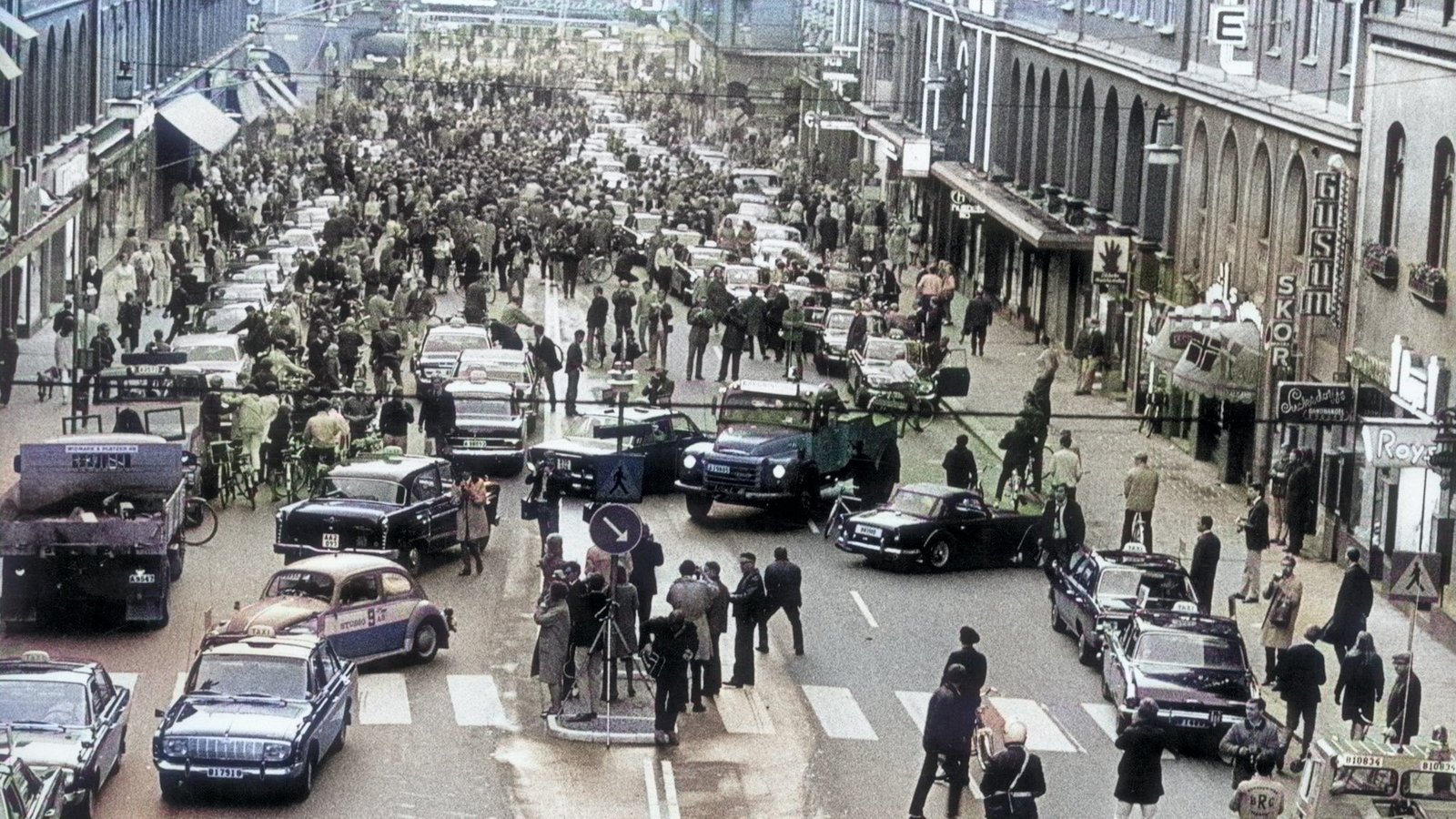
However, in the case of Dagen H, every driver was potentially expecting every other driver to do something incorrect. “If you did turn the wrong way down the road,” said Dr. Rudin-Brown, “at least you’d be facing drivers who might expect that to happen rather than people just continuing [on] into a collision.”
Despite some level of chaos, the number of accidents was far below that of a typical day. One hundred and fifty-seven accidents were reported nationwide, only a small number of which were serious.
However, one visiting traffic expert warned of celebrating too soon: “We have only seen the bride and groom brought to the altar. The citizens of Sweden have now embarked on their honeymoon. It is too early to judge the results.”
In the first few weeks after Dagen H, traffic accidents maintained their low levels, some of which was attributed to lower speed limits and other rules established alongside the switch.
Throughout 1967, the year of the switch, 1,077 traffic deaths were recorded, compared to 1,313 in 1965. The mood in Sweden had also changed: Instead of the initial 83 percent against the move in the 1955 referendum, 57 percent of Swedes after Dagen H perceived it favorably.
The complex safety results of Dagen H
In the following years, overall traffic deaths crept back up. However, when compared to deaths per 100,000 cars, the fatalities continued reducing. This meant that even while the number of cars on the roads was increasing, driving had become safer.
Dr. Felix Rösel, professor of economics at Technische Universität Braunschweig, studied the Dagen H switch to examine the causal effect of wrong-hand-drive vehicles on road safety. He was able to determine that “more than 4,000 lives between 1953 and 1966” could have been saved if Dagen H had happened earlier. Rösel’s results highlighted just how dangerous a wrong-hand-drive misalignment is. “I came up with this one-third markup in risk,” said Dr. Rösel. “I think that’s quite substantial. It’s not a trivial thing.”
In addition, it was not only the most serious types of accidents that could have been prevented earlier. Rather, the effect was also shown with minor accidents, such as hitting another parked car.
“We see very similar effects on the number of fatalities and the number of injuries [from the study],” said Dr. Rösel. “It seems you have a problem per se, that you have this bad vision that is not aligned with the road.”
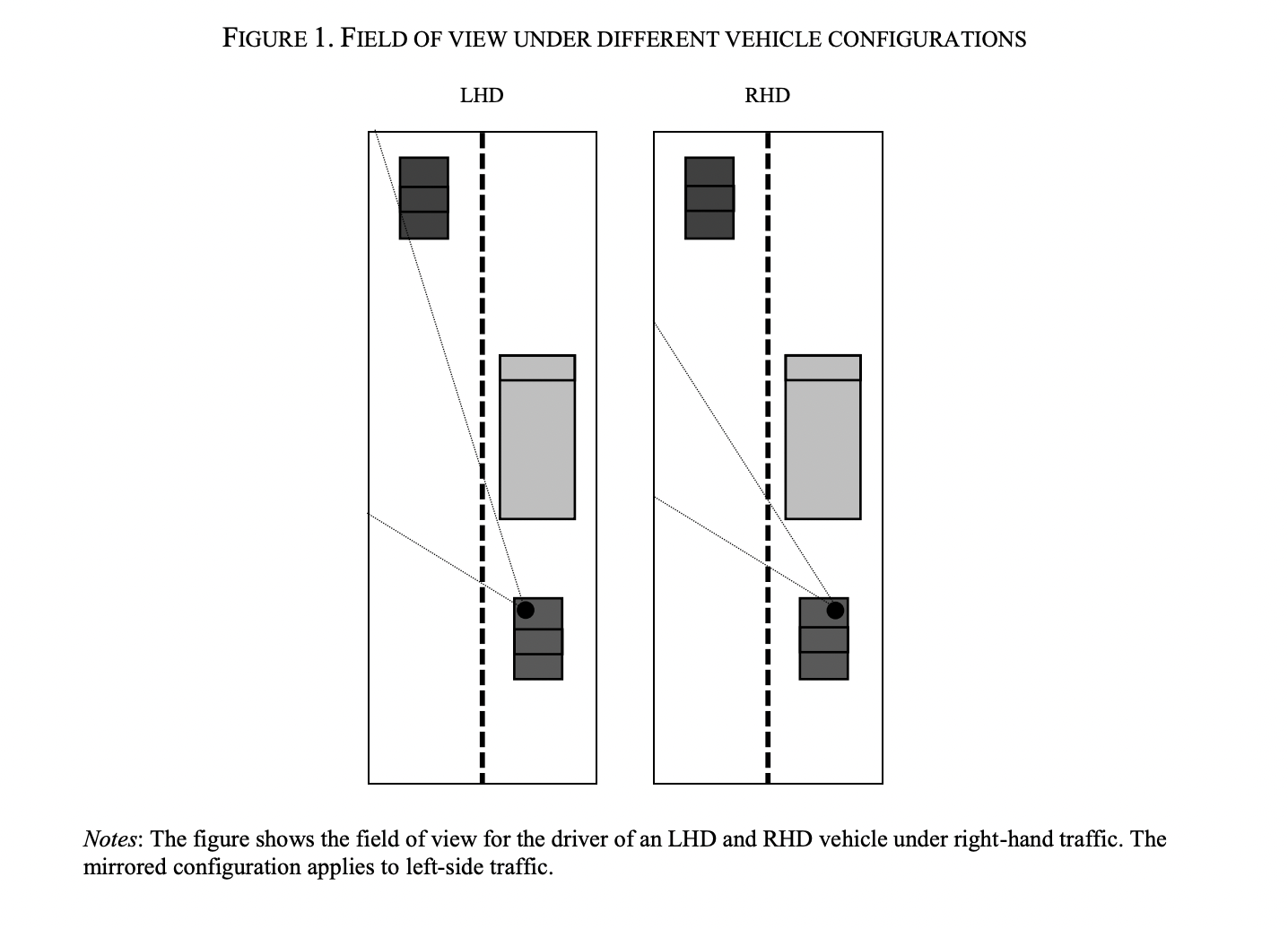
Dr. Rösel also found that the reduction in accidents was likely due to the switch, rather than because of reduced speeds or other safety measures put in place after the event. But if safety improvements came from Dagen H, why did accidents not reduce more significantly? This is partially due to behavioral adaptation.
“People usually use [a safety improvement] in some way to adapt and improve their experience,” said Dr. Rudin-Brown. “They feel like the road is safer, they feel like they’re better able to drive faster and assume more risk.” This means that even with the safety benefits of Dagen H and greater visibility, drivers eventually reverted to driving less carefully.
A huge undertaking with global relevance
Other countries have followed the example of Sweden and made similar changes, most notably Samoa in 2009. In Samoa, the country switched from right- to left-side driving to bring it into step with surrounding countries. Samoa also faced widespread protests (including from a group called “People Against Switching Sides”), and broadcast a song about the switch.
A number of other countries around the world still deal with wrong-side-drive alignment, particularly Kyrgyzstan, Armenia, and Russia, all of which experienced widespread protests when changes were suggested.
“These fundamental institutions of driving on the left or right, it’s almost in the genes: the British on the left and the continent on the right,” said Rösel. “This really takes a long time [to change]. Even in Sweden, it was not a switch from one day to another. It took decades.”
In the case of Dagen H, the switch was considered a success. For Swedes at the time, only “a few minor skirmishes between right-hand partisans—now estimated at 43 percent of the population—and adherents of the old way were reported in towns across the country,” wrote the Daytona Beach Morning Journal. “But even the reluctant majority appeared to be swept up in the festive mood of the day.”
In That Time When, Popular Science tells the weirdest, surprising, and little-known stories that shaped science, engineering, and innovation.
Related ‘That Time When’ Stories

2026 Popular Science Home of the Future Awards
Check back often for more exciting news!