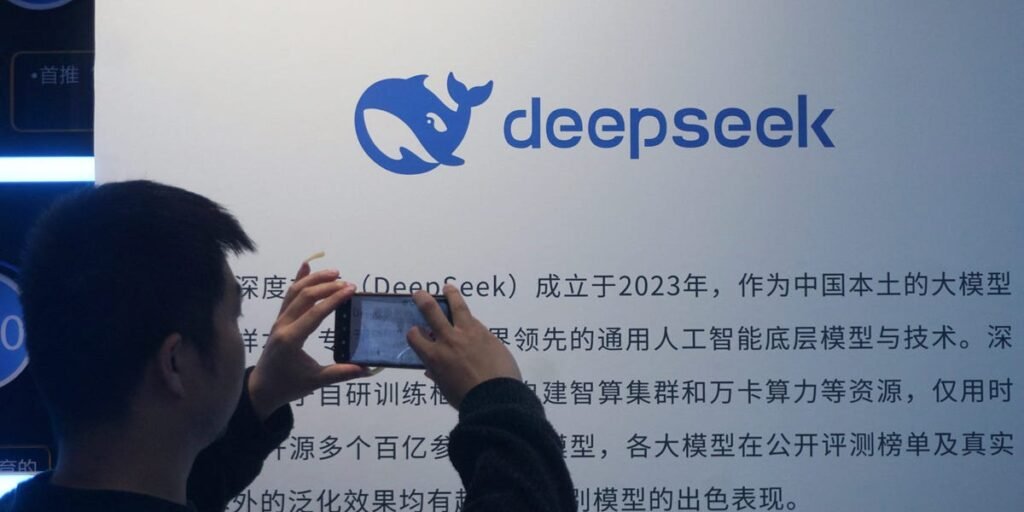
A DeepSeek engineer who helped write a key component of the company’s latest model has given his readers a rare insight into work at a Chinese frontier lab — and how China’s workers are contending with AI’s risks. In a blog post published in Chinese on his public WeChat account titled “I Have No Choice
A DeepSeek engineer who helped write a key component of the company’s latest model has given his readers a rare insight into work at a Chinese frontier lab — and how China’s workers are contending with AI’s risks.
In a blog post published in Chinese on his public WeChat account titled “I Have No Choice but to Bury My Talent in Yesterday,” Liu Shengyu, an AI developer at DeepSeek, reflected on the strange reality of helping build AI that could eventually make his own specialized skills obsolete.
Liu confirmed to Business Insider that he wrote the post, but declined to comment.
He wrote that, in about a year, AI had gone from a tool that could help him search documentation and spot bugs to one capable of reading GPU code and optimizing the software operators.
As much as he is “proud of the success of DeepSeek v4.1,” Liu said he is “well aware” that the operators written by AI “will most likely be as good as mine, or even surpass mine.”
And in one particularly poignant part of the essay, Liu considers what it means to help build technology that could replace him.
Human beings have never hesitated when it comes to engineering their own destruction. Why, then, do I still try my hardest to optimize kernels, knowing full well that the better I write them, the faster our new models can be trained and run, the faster their capabilities will advance, and the sooner I’ll be replaced? Partly, it’s because writing kernels feels like playing a video game to me. I get an enormous thrill from it. The excitement I feel when I invent a new technique, or see one of my kernels perform better, is no less intense than what a runner feels when they break their own record. And when my kernel dramatically outperforms the hardware vendor’s official version, I feel an immense sense of pride. But there’s another, more important reason: Even if I decided to “lie flat,” or deliberately threw a wrench in the works to slow down model training, rival companies would keep advancing their models, and I’d still end up being replaced all the same. Of course I’d rather not be overthrown by the revolution. But if revolution is inevitable, I’d rather be the one to “revolutionize myself.” When everyone is this determined to bring about their own destruction, I have little choice but to join this brutal arms race.
A new industrial revolution
Liu said he does not think he will be out of work, but is worried that AI could take away the hands-on part of the job he loves, turning him from someone who writes operators himself into someone who mainly steers AI agents to do it.
He likened the shift to a talented knitter who has to give up making sweaters by hand and use a faster machine because everyone else in the trade has one too.
“But the pleasure of listening to the rain by the window, threading a needle, and slowly passing the time was ultimately crushed by the roar of the machines,” Liu wrote.
Liu, in his post, wondered if his readers felt the same way: having to engage with AI to protect their livelihoods, while knowing that things will change and take away what they like most about their work.
“I tend to keep my rational and emotional sides quite separate. When a problem calls for reason, I can be very rational. But there are times when my sentimental side comes through,” Liu wrote.
“I remember sobbing when I moved out of an apartment I had rented for just a year, unable to bear parting with the memories I had made there,” he added. “Saying goodbye today to the era of hand-written kernels and optimization driven by human ingenuity is undoubtedly far more painful.”
Anxiety over who should control frontier AI
Liu also warned against frontier AI being controlled by a handful of companies, which he wrote could widen inequality by giving those with access to the most capable models an even greater advantage.
“Therefore, I still believe that cutting-edge intelligence should be available to everyone in an open and affordable way,” Liu wrote.
“I don’t trust Anthropic or OpenAI to do this, and I especially don’t want Anthropic to master the most advanced artificial intelligence or AGI; to exaggerate, the seriousness of that would be no less than Hitler acquiring atomic bomb technology before the Allies,” he wrote.
Liu’s post comes as AI leaders sound the alarm about the technology’s trajectory.
Last week, Jacob Coxon, a former researcher at Anthropic and OpenAI, announced he had quit Anthropic over AI safety concerns. In a post on X, he wrote that AI companies were “racing straight to self-improving superintelligence” and “gambling with our lives.”
Coxon’s words set off a wider debate, with leaders including Dario Amodei, Sam Altman, and Elon Musk, weighing in on whether the race to build more powerful AI is moving too quickly.
The warnings come as China makes its own push to become a major force in frontier AI. Like DeepSeek before it, Moonshot AI’s Kimi K3 has renewed attention on how quickly Chinese labs are advancing.
Check back often for more exciting news!