
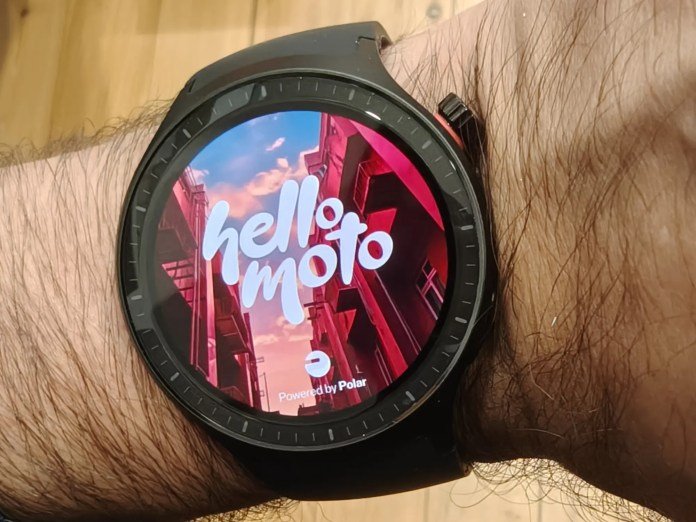
I wore this for the last few weeks and came away positive, but that’s because I had realistic expectations of what the watch would be able to do. If you expect the same features as a more expensive Google Wear-powered smartwatch or an Apple Watch, you’ll be disappointed. Some American reviewers compare it to the
I wore this for the last few weeks and came away positive, but that’s because I had realistic expectations of what the watch would be able to do. If you expect the same features as a more expensive Google Wear-powered smartwatch or an Apple Watch, you’ll be disappointed. Some American reviewers compare it to the Samsung Galaxy Watch FE, which costs slightly more and barely lasts 1 day of battery life. This is a pointless comparison.
The Moto Watch battery life is genuinely impressive, and the design looks like an actual watch. But Motorola’s “Powered by Polar” promise turns out to be more complicated in practice than on paper. Here’s what you need to know before you buy.
First, a searching tip. If you Google “Moto Watch,” Motorola’s own site at motowatch.com doesn’t list this product. The actual product page is at motorola.com/au. Motorola really needs to use more distinctive names for its watches.

Unboxing & Setup


Two Versions, Same Price
The Moto Watch 2026 is available in two variants for $199 in Australia. I tested the Volcanic Ash version with a grey silicone band. For the same money you can get the Matte Black version with a stainless steel link bracelet that looks even more like a traditional watch. Both have the same 47mm aluminium frame and stainless steel crown.

The round face has five-minute markings around the dial. It reads like a proper watch, not a fitness tracker. At 35 grams without the band it sits lightly on the wrist. The 22mm lug size means you can swap to any standard aftermarket band, which matters if you want leather or fabric instead of silicone.
The display is a 1.4-inch OLED with Gorilla Glass 3 protection. It’s bright enough to read outdoors without much trouble. IP68 water resistance handles rain and sweat.
Battery Life Is the Star
Ten days of real battery life, which is pretty good considering the 13-day marketing claim. That’s with always on display off, some activity tracking, lots of alarms, timers, notifications (you can customise which phone app notifications appear eg your bank).
Top-up charging works well. Five to ten minutes on the charger genuinely adds a full day of use, which means charging while you shave and shower covers you for another couple of days without thinking about it. A full charge from empty is slower, running at roughly 1% per minute.
The charger itself is a weak point. It’s proprietary and magnetic. The cable is short and you can’t swap it out for a longer one, even though it uses a USB-C plug at the wall end. The watch also only charges correctly in one orientation. Don’t lose the cable. There’s no USB-C port on the watch itself or QI charging capability.
The Polar Promise vs. The Reality
This is the first Motorola watch to carry Polar’s fitness software, and it’s the main selling point. Polar has nearly 50 years of sports science behind it. The partnership sounds impressive on paper. In real use, it’s more complicated.


The sleep tracking is the strongest part of the Polar integration. You get a breakdown of light, deep and REM sleep stages, a sleep quality score, and a Nightly Recharge stat that tells you how well your body recovered overnight. The best way to use the sleep data is trend-based. Watch what happens over weeks, not just one night.
Activity tracking is where the gap between expectation and reality shows up most clearly. The watch has over ten workout modes including running, cycling, walking, yoga, strength training and more. Auto activity detection does exist. But when the watch detects you might be exercising, it asks if you want to start tracking after about a kilometre of movement. When you confirm, it starts the clock and distance counter from zero. It doesn’t backfill the data from before you tapped yes. Start workouts manually before you leave the house and save yourself the frustration.
No Strava sync. No Runkeeper. The only third-party health connection is Google Health Connect.
What the Software Gets Right and Wrong
The OS is Motorola’s own, not Wear OS and that is the main reason for the super long battery life. The interface borrows heavily from Wear OS: swipe down for quick settings, up for notifications, left and right to switch between tiles. It looks familiar if you have had a Wear OS watch before.
You can take calls directly from the watch when your phone is nearby. The built-in microphone and speaker work for short conversations.
Notifications arrive on your wrist, but you can’t reply or interact with them. You’ll still reach for your phone. Recent Notifications can be seen by swiping up, but can’t be individually cleared by swiping sideways; you have to press the ones you don’t care about one by one to dismiss or dismiss all of them at once. It’s a small thing, but it shows the software still has some rough edges to sand down.
Watch face choices are limited, but I found one that I liked. There are some AI-generated faces if you have a compatible Moto phone, but they just place a digital clock over a generated image. Not for everyone.

No tap-to-pay. No third-party apps like Spotify or Google Maps. No iPhone support at all. That last point is a step back from older Motorola wearables that worked across both platforms.
Who This Is For
The Moto Watch (2026) is for Android users who want something that looks like a proper watch, lasts well over a week between charges and tracks everyday health without demanding much attention.
If you need iPhone support, run marathons, train hard, want to use Google apps on a watch or use Watch tap payments, look elsewhere.
If you want IP68 protection, big screen, much easier menus than Garmin, a classic watch look, step tracking, alarms, timers, sleep monitoring, notifications and a battery you only think about once a week or so, then the cost of $199 is worth it.
The super long battery life means this smartwatch should last you many years, which is great for your budget and reducing e-waste. Just start your activities manually, guard that charging cable and keep your expectations for Polar realistic. The partnership could add genuine value to sleep tracking and recovery data with software updates. Software still needs refinement, which will hopefully improve with software updates (the watch has already received an update during my testing).


















Leave a Comment
Your email address will not be published. Required fields are marked with *