
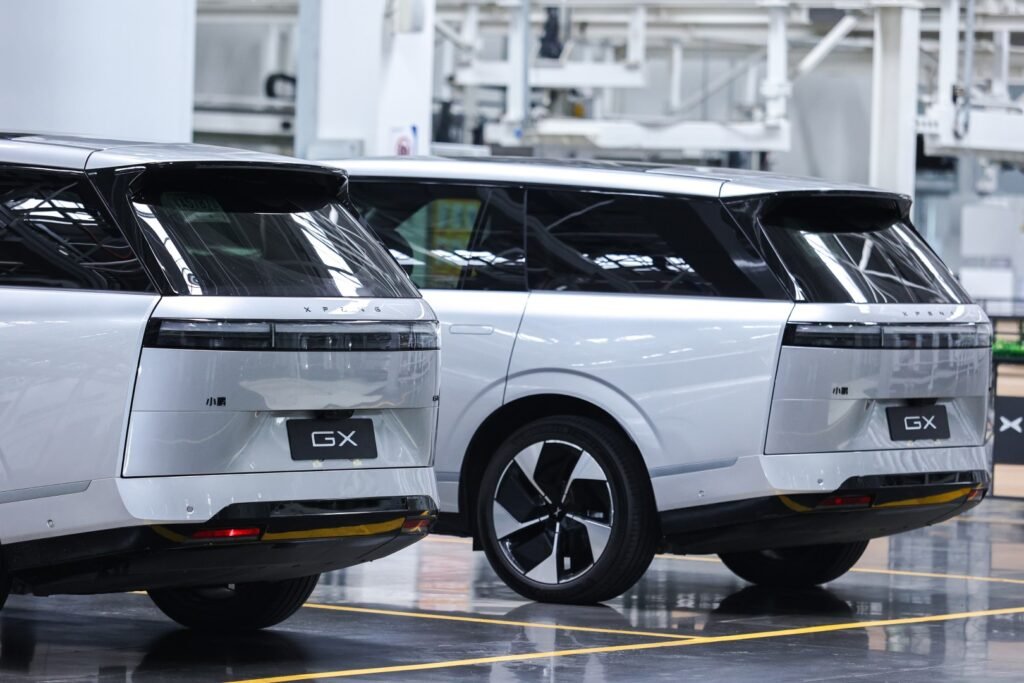
Chinese electric vehicle manufacturer XPENG has officially rolled off its first mass-produced Robotaxi from the production line in Guangzhou, China. This announcement marks a significant milestone as the company becomes the first automaker in China to achieve mass production of an autonomous taxi through full-stack, in-house development. The vehicle is built on the company’s new
Chinese electric vehicle manufacturer XPENG has officially rolled off its first mass-produced Robotaxi from the production line in Guangzhou, China. This announcement marks a significant milestone as the company becomes the first automaker in China to achieve mass production of an autonomous taxi through full-stack, in-house development.
The vehicle is built on the company’s new XPENG GX platform and is engineered from the ground up to meet strict Level 4 autonomous driving standards. Unlike many experimental autonomous vehicles that require aftermarket modifications, this model comes pre-assembled and production-ready straight from the factory floor.
XPENG is positioning itself to bypass the traditional lengthy transition from research to commercial operations by leveraging its existing manufacturing scale. The company handles everything in-house, spanning software development, specialised chips, and complete vehicle manufacturing.
Massive computing power and pure vision tech
Driving the technical capabilities of the new Robotaxi are four self-developed Turing AI chips. Together, these chips deliver an industry-leading effective on-board computing power of 3,000 TOPS to handle complex driving environments.
Instead of relying on expensive LiDAR sensors or pre-mapped high-definition routes, XPENG has chosen a pure vision solution. This approach is heavily driven by their VLA 2.0 end-to-end large AI model, which processes visual data similarly to human drivers.
By eliminating the traditional language-translation step found in older three-stage architectures, the vehicle achieves a system response latency of under 80 milliseconds. This rapid processing power gives the Robotaxi enhanced urban generalisation capabilities, allowing it to support cross-city and cross-border deployment.

Premium passenger experience inside the cabin
Inside the vehicle, the focus shifts toward delivering a premium, safe, and highly intelligent travel experience for passengers. The cabin features unique practical configurations, including privacy glass and comfort gravity seats designed for longer commutes.
Passengers also get access to rear in-car entertainment screens to keep them occupied during their journey. A built-in voice assistant allows riders to easily enjoy multimedia entertainment and adjust various in-car settings during the ride.
This vehicle foundation is also shared with other products in XPENG’s physical AI ecosystem. The VLA 2.0 large model used here also powers the company’s IRON humanoid robot and their ongoing flying car projects.
Roadmap to commercial operations
XPENG has been quietly hitting milestones ahead of this production announcement for some time now. In January of this year, the company secured an official road testing permit for intelligent connected vehicles in Guangzhou to begin routine public road testing.
Following that permit, the company established a dedicated Robotaxi business unit in March to oversee product definition, R&D testing, and operations. This structured approach is designed to accelerate the overall commercialisation roadmap across the region.
The company plans to officially initiate pilot Robotaxi operations in the second half of this year. These initial pilots will validate the technical viability, user acceptance, and the complete business model before scaling further.
Software readiness: Is the AI actually ready for prime time?
Having cutting-edge hardware is one thing, but the real question is whether the software can actually handle the chaotic nature of real-world driving. XPENG’s new VLA 2.0 (Vision-Language-Action) end-to-end large model represents a massive architectural shift in how these vehicles think. By compressing system response latency to under 80 milliseconds, the car can translate visual data directly into physical driving decisions almost instantly.
This pure vision software eliminates traditional high-definition maps, relying instead on advanced spatial intelligence to navigate unfamiliar areas. Early testing shows strong urban generalisation capabilities, meaning the software is designed to adapt to different cities and cross-border driving without needing localised updates. This gives it a major theoretical advantage over heavily geofenced autonomous networks that require months of mapping before expansion.
However, the software is still very much in its validation phase rather than being a finished product. The public road testing that kicked off earlier this year remains supervised, and the upcoming pilot operations are specifically designed to put the AI through its paces. XPENG’s timeline to remove the on-site safety officer by early 2027 shows that while the software has the foundation it needs, it still has a lot of real-world learning to do.
Future outlook and global ecosystem expansion
Looking further ahead, XPENG aims to achieve fully autonomous operations without any on-site safety officers inside the vehicle by early 2027. This would represent a massive shift in how ride-hailing networks operate globally.
To help grow the ecosystem, XPENG intends to open its Robotaxi software development kit to external partners. The popular navigation platform Amap has already signed on to become the company’s first global ecosystem partner.
While there are currently no pricing details or specific timelines announced for an Australian launch, the rapid scaling of this technology shows how quickly the autonomous driving landscape is evolving globally.

How the computing power stacks up globally
To put XPENG’s 3,000 TOPS computing power into perspective, it helps to look at what other players are doing in the autonomous space. Central car computers have quickly become the primary battlefield for achieving higher levels of autonomy.
Tesla’s Hardware 3 (HW3), introduced back in 2019, delivers a total of 144 TOPS of compute using two custom-designed chips. While highly efficient for its time, its technical limitations have recently led to ceilings regarding unsupervised driving.
The newer Tesla Hardware 4 (HW4) bumps total system performance up to roughly 500 TOPS. While a major leap forward in processing camera throughput, it still sits far lower on raw compute figures compared to the multi-chip array XPENG is manufacturing.
When looking at industry supplier giants, NVIDIA’s current Drive Thor platform sits at 1,000 INT8 TOPS (or 2,000 FP4 TFLOPS) of centralised performance. Dual Thor configurations used by premium brands scale past 2,000 TOPS, putting XPENG’s 3,000 TOPS system right at the bleeding edge of automotive silicon deployment.
Alphabet’s Waymo takes a different approach by relying on a custom onboard computer packing server-grade CPUs and GPUs. This heavy hardware stack is designed to process massive chunks of redundant data coming from its extensive sensor suites, including 13 cameras, four lidars, and six radar units.
For more information, head to https://www.xpeng.com/



















Leave a Comment
Your email address will not be published. Required fields are marked with *