
This morning I woke to social media teasers from both Nvidia and Microsoft, which seen many on social media speculating about it’s meaning. The identical posts feature a simple message – a new era of PC is coming. This isn’t jsut a new generation of an existing architecture, but suggests a big change the industry
This morning I woke to social media teasers from both Nvidia and Microsoft, which seen many on social media speculating about it’s meaning. The identical posts feature a simple message – a new era of PC is coming. This isn’t jsut a new generation of an existing architecture, but suggests a big change the industry should pay attention to.
Included in the posts were the coordinates 25.0528, 121.5990. If we take these and plug them into Google Maps as latitude/longitude coordinates, they point to Taipei Taiwan, which led my mind to the massive Computex conference, which I’ve been to in the past.
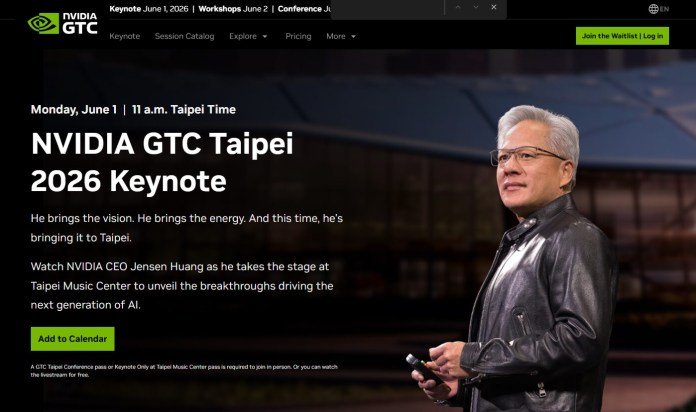
If we take a closer look, the exact mapping reveals the location is just down the street, at the Taipei Music Center, designed by RUR Architecture. This futuristic, crystalline venue is the official home for GTC Taipei 2026, running from June 2 to June 5, 2026 (next week).
The dual postings from both the official Nvidia and Windows accounts point strongly to the fact we’ll see new generation a devices powered not by Intel’s x86 CPU architecture, but rather one build by Nvidia.
A new era of PC silicon
The core of the teaser revolves around the phrase “A new era of PC” which strongly signals a structural move toward high performance ARM architecture. Industry speculation points to Nvidia introducing its own consumer system on a chip, currently referred to under the N1 and N1X designators.
This would mark Nvidia’s official entry into the mainstream PC processor market with its own integrated silicon. The company has dominated the graphics and enterprise artificial intelligence sectors for years, but a dedicated consumer platform changes the entire ecosystem.
By combining their world class graphics architecture with high efficiency ARM processing cores, Nvidia can target the premium laptop market directly. This move bypasses traditional x86 design restrictions and allows for much tighter control over both power consumption and raw performance.
Bringing the energy to Taipei
The upcoming keynote is positioning itself as a historic milestone for the consumer hardware industry. Nvidia is leaning heavily into the star power and track record of its leadership to set massive expectations for the presentation.
Promotional materials for the event explicitly state what attendees can look forward to as the presentation gets underway. The promotional text highlights the scale of the upcoming presentation at the music venue.
“Watch NVIDIA CEO Jensen Huang as he takes the stage at Taipei Music Center to unveil the breakthroughs driving the next generation of AI.”
Seeing Microsoft actively cross promote a GTC event confirms that this is not just a graphics update. This looks like a fundamental redesign of the Windows hardware ecosystem, driven by the world leader in AI compute.

Microsoft’s long road to ARM stability
Microsoft has attempted to establish Windows on ARM several times over the last decade. Early attempts like Windows RT and subsequent Surface devices powered by custom SQ processors were heavily criticised by users and reviewers alike.
Those early platforms were largely underpowered and suffered from poor software compatibility. Users were frequently frustrated by sluggish performance and the complete inability to run standard legacy Windows applications.
The landscape has shifted dramatically since those early attempts. Windows 11 has introduced vastly improved emulation layers, and the broader software ecosystem has finally begun treating ARM architecture as a first class citizen.
Disrupting the x86 duopoly
For decades, Intel and AMD have maintained a firm grip on the x86 processor market that powers the vast majority of Windows computers. Nvidia entering the race with an integrated system on a chip represents the biggest threat to that dominance in recent memory.
Nvidia holds a massive advantage because of its deep expertise in graphics processing units and artificial intelligence compute models. Bringing that technology directly onto the main processor silicon could yield unprecedented performance per watt.
If these chips deliver on the architectural promises, legacy chipmakers will face intense pressure. The promise of multi day battery life combined with high end gaming and AI performance is something traditional x86 processors struggle to deliver simultaneously.

How the application ecosystem will work
The success of this new hardware platform will live or die based on how well it runs everyday software. Modern Windows on ARM relies on an emulation engine called Prism to translate legacy x86 code dynamically.
Applications built natively for ARM will run flawlessly, taking full advantage of the internal hardware speeds. Popular browsers, productivity suites, and creative tools from companies like Adobe have already migrated to native ARM code.
For legacy apps, the emulation layer intercepts the instructions and translates them for the ARM processor. While this process is incredibly efficient on modern silicon, it does introduce a slight performance overhead compared to running native code.
The software compatibility roadblocks
Despite massive leaps in emulation technology, there are still specific categories of software that will not run on an ARM based Nvidia chip. The most significant roadblock involves software that requires kernel level drivers.
Third party antivirus programs, deep system utilities, and complex virtualization software often fail to emulate because they interact too closely with the underlying processor architecture. Most users can find modern cloud based alternatives, but it remains an important consideration for enterprise environments.
The other major area of concern is hardware peripheral software. While standard USB mice, keyboards, and external drives work automatically, specialized equipment requiring proprietary control software may face compatibility issues if the manufacturer has not compiled an ARM native version.
The gaming equation and anti-cheat hurdles
Nvidia entering the PC processor market raises massive questions about how PC gaming will adapt to ARM silicon. Historically, Windows gaming has been strictly tied to the x86 architecture used by Intel and AMD.
Many modern video games will run through Microsoft’s translation layers, but heavy simulation titles and unoptimized engines may see reduced frame rates. More importantly, competitive games utilizing strict kernel level anti-cheat software will face major barriers.
Popular anti-cheat systems like Riot Vanguard require deep system access that cannot be easily emulated. Unless game developers actively compile native ARM versions of their titles, certain competitive multiplayer games will remain unplayable on this hardware at launch.
Local artificial intelligence execution
A massive selling point for a joint Nvidia and Microsoft platform is the acceleration of local artificial intelligence workflows. Nvidia leads the world in AI hardware, and shrinking that capability into a laptop processor will supercharge features like Windows Copilot.
Instead of sending data to remote cloud servers, tasks like image generation, live translation, and advanced code completion can occur instantly on the device. This approach offers significant advantages for user privacy and eliminates latency issues entirely.
Developers will also gain access to powerful local development environments. Running complex machine learning models directly on a thin laptop could redefine productivity for software engineers and data scientists on the move.
The competitive response
Intel and AMD are not standing still while this partnership forms. Both traditional chipmakers have accelerated their own roadmaps to introduce advanced neural processing units alongside their standard compute cores.
Intel’s latest architectures focus heavily on power efficiency to counter the battery life advantages inherent to ARM designs. AMD continues to leverage its strong graphics partnerships to keep gaming performance high on thin laptops.
The introduction of an Nvidia system on a chip will force a massive competitive reaction across the entire industry. This level of competition is fantastic for consumers, as it drives rapid innovation and forces manufacturers to justify premium price points.
Final thoughts ahead of the keynote
The collaboration between Nvidia and Microsoft represents a fascinating turning point for personal computing. It brings together the dominant force in modern visual compute with the world’s most widely used desktop operating system.
The cryptic coordinates have set the stage for what could be the most important presentation in years. We will be tracking the announcements closely to see exactly how these new devices perform in the real world.
For more information, head to https://www.nvidia.com/en-tw/gtc/taipei/keynote/



















Leave a Comment
Your email address will not be published. Required fields are marked with *