Written by Deborah Padgett, MSL Operations Products Ground System Task Leader at NASA’s Jet Propulsion Laboratory Land Planning Date: Thursday, July 2, 2026 Curiosity spent the week leading up to the July 4 holiday approaching a geologic boundary between a very smooth but somewhat sandy region and a rougher bedrock unit. Leaving the polygonal terrain
Written by Deborah Padgett, MSL Operations Products Ground System Task Leader at NASA’s Jet Propulsion Laboratory
Land Planning Date: Thursday, July 2, 2026
Curiosity spent the week leading up to the July 4 holiday approaching a geologic boundary between a very smooth but somewhat sandy region and a rougher bedrock unit.
Leaving the polygonal terrain behind, the rover arrived at the first location of the week at sol 4939 and, on the next sol, 4940, searched for dust devils with Navcam and performed an AEGIS ChemCam laser spectroscopy observation and Mastcam images of a selected target aboard the rover. Unfortunately, there were no large rocks suitable for the DRT to graze at this rover stop.
On Sol 4941, the MAHLI camera took images of “Malpartida” and “Pico del Tunari,” both light-colored rock fragments, and APXS performed X-ray spectroscopy on them to determine their composition. ChemCam used active laser spectroscopy to remove the light-colored bedrock fragment “Kunturiri,” while “Mecoyite,” a dark-hued “floating” rock, which appears to have been transported to this area from elsewhere, was passively observed. ChemCam also used its RMI telescopic camera to study the sedimentary layers at the base of the Cordillera. Mastcam obtained several mosaics of images on a ridge of sand and rock fragments called “Sitajana”.
On the next sol, 4942, Mastcam continued its study of “Sitajana” and ChemCam RMI obtained more views of Cordillera Butte. Navcam took a movie of suprahorizon clouds and a movie of dust devils. Finally, ChemCam obtained laser spectroscopy of the dark bedrock fragment “Toconce” with documentation images from Mastcam. Mastcam also took images of the “Sierra Vicuña Mackenna” to study a partially exposed rock shedding sand in an area of small dune undulations.
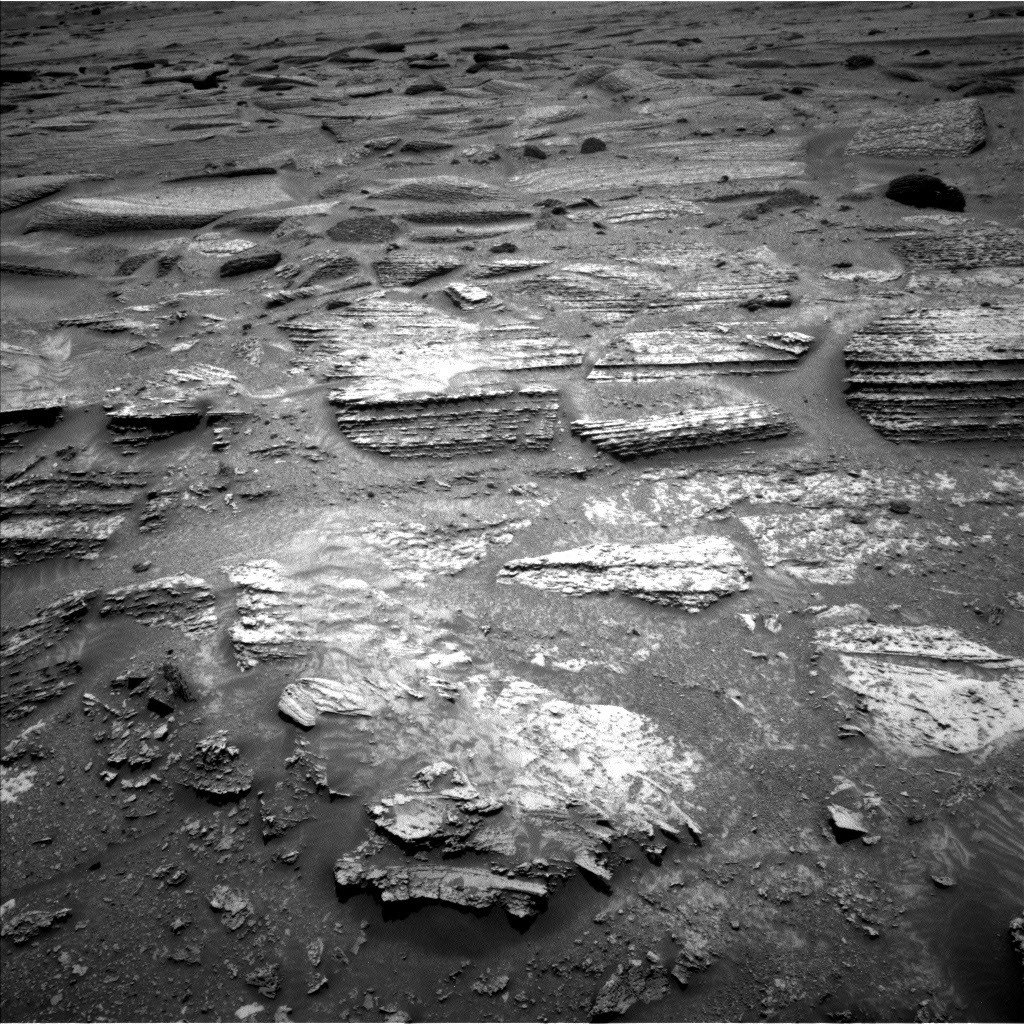
On the afternoon of Sol 4942, Curiosity drove about 36 feet (about 11 meters) to the edge of the geologic contact and took panoramic mosaics after the trip with Navcam and Mastcam. These images revealed a field of exposed bedrock outcrops with beautiful striped layers. A Navcam AEGIS observation was taken for selection on board a ChemCam laser spectroscopy target. This soil and rock target was observed by ChemCam with Mastcam documentation on Sol 4943. Additionally, Navcam made a movie of the dust devil and Mastcam took an observation of the atmospheric dust.
For Sol 4944, two adjacent light bedrock targets, “Laguna Fea” and “Laguna Lejia,” were selected for DRT brushing, MAHLI imaging, and APXS X-ray spectroscopy to determine composition. ChemCam laser spectroscopy will target the darkest ledge of the “Hornillos” bedrock, accompanied by Mastcam documentation. The “Hornillos” investigation will include detailed images of MAHLI, but it was determined to be too difficult for DRT brushing. Mastcam will take a large mosaic of field images of the “Cerro Castillo” striped bedrock outcrop, as well as a smaller mosaic of a nearby depression. The ChemCam telescopic RMI camera will point to a dark layer on the Cordillera hill, which appears to be shedding dark rocks. Navcam will take a movie of the dust devil and a movie of the suprahorizon cloud.
At Sol 4945, ChemCham will perform laser spectroscopy of “Lejía Lagoon” with Mastcam image documentation, and the ChemCam RMI telescopic camera will study another area at the base of the Cordillera where the location of large stones on the slope suggests that ice processes may have played a role. A dust devil study with Navcam and a dust imaging study with Mastcam will also be carried out. In the afternoon, there will be a Navcam dust devil survey, a top-down observation and a supra-horizon cloud film, as well as a Mastcam dust observation and a 20×4 mosaic image of Mishe Mokwa Hill. During the night an APXS atmospheric observation will be carried out that will last many hours.
During Sol 4945, ChemCam will perform laser spectroscopy of the “La Puntilla” target accompanied by Mastcam images, followed by passive sky observation with ChemCam. Curiosity will then drive about 56 feet (17 meters) toward a large dark rock in the distance, which may be a meteorite, and take post-trip images and Navcam sky plans.
The next morning, there will be an atmospheric observation that will include a Navcam overhead film, a suprahorizon cloud film, and a line-of-sight dust observation, as well as a Mastcam dust “tau” observation.
Keep following us for the latest insights.