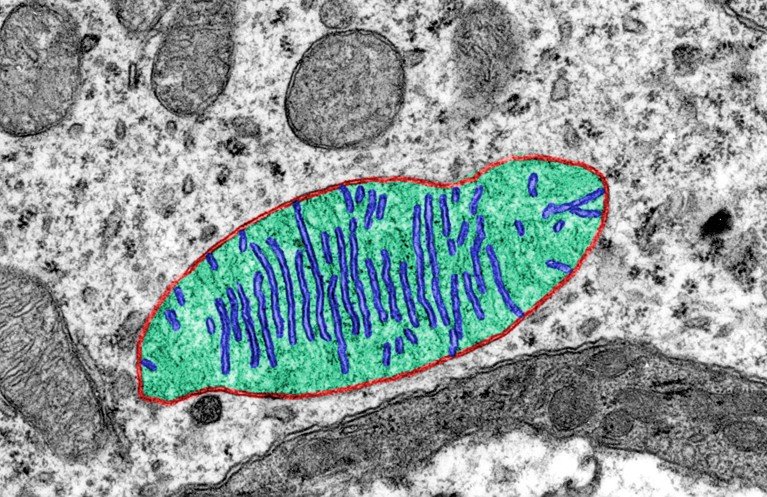
Mitochondria (green in this false-color transmission electron micrograph) may play a role in the physiological effects of microgravity.Credit: José Calvo/Scientific Photography Library Researchers have found that exposure to microgravity aboard the International Space Station causes mitochondria in human cells and worms to produce fewer proteins. The work also identified a previously unknown molecular pathway that
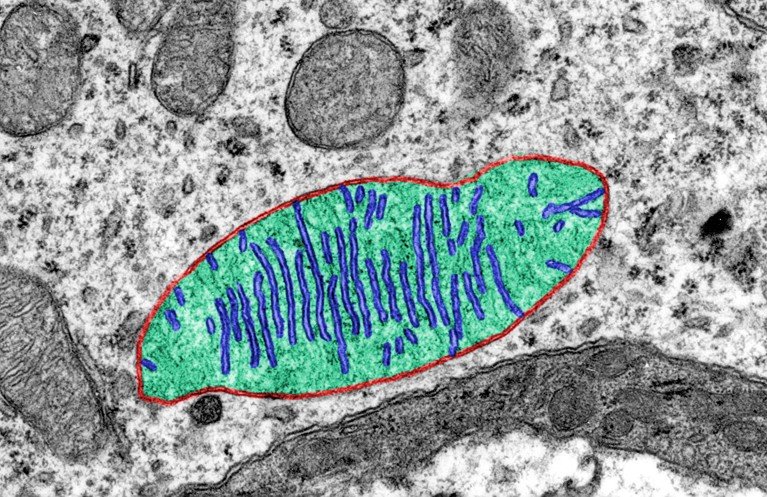
Mitochondria (green in this false-color transmission electron micrograph) may play a role in the physiological effects of microgravity.Credit: José Calvo/Scientific Photography Library
Researchers have found that exposure to microgravity aboard the International Space Station causes mitochondria in human cells and worms to produce fewer proteins.
The work also identified a previously unknown molecular pathway that translates the effects of gravity on mitochondria through the mechanical action of cell adhesion, and that could explain why protein activity decreases when those effects are removed. The study was published in Nature Communications June 301.
The findings “could have implications for space travelers,” says Thomas Corydon, a space biologist at Aarhus University in Denmark. “This could be used to understand how we should better prepare astronauts going into space.”
Previous studies2 from cells and mice that have flown into space and samples from astronauts have suggested that space flight causes damage to mitochondria. “We saw an overview of how mitochondrial deregulation was occurring,” says Afshin Beheshti, a space biomedicine researcher at the University of Pittsburgh in Pennsylvania, who was involved in the previous work. But the molecular mechanisms through which gravity affects mitochondrial biology are not well understood, he adds. Previous research3 They also found that reduced gravity had an impact on the transcription of DNA into messenger RNA.
The cells are exchanging their mitochondria. What does this mean for our health?
But for the most recent study, Shintaro Iwasaki, a molecular biologist at the Japanese national scientific research institute RIKEN in Wako, and his colleagues wanted to look at the effects on translation, by which molecular machines called ribosomes use mRNA to synthesize proteins.
With the help of astronauts on the International Space Station, the team grew human cells in a laboratory module aboard the station for 24 to 48 hours and then froze them. Control cell samples were kept in a centrifuge simulating standard Earth gravity while being cultured.
After all the samples returned to Earth, their analysis revealed that cells that had been exposed to microgravity for 24 hours had reduced mitochondrial mRNAs compared to controls, and that their mitochondrial ribosomes produced fewer proteins.
The researchers found similar results, although less marked, in larvae of Caenorhabditis elegans worms that were grown in microgravity on the space station for four days, compared to worms that were kept in a centrifuge.
In additional laboratory experiments on Earth, Iwasaki and his colleagues used a clinostat, a tool that rotates cells to mimic reduced gravity. After 24 hours on the clinostat, the mitochondria of human cells showed reduced production of 13 proteins. Keeping the cells spinning for up to 48 hours and 72 hours further decreased mitochondrial protein synthesis.
“It is well known that microgravity reduces or alters gene expression,” says Corydon. This analysis provides evidence of how it affects cells “directly at the protein level,” he adds.
Disruptive force
For more tech updates, stay tuned to our blog.