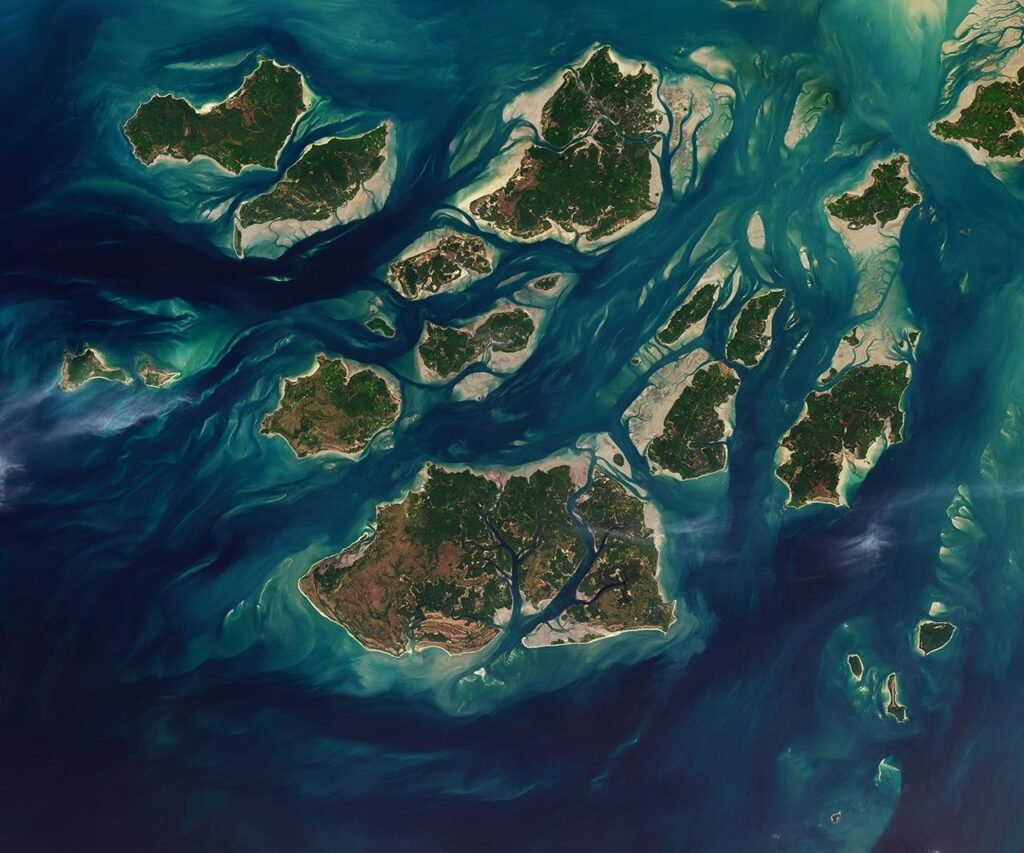
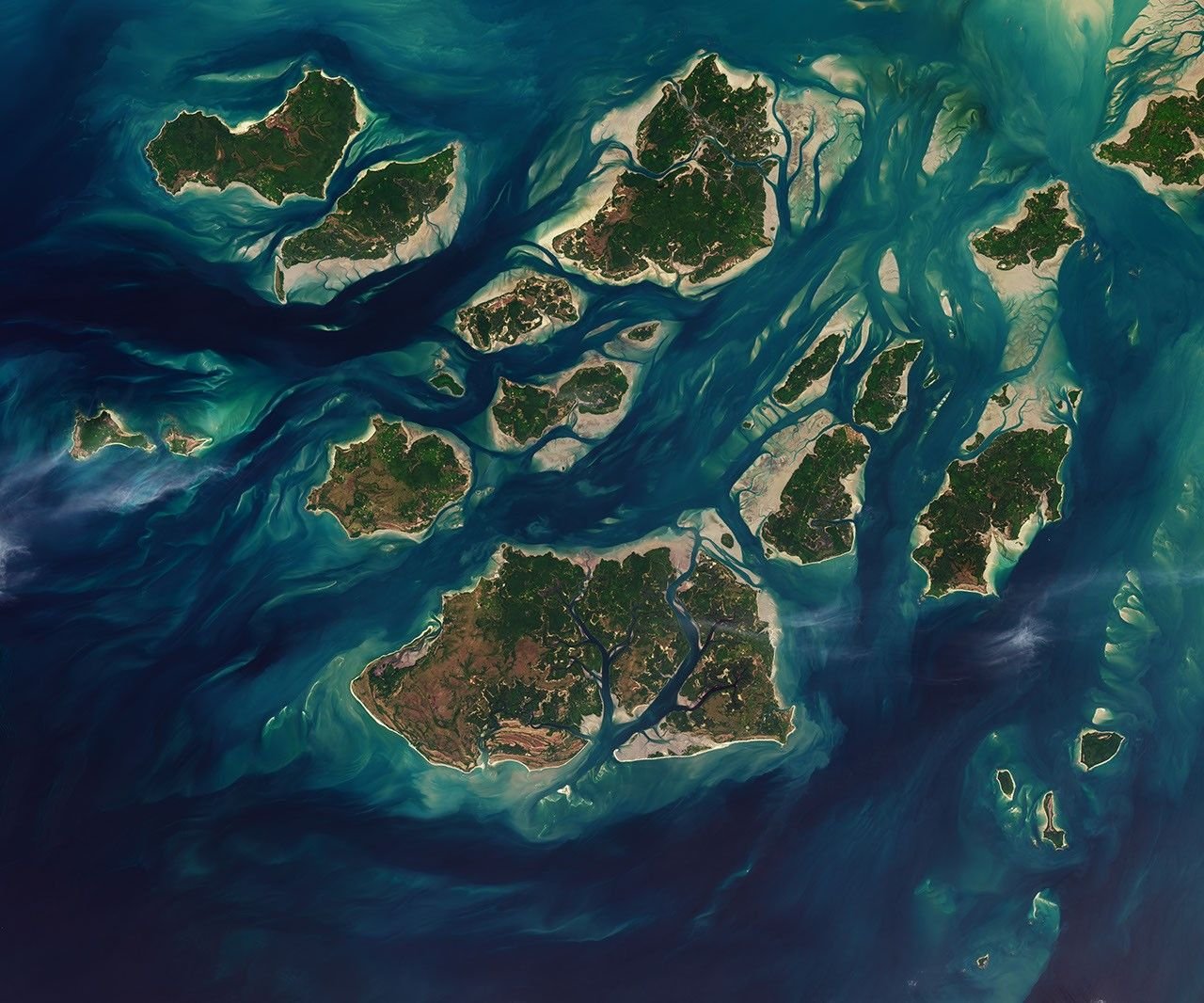
Twice a day, the tides ebb and flow through a labyrinth of sandy channels, salt marshes and mangrove forests that flank the 88 islands and islets of Guinea-Bissau’s Bijagós Archipelago (Arquipélago dos Bijagós in Portuguese). Seen from above, the process leads to radical changes in the landscape: during low tide, intertidal mudflats and sand flats
Twice a day, the tides ebb and flow through a labyrinth of sandy channels, salt marshes and mangrove forests that flank the 88 islands and islets of Guinea-Bissau’s Bijagós Archipelago (Arquipélago dos Bijagós in Portuguese). Seen from above, the process leads to radical changes in the landscape: during low tide, intertidal mudflats and sand flats emerge from the sea, causing the islands to grow significantly before shrinking again hours later.
The perpetual rhythm of the tides sustains the outpouring of marine life in an archipelago that, as of 2025, was inscribed as a World Heritage Site by UNESCO. The site protects the only active deltaic archipelago on Africa’s Atlantic coast, a place where tides, river sediments, coastal upwellings and coastal currents come together to shape unusually productive and biodiverse island ecosystems.
UNESCO estimates that the islands are home to some 870,000 migratory shorebirds, making it one of the most important feeding areas for birds in West Africa along the East Atlantic Flyway. Hundreds of bird species feed on a potpourri of marine worms, crustaceans, mollusks and small fish found in the mudflats exposed by low tides. During high tides, manatees, dolphins and schools of fish move closer to the islands, moving deeper into the surrounding mangrove forests, and tens of thousands of sea turtles swim inland to sandy beaches as they search for nesting sites.
A huge population of green sea turtles nests on the small island of Poilão, part of the João Vieira and Poilão National Marine Park. After hatching, young turtles make dangerous nightly runs to the water, often pursued by crabs, lizards and birds. Once they reach the water, sea turtle hatchlings face a variety of predators, including trevally, barracuda, grouper and snapper patrolling in shallow water, as well as tuna, mackerel, sharks and rays in deeper water. By some estimates, less than 1 percent of green sea turtle hatchlings survive to adulthood.
A 2025 analysis of the region’s tides explored why the archipelago has some of the largest tidal ranges in West Africa. The researchers concluded that the region’s wide, shallow shelf and estuary geometry combine to create a tidal range of up to 7 meters (23 feet), compared to about 1 meter (3 feet) in many other parts of the West African coast. The scientists used altimetry data from the NASA/CNES TOPEX/Poseidon, Jason-1, and Jason-2 satellites to help validate their findings.
NASA Earth Observatory images by Lauren Dauphin, using Landsat data from the US Geological Survey. Story by Adam Voiland.
- Campredon, P. & Catry, P. (2016) Bijagos Archipelago (Guinea-Bissau) in The Wetland Book. (Springer, Dordrecht).
- Dièye, A., et al. (2025) Tidal amplification and distortion in Guinea-Bissau, West Africa. Estuarine, coastal and shelf science, 320, 109318.
- Hays, G., et al. (2026) Is it really 1 in 1,000 sea turtle hatchlings that survive to adulthood? Royal Society Open Science13(1), 251563.
- The New York Times (2024, April 22) A remote island attracts thousands of turtles each year. Could it attract tourists? Accessed July 16, 2026.
- Ocean (January 30, 2025) How will we count them all? Accessed July 16, 2026.
- UNESCO (2025) Coastal and Marine Ecosystems of the Bijagós Archipelago – Omatí Minhô. Accessed July 16, 2026.
Check back often for more exciting news!