Captured by the multispectral imaging instrument on NASA’s Psyche mission, this is a color-enhanced mosaic created from four individual images acquired on May 15, 2026, during the spacecraft’s flyby of Mars. Psyche traveled from right to left (northeast to southwest on Mars) during the six minutes it took to acquire the images for this mosaic,
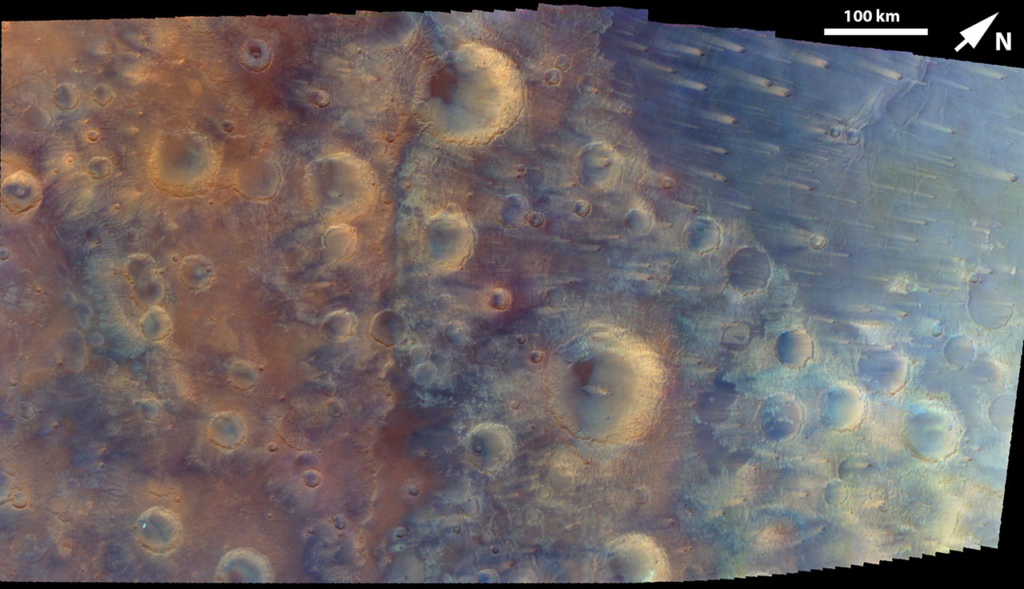
Captured by the multispectral imaging instrument on NASA’s Psyche mission, this is a color-enhanced mosaic created from four individual images acquired on May 15, 2026, during the spacecraft’s flyby of Mars.
Psyche traveled from right to left (northeast to southwest on Mars) during the six minutes it took to acquire the images for this mosaic, and the pixel scale resolution ranges from 381 meters per pixel on the right to 440 meters per pixel on the left. The imager used its near-infrared, green and blue filters, which helped reveal highly contrasting craters, ridges, wind gusts and volcanic plains materials on the surface.
The mosaic covers part of the Iapygia region of the rugged southern highlands of Mars, from approximately 62 degrees east to 78 degrees east longitude and 4 degrees north to 14 degrees south latitude. The largest crater, just below the center, is called Fournier and is approximately 114 kilometers (71 miles) in diameter. The linear feature running from top to bottom of the mosaic just left of center is part of a long irregular cliff system (or scarp) called Oenotria Scopuli, which is part of the circular structure of the large Isidis impact basin northeast of this area.
For more information about NASA’s Psyche mission, visit:
https://science.nasa.gov/mission/psyche/
Keep following us for the latest insights.