A Dyson fan It costs around $400, which is to be expected from a brand known for its status-symbolizing appliances. But what if I told you that there is a fan that costs even more? Although the brand may not be a household name in the US, Tokyo-based Balmuda is well known in Japan for
A Dyson fan It costs around $400, which is to be expected from a brand known for its status-symbolizing appliances. But what if I told you that there is a fan that costs even more?
Although the brand may not be a household name in the US, Tokyo-based Balmuda is well known in Japan for its high-end, minimalist appliances like The Brew and The Toaster (there’s also The Clock, The Speaker, and… The Teppanyaki). Their latest release, a pedestal-style fan, is not called “The Fan” but NatureWind Studio. It sells for $429 and is available in black and white.
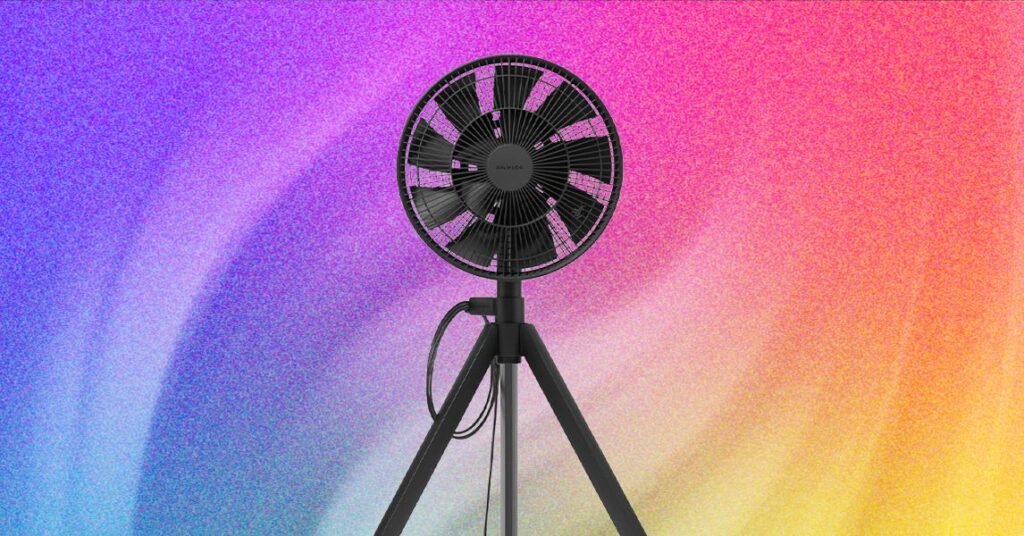
The NatureWind Studio looks a bit like a caged windmill on a wide tripod. It does not include a remote control, it does not have smart functions and it does not correspond to any application. It has only one objective: to imitate the natural breeze outside. One could argue that most fans can achieve this by simply running at low speed. But NatureWind Studio’s patented double-blade design results in smooth, wide-reaching and effectively silent output.
Balmuda rates the NatureWind Studio at just 9 decibels at its lowest setting. I couldn’t independently verify this, as my house’s ambient noise level is higher, but I can say that, in an otherwise quiet room, the fan was completely inaudible. This is impressive, but after using the NatureWind Studio in the middle of my living room for three weeks, I’m not sure its features justify the premium price, especially without a remote control.
Built to last
Unlike most pedestal fans I test, which typically only include a base and stem, the NatureWind Studio arrives in several pieces. I had to attach blades to the motor, assemble the protective housing, and slide it onto the sturdy tripod legs. This process wasn’t complicated, but it took me about 20 minutes to make sure I had everything connected correctly. However, the advantage of the setup is that I know how to easily disassemble the parts for cleaning, which is not the case with many pedestal fans. Several of the NatureWind Studio’s components, including the blades and motor housing, are metal and feel precision-built, which is to be expected at this price, but is still nice to see.
NatureWind Studio is not a new model for Balmuda; It’s been available in Japan since 2010 (where it’s called “GreenFan Studio”), but it’s new in the US since early June. Its main feature is dual-blade technology, where a slow-moving inner blade and a faster-moving outer blade create a combined airflow that is intended to be more like, as the marketing materials put it, “a wind through an open window than a mechanical fan.”
While the fan’s height doesn’t adjust and the NatureWind Studio doesn’t have a built-in rechargeable battery for wireless operation, it does have an impressively long 10-foot fabric-wrapped cord, for which there’s a small hook on the back of the fan stem to coil up excess length.
For more tech updates, stay tuned to our blog.