Some Antarctic icebergs linger close to home for decades, running aground near the ice shelves that spawned them or circling partway around the continent on coastal currents. Others, like Iceberg A-81, make a faster exit, heading north out of the Weddell Sea along a route well-traveled by the region’s bergs. Fast is relative, though. After
Some Antarctic icebergs linger close to home for decades, running aground near the ice shelves that spawned them or circling partway around the continent on coastal currents. Others, like Iceberg A-81, make a faster exit, heading north out of the Weddell Sea along a route well-traveled by the region’s bergs.
Fast is relative, though. After breaking from the Brunt Ice Shelf in January 2023, the roughly 1,550-square-kilometer (600-square-mile) berg spent more than three years in the Weddell Sea, carried along the coast by the clockwise-flowing Weddell Gyre. By May 2026, it reached the tip of the Antarctic Peninsula. It then moved north into the Scotia Sea, and by late October 2026, it approached the remote island of South Georgia in the South Atlantic Ocean, 2,300 kilometers (1,400 miles) north-northwest of the Brunt Ice Shelf.
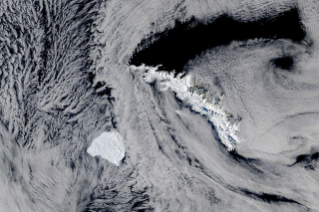
This image, acquired by the MODIS (Moderate Resolution Imaging Spectroradiometer) on NASA’s Terra satellite, shows the berg on October 20. In the days before, its progress slowed noticeably, and it appeared to be bumping along the edge of the island’s underwater shelf, according to Jan Lieser of Australia’s Bureau of Meteorology and Christopher Shuman of the University of Maryland (retired). South Georgia has slowed and even stopped icebergs before. In 2025, for instance, Iceberg A-23A ran aground on the shelf and later broke apart.
Though Iceberg A-81 was a steadfast traveler once it broke free, it took its time in becoming an iceberg in the first place. For about 35 years, one of the Brunt Ice Shelf’s rifts known as Chasm 1 was relatively stable. Then, around 2012, it began growing again, and by 2019, it was advancing quickly enough that a break seemed imminent. But the floating glacial ice held on for several more years until finally, in January 2023, the berg let go.
Calving is a normal part of the life cycle of ice shelves, but scientists keep a close eye on Brunt, which has recently shed several large icebergs in quick succession and is home to the British Antarctic Survey’s Halley Research Station, a major base for Earth, atmospheric, and space science research since the 1950s. Besides A-81, the ice shelf calved Iceberg A-74 from the North Rift in 2021 and Iceberg A-83 from the Halloween Crack in 2024. A-74 has since broken up, while A-83 remains intact and is trailing A-81 northward, along with a handful of other icebergs that appear to be clearing out of the Weddell Sea.
NASA Earth Observatory image by Michala Garrison, using MODIS data from NASA EOSDIS LANCE and GIBS/Worldview. Story by Kathryn Hansen.
Keep following us for the latest insights.