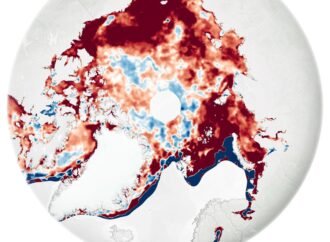
For decades, Arctic sea ice has been melting earlier in spring and freezing later in fall, extending the melt season and contributing to widespread ice loss. A new NASA-led study has found that while the Arctic melt season has lengthened dramatically since satellite records began, that trend unexpectedly stabilized around 2010. The Arctic sea ice
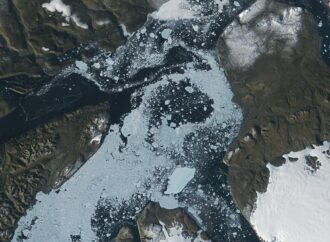
Summer is prime iceberg season in Greenland’s glacier-fed fjords, and 2026 was no exception. Especially notable was the berg that broke from the Petermann Glacier along Greenland’s northwest coast in August. Roughly the size of St. Thomas in the U.S. Virgin Islands, it was the largest calving event by any Arctic glacier since 2020. Iceberg
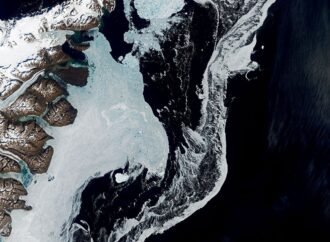
Greenland’s jagged coastline is lined with fjords, many of them cradling marine-terminating glaciers that routinely calve icebergs into the water. It’s common to see these bergs, small and large, drifting in the island’s fjords each summer once the sea ice breaks up. In summer 2026, one exceptionally large berg turned up in the Denmark Strait—more
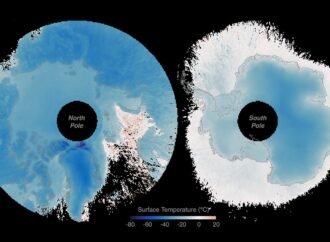
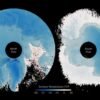
At the top and bottom of the planet, the seasons arrive on a schedule all their own. Satellite data from a mission measuring infrared energy reveal just how differently—and how dramatically—surface temperatures swing across two full years at the poles. In this animation, surface temperatures across the Arctic and Antarctic pulse between cold (dark blue)
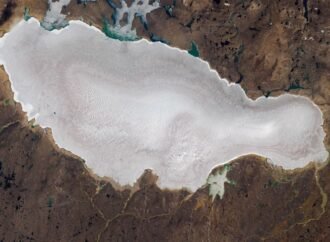
For most of the year, the Barnes Ice Cap in the Canadian Arctic lies quiet under a blanket of snow. By summer, that snow melts back, and the ice cap transforms in texture, its bare ice dotted with turquoise ponds and its surface threaded with meltwater channels. In summer 2026, this seasonal awakening arrived fast and
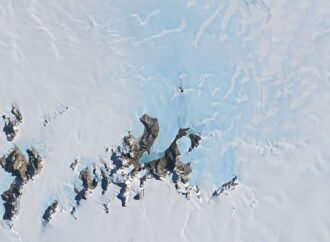
Scientists estimate that Earth is home to more than 100 million lakes. Among the most unusual is Lake Unter-See, one of Antarctica’s largest and deepest surface lakes, known for its distinctive water chemistry. Its ice-covered waters have exceptionally high levels of dissolved oxygen, low dissolved carbon dioxide, and a strongly alkaline (basic) pH. The OLI