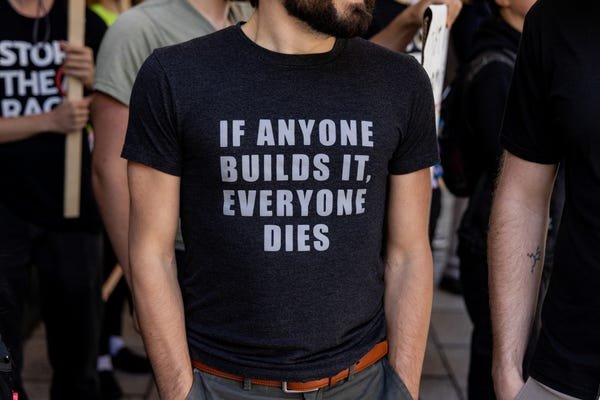
Tech leaders like Dario Amodei, Sam Altman, and Elon Musk are calling for a slowdown in the development of AI, and investors on Monday appeared to be taking the notion seriously. Stocks linked to the AI boom tumbled as investors processed the implications of frontier labs hitting the brakes. The Philadelphia Semiconductor Index fell as
Tech leaders like Dario Amodei, Sam Altman, and Elon Musk are calling for a slowdown in the development of AI, and investors on Monday appeared to be taking the notion seriously.
Stocks linked to the AI boom tumbled as investors processed the implications of frontier labs hitting the brakes. The Philadelphia Semiconductor Index fell as much as 5.7% on Monday, while the tech-heavy Nasdaq 100 dropped as much as 1.6%.
The cautionary tone from the AI titans comes on the heels of comments from Jacob Coxon, a former Anthropic Researcher who warned last week that AI could cause humans to go extinct within 10 years.
After the initial reaction on Monday, investors will be left to grapple with how serious a risk a pullback in AI spending is. The capex boom has lifted markets for the last few years, and even as investors question the return on massive spending, a sudden slowdown would throw a wrench in the economics of AI trade.
Despite the sell-off, Wall Street pros seem dubious about the prospect of companies hitting the brakes on AI development and spending. The selling also appeared to taper off, with stocks paring losses as oil prices and bond yields pulled back from intraday highs. This suggests the earlier declines were less about AI and more about macro forces that have been weighing on stocks for weeks.
Marta Norton, the chief investment strategist at Empower, told Business Insider on Monday that AI firms aren’t likely to meaningfully slow their work, as doing so would risk falling behind competitors.
“There’s no question in my mind that this is a PR angle,” Norton said. “I could be wrong, but it strikes me that competition is a pretty big motivator. So what they say and what they do may not be perfectly aligned.”
The AI race is also important for governments, Norton said, creating another driving force behind continued AI advancement.

AI
Norton hit on two common themes that emerged in commentary from Wall Street experts on Monday.
Here’s what Gene Munster, a managing partner and co-founder at Deepwater Asset Management, had to say on X:
“There’s no way these companies are going to measurably back off for two reasons: 1) The Prisoner’s Dilemma is in play. If one maintains its pace, the others that dial it back will be at a significant disadvantage. 2) The China-US dynamic is real, and at a minimum, the US has to keep pace with China,” Munster wrote.
In a client note, Bank of America research analyst Vivek Arya wrote that “we view these events as noise relative to a secular market where AI-capex could surge 3x to $3tn+ by decade-end,” and added that “for this US administration in particular, AI has become a strategic priority, central to winning the technology race versus China, sustaining productivity and GDP growth, and cementing US leadership.”
Still, the big risk is the damage that could be done to AI sentiment, Mark Hackett, the chief market strategist for Nationwide, said on Monday. Hackett argued that the recent high profile warnings could trigger volatility even if the calls to slow the pace of development don’t amount to much.
“The S&P 500 Index cannot absorb a major break in the AI story. After driving so much of the market’s gains, even a modest shift in sentiment around AI leaders, data centers or financing could trigger outsized moves.”
However, David Stubbs, the chief investment strategist at AlphaCore Wealth Advisory, agreed with the idea that there were other forces that likely contributed to Monday’s sell-off, such as the ongoing rise in long-term Treasury yields and the spike in oil prices. Brent rose to almost $110 per barrel before paring. Meanwhile, the 10-year Treasury yield
Norton stressed the importance of diversifying portfolios to account for any swings in the AI trade, and said that healthcare stocks and European stocks are two areas that have limited exposure to the AI theme.
Stubbs said industrial metals and gold are two other ways to diversify as demand for the physical assets remains high.
{For more tech updates, stay tuned to our blog.|Keep following us for the latest insights.|Check back often for more exciting news!}