Explanation: What color is the Moon? It depends on the night — and the time. Outside of the Earth’s atmosphere, the dark Moon, which shines by reflected sunlight, appears a magnificently brown-tinged gray. The featured image highlights a collection of apparent colors of the full moon on Earth, documented by one astrophotographer over 10 years
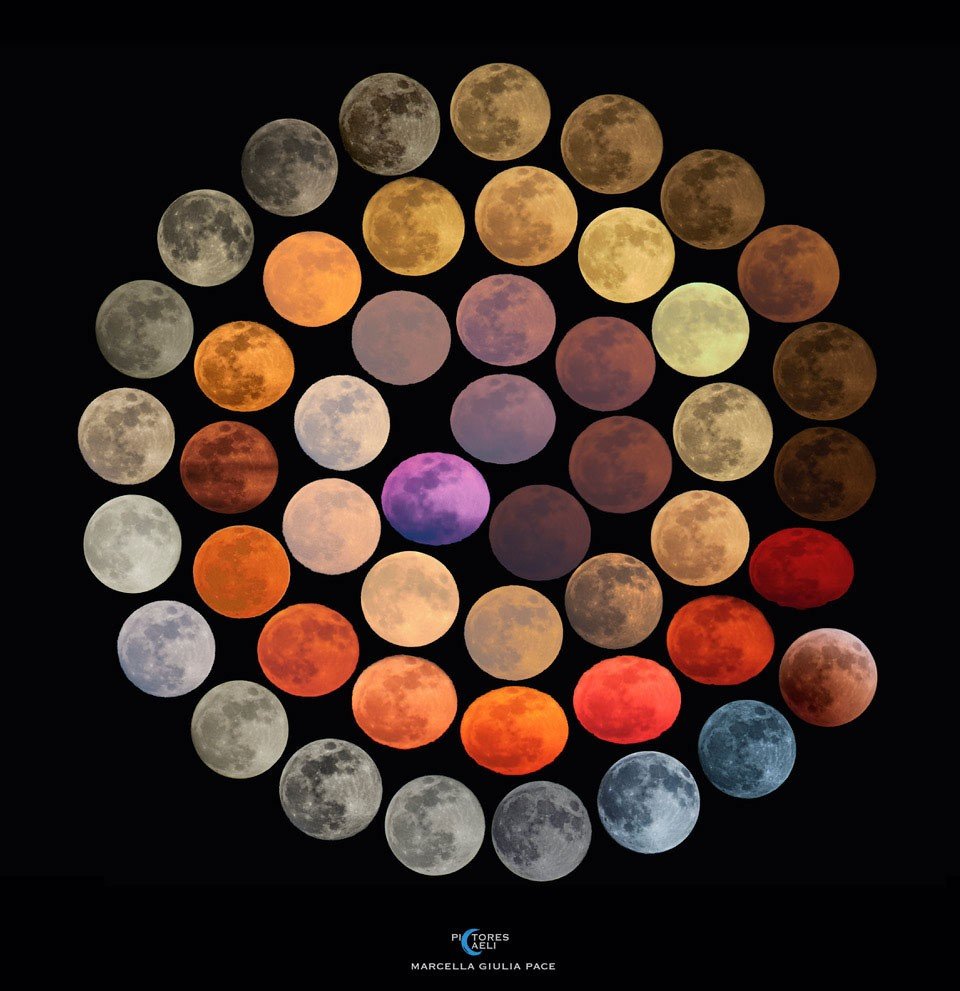
Explanation: What color is the Moon? It depends on the night — and the time. Outside of the Earth’s atmosphere, the dark Moon, which shines by reflected sunlight, appears a magnificently brown-tinged gray. The featured image highlights a collection of apparent colors of the full moon on Earth, documented by one astrophotographer over 10 years from different locations across Italy. A red- or yellow-colored moon usually indicates a moon seen near the horizon. There, some of the blue light has been scattered away by a long path through the Earth’s atmosphere, sometimes laden with fine dust. A blue-colored moon is more rare and can indicate an atmosphere carrying larger dust particles. What created the purple moon is unclear — it may be a combination of several effects. The last image captures the total lunar eclipse of 2018 July — where the moon, in Earth’s shadow, appeared a faint red — due to light refracted through air around the Earth. Have you ever seen an unusually colorful Moon?
Tomorrow’s picture: open space
For more tech updates, stay tuned to our blog.