As officials review widely circulated bystander videos of the police shooting death of a homeless man in Madison, Wisconsin, one key insight will not emerge: footage from officers’ body cameras. Unlike almost every other city of similar size, Madison does not require police to use them. The absence of that footage has left residents in
As officials review widely circulated bystander videos of the police shooting death of a homeless man in Madison, Wisconsin, one key insight will not emerge: footage from officers’ body cameras.
Unlike almost every other city of similar size, Madison does not require police to use them.
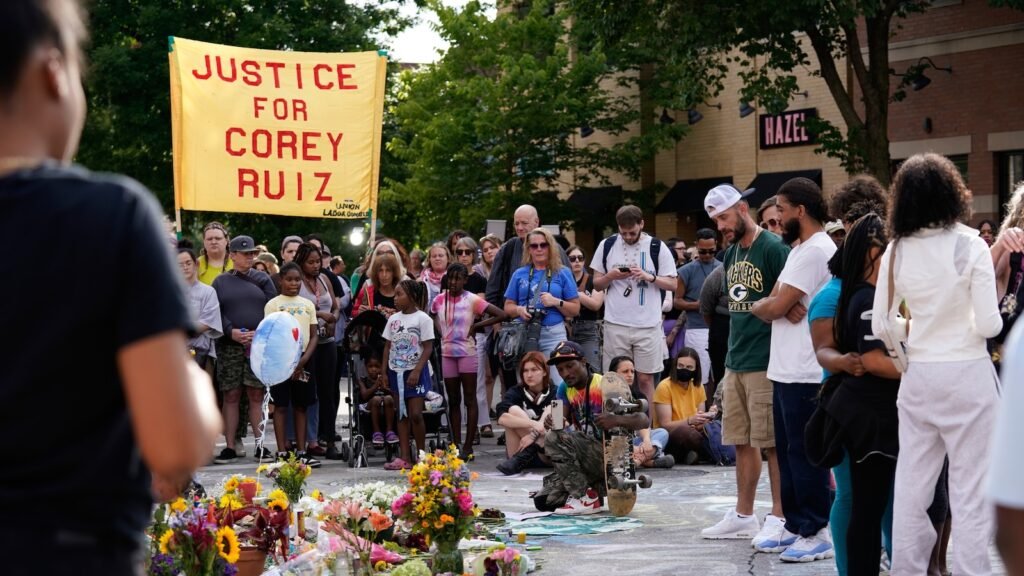
The absence of that footage has left residents in the dark about the key moments leading up to the shooting, when police say Corey Ruiz pulled a knife during a fight with four officers, wounding one of them. That officer then fired shots, according to police. The four officers have been placed on administrative leave pending a state investigation.
Meanwhile, the deadly encounter has reignited a contentious debate over body cameras, which has long irritated local officials and pitted some of the city’s progressive groups against each other.
Last November, the Madison Common Council rejected a proposal to redirect funding from a police oversight group to a body camera program. The legislative body is expected to approve a new proposal to allocate $414,800 for a three-year implementation of the program.
Police Chief John Patterson described the proposal as “modest” and added that the cameras had become “essential tools for the modern police officer.”
Law enforcement experts tend to agree, and some expressed surprise that the city’s nearly 500 officers weren’t already wearing the cameras.
“There are very, very few agencies of that size that don’t have a body camera program,” said Michael D. White, a criminal justice professor at Arizona State University who led camera adoption training for the U.S. Department of Justice.
“Madison has a long tradition of being an innovative and progressive police department, so it’s amazing,” he added.
Already in 2016, about 80% of police departments with 500 or more sworn officers had purchased body cameras, a figure that White said was now approaching 100%.
Over the past decade, Madison officials have repeatedly debated adopting the cameras. Subcommittees have emerged from the commissions, which have prepared feasibility studies, amendments and hours of debate.
Local officials primarily blame budget concerns, along with political inertia, for the current stalemate. Another common source of opposition, identified in a 2021 feasibility study, came from community groups concerned that the cameras would be used to surveil and criminalize marginalized groups.
“I can’t approve something that doesn’t have a policy and procedure behind it that is potentially going to hinder the community more than help it,” said Verónica Figueroa, then a member of the body cameras subcommittee.
As camera adoption has become more widespread in recent years, those concerns have largely faded, according to Common Council President Sabrina Madison.
But he said local officials have largely been preoccupied with another issue: finding shelter for a homeless population that has increased since the COVID-19 pandemic.
“It was like, if we’re going to figure something out, we’re going to figure out how to fund shelter operations,” Madison told The Associated Press on Thursday. “So the last two years, that’s where the focus has been.”
The city briefly conducted a body camera pilot program in the summer of 2024. A subsequent report found that the cameras had little impact on officer behavior or community sentiment toward police.
Dr. Broderick Turner, an independent researcher who analyzed the program and authored the report, noted that the length of the pilot (just 90 days) meant there was little time for anyone to notice a significant difference. And he described the demographic differences in the city’s response.
“Black communities tend to want body cameras, but Madison is overwhelmingly white,” Turner said. “The groups that opposed it were less affected by crime and less affected by police action.”
For some in the city, Wednesday’s shooting has brought up memories of Tony Robinson, an unarmed 19-year-old who was shot and killed by Madison police in 2015.
His death eventually led to the creation of the Office of the Independent Police Monitor.
Last winter, Madison lawmakers rejected a budget proposal that would have paid for a body camera program by cutting funding for the monitor.
Katey Nelson, a member of the police civilian oversight board, said the amendment had presented residents with a “false choice.”
“Cuts can be made with the Madison Police Department or the County Sheriff’s Department, but they are trying to confront similar agendas with each other,” he said.
“No one can agree on anything,” Nelson added. “Now here we are, facing another police shooting where we don’t have what we need to make sure officers are held accountable.”
Keep following us for the latest insights.