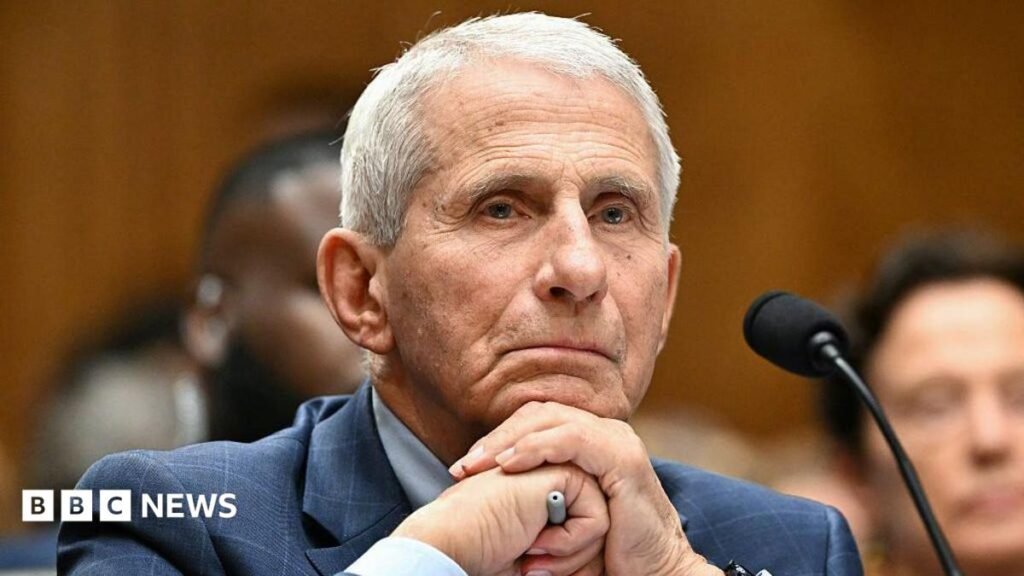
Former top US health official Anthony Fauci refused to answer questions at a tense US Senate hearing on Covid-19, saying he feared Republicans would try to use his testimony to prosecute him for perjury. He invoked the Fifth Amendment of the United States Constitution, which says that no one may be “compelled in any criminal
Former top US health official Anthony Fauci refused to answer questions at a tense US Senate hearing on Covid-19, saying he feared Republicans would try to use his testimony to prosecute him for perjury.
He invoked the Fifth Amendment of the United States Constitution, which says that no one may be “compelled in any criminal case to be a witness against himself.”
Contradicting himself under oath could be legally dangerous for him. Fauci noted that he had testified about Covid and its origin in several congressional hearings.
Republicans have long accused Fauci of hiding information about the pandemic from the public and lying about its dangers.
He has denied wrongdoing and called the allegations against him “simply absurd” in previous testimony before lawmakers.
“While it pains me to do so because of the respect I have for the legislative branch of government … under the advice of my attorneys, I will invoke my right under the Fifth Amendment of the Constitution to refrain from answering your questions,” Fauci, 85, former head of the National Institute of Allergy and Infectious Diseases (NIAID), said at Wednesday’s hearing.
Adopting the Fifth is not an admission of guilt: it is designed to protect people from coercion, mistakes, and unfair shifting of the burden to provide evidence of wrongdoing.
While former President Joe Biden granted him a preemptive pardon, shielding him from federal prosecution for his actions between 2014 and 2025, Fauci could still face charges for anything after that date, including his actions toward the Senate committee. You could also face state or local charges.
In his testimony before the Senate Homeland Security Committee on Wednesday, Fauci said Republican Sen. Rand Paul, who chaired the hearing, had an “obvious obsession” with prosecuting him and that had led Fauci to refuse to answer questions.
“The only conclusion I can come to is that the only reason you are calling me before this committee is so that I can say something, anything, that will vindicate your repeated public promises that I will end up, in your words, ‘behind bars,'” Fauci said.
Paul, who worked as an eye surgeon before joining Congress, continued to question Fauci despite his refusal to answer. He repeatedly called on Fauci to “apologize” and said the committee would vote next week on a resolution that would declare Fauci in contempt of Congress.
Republicans asked Fauci about the change in health guidance, which changed during the pandemic as health officials learned more about the disease. Fauci has previously defended his political positions.
One of Fauci’s lawyers, David Schertler, who was sitting next to him, repeatedly attempted to intervene during Paul’s questioning and was removed from the room.
Schertler later called it “outrageous” that Paul “excluded his attorney for raising a legitimate legal argument,” adding in a statement: “It proves the baseless and vindictive nature of this proceeding and Rand Paul’s personal vendetta against Dr. Fauci.”
During the hearing, President Donald Trump took to social media to call Fauci “crazy.”
“I said from the beginning that the virus came from the Wuhan lab in China. Fauci disagreed, always trying to protect China,” Trump said.
The origins of the pandemic have been a topic of intense debate in the United States, including between Trump, who was in office when it began in 2020, and public health officials, including Fauci.
The couple frequently argued over the handling of the pandemic, even as Trump suggested unproven treatments.
At the hearing, Paul suggested that while Fauci said publicly that Covid originated naturally, he privately believed the virus originated in a medical laboratory. The senator has repeatedly promoted the lab leak theory that Covid came from the Wuhan Institute of Virology in China.
In 2025, the World Health Organization said the natural origin theory (the virus spreading from animals to people) was the idea “best supported” by available evidence, but said that until more information emerges, the origin determination is “inconclusive.”
For more tech updates, stay tuned to our blog.