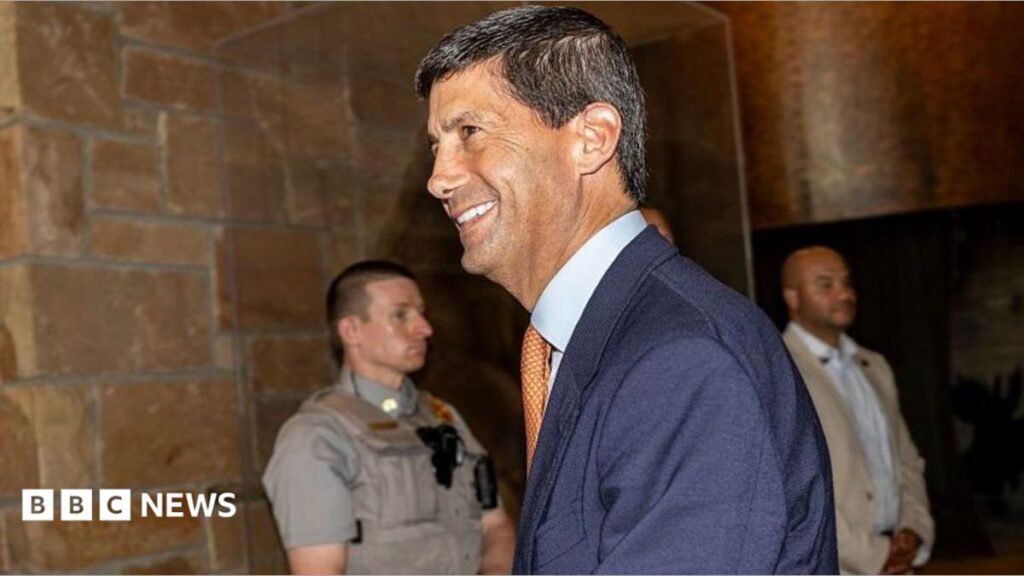
The head of the US central bank said policymakers will “have work to do” to if they are not confident cost of living pressures are easing for Americans. Federal Reserve chairman Kevin Warsh said while inflation readings looked better than expected over the summer, they did not show that the current picture had “meaningfully improved”.
The head of the US central bank said policymakers will “have work to do” to if they are not confident cost of living pressures are easing for Americans.
Federal Reserve chairman Kevin Warsh said while inflation readings looked better than expected over the summer, they did not show that the current picture had “meaningfully improved”.
The new Fed boss stressed that his remarks should not be treated as a guide for future interest rate decisions, but the comments suggest rates could be raised if policymakers believe inflation is too high.
The latest figures showed prices rose 3.4% in the year to July, above the Fed’s 2% target.
Warsh made the comments in his first speech at the annual Jackson Hole Economic Policy Symposium in Wyoming, which sees central bankers, government officials and academics from around the world gather to talk about interest rates, inflation and other economic issues.
Warsh said given prices were rising by more than 2% on annual basis, “the Fed’s predominant focus right now should be on prices”.
“Here is my standard: We must be confident that underlying inflation is moving to our objective, clearly and at sufficient speed. Otherwise, we have work to do.”
The central bank boss has remained tight-lipped about the potential path of interest rates, but investors will have watched his speech closely for any signs of the Fed’s approach under his leadership.
The central bank’s next interest rate decision will be made on 15-16 September.
Warsh issued a plea in his speech to not label his remark as “forward guidance” and said he believed the practice of sending signals to the markets on future interest rate decisions, adopted in the wake of the 2008 financial crisis, had “overstayed its welcome”.
“Oversharing policy deliberations and overcommitting to future decisions can lead markets, businesses, and households astray,” he said, adding it also inhibited the Fed the “freedom to make the right calls when it’s time to decide”.
Interest rates were left unchanged between 3.5% and 3.75% in July for the fifth time in a row amid concerns over inflation due to the ongoing conflict between the US and Iran, which has caused as surge in global oil prices.
Higher oil prices has also fuelled bond market investors, who have demanded higher returns, leading to higher borrowing costs for the US government and other major corporations.
Such borrowing costs impact the cost of borrowing for mortgages, car loans and credit cards.
The spike in interest payments has driven US national debt past the $40tn (£29.5tn). The figure has doubled in a decade under both the Trump and Joe Biden administrations.
The figure is rising by about $90,000 every second, or $7.8bn a day, according to the Congress Joint Economic Committee.
Keep following us for the latest insights.