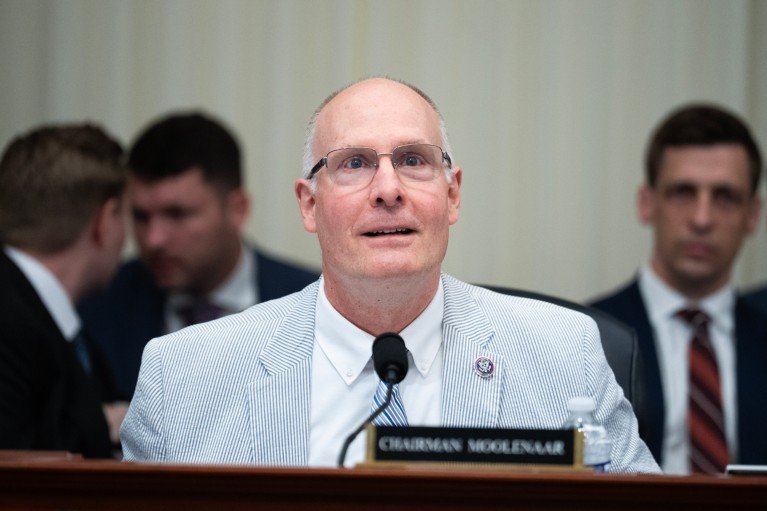
John Moolenaar, Republican of Michigan, is the chairman of the US House Select Committee on China.Credit: Tom Williams/CQ-Roll Call, Inc/Getty U.S. House lawmakers from both sides of the political aisle have expressed concerns about China exploiting U.S. research but have diverged over how to protect the country’s research and fund it. The concerns, expressed at
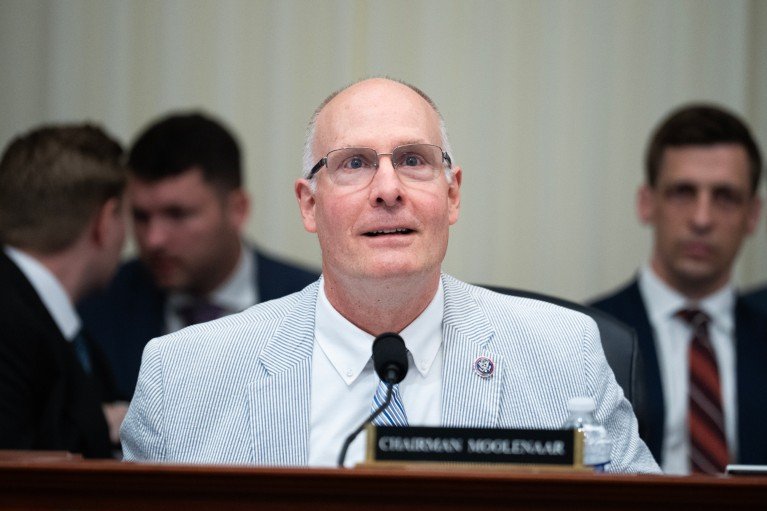
John Moolenaar, Republican of Michigan, is the chairman of the US House Select Committee on China.Credit: Tom Williams/CQ-Roll Call, Inc/Getty
U.S. House lawmakers from both sides of the political aisle have expressed concerns about China exploiting U.S. research but have diverged over how to protect the country’s research and fund it. The concerns, expressed at a hearing on Capitol Hill on July 15, follow an announcement by the U.S. National Science Foundation (NSF) a week earlier that it would ban collaborations between the U.S. scientists it funds and international institutions that the federal government considers dangerous to national security, including many major Chinese universities.
China’s scientific influence grows as US influence declines: data shows how
John Moolenaar, Republican of Michigan and chairman of the House Select Committee on China, which scheduled the hearing, praised the NSF policy and called on officials from other U.S. science agencies who were testifying at the session to adopt the same ban. “Should American taxpayer dollars be used for research with entities within China’s military-industrial and defense research base? The common sense answer is no,” he said at the hearing.
Patricia Valdez, chief research integrity officer at the U.S. National Institutes of Health (NIH), and Jeremy Ison, chief of staff to the undersecretary for science at the U.S. Department of Energy (DoE), responded that they were closely watching the NSF policy, although they emphasized that their agencies already have research safeguards in place.
On the other side of the aisle, Democrats agreed that collaborations with China could be fertile ground for research theft, but warned that staff and spending cuts to U.S. scientific agencies enacted by Republican President Donald Trump’s administration are making the situation worse. Rebecca Keizer, head of the NSF’s Office of Research Security Policy and Strategy, testified at the hearing that her department has only five staff members today compared to ten in 2024, before Trump took office. “I have zero tolerance for the PCC [Chinese Communist Party] “We are stealing what American scientists build,” said Ro Khanna, a California representative who is the ranking Democrat on the committee. “But we cannot protect American research while the administration is dismantling the very people and programs that protect it.”
Greater security
The NSF funds about 25% of basic academic research in the United States and has historically placed few restrictions on international collaborations. But its new policy, which takes effect Oct. 1, would prohibit high-level staff listed on research grants from collaborating with or receiving funding from “restricted entities” — institutions, companies and individuals in China and other countries that have been designated as a national security threat by U.S. agencies such as the Department of Defense. Among these entities are major Chinese institutions, including the University of Science and Technology of China in Hefei and Sun Yat-Sen University in Guangdong.
The number of researchers with dual affiliation between the United States and China is declining
Over the past two decades, as China’s star has risen and tensions between China and the United States have risen, so have U.S. officials’ concerns about the security of the research. During Trump’s first presidency, from 2017 to 2021, his administration launched the China Initiative, a controversial program aimed at protecting American laboratories from espionage that saw the arrest of several Chinese-born American academics. Many charges were eventually dropped or dismissed. Although Trump’s successor, Democrat Joe Biden, discontinued the initiative in 2022, his administration maintained its focus on research security.
Under the second Trump administration, research and security policy has largely been left in the hands of individual US agencies. In addition to the NSF policy change, last year the NIH changed the way it funds foreign institutions, which had the effect of suspending many clinical trials. But that gradual approach could change: A far-reaching proposal issued by the White House Office of Management and Budget in May suggests an outright ban on collaborations involving recipients of federal research grants and “foreign adversaries,” although it does not define who those adversaries are.
Perhaps the strongest push for restrictions comes from House Republicans, who have repeatedly called on the Energy Department to ban researchers of Chinese descent who are not U.S. citizens from working in U.S. national laboratories. Jill Tokuda, a Democrat representing Hawaii, said at the hearing that the ban would hurt, not “help us bring the best and brightest” researchers to the United States.
For more tech updates, stay tuned to our blog.