
I have traveled to almost 90 countries around the world, including Peru, Austria, Egypt, India and many, many more. I often travel with my children and I think one of the best parts of traveling is trying local food and breaking bread with locals, including, and perhaps especially, street food. For the most part, I’ve
I have traveled to almost 90 countries around the world, including Peru, Austria, Egypt, India and many, many more. I often travel with my children and I think one of the best parts of traveling is trying local food and breaking bread with locals, including, and perhaps especially, street food.
For the most part, I’ve been able to avoid food poisoning while traveling by following simple rules I’ve collected over the years from my doctors, travel health clinics, and the Centers for Disease Control and Prevention (CDC).
Cyclospora, the pathogen that has sickened thousands of people across the United States, is also a danger abroad. Staphylococcus aureus, Listeria, E. coli, Salmonella and norovirus, among many other pathogens, also pose a risk when food is not prepared, stored or handled properly, says Dr. Karl Kwok, a gastroenterologist at Kaiser Permanente Southern California. Sometimes food gets contaminated anyway, even if you do everything right.
“The name of the game is risk management. It’s unrealistic to expect risks to be completely avoided,” he says. Washing your hands with soap and water for 20 seconds before eating is as important abroad as at home, but it is often not enough.
Here are some ways I protect myself when I travel, particularly when visiting places where sanitation practices differ from those I’m accustomed to in the United States or where the risk of food poisoning is high.
I don’t eat fresh foods that can’t be peeled, boiled or cooked.
When I started traveling to parts of the world where parasites are common, one of the first rules I learned was “boil it, cook it, peel it or forget it.” Although this requires adjusting my diet rich in salads and berries, that doesn’t mean I subsist on junk food.
Lettuce and celery are banned in many of the destinations I visit, but bananas, peeled cucumbers, carrots and spinach, cooked broccoli and potatoes are usually fine. Kwok agreed that avoiding raw fruits and vegetables abroad is a good idea, especially if you are concerned about local health practices. As a general guideline, if the water is not safe to drink, I will not eat raw fruits and vegetables washed with that water. I also research the CDC guidelines on eating raw fruits and vegetables before landing.
On trips around the world, including Peru, Ecuador, Jordan, Egypt, India and beyond, I avoided eating anything raw. However, on trips to Europe, including France, Italy, England and Austria, I consumed salads without worry.
I make sure any street food I eat is fresh off the grill.
Although I don’t consider myself a food enthusiast, I love trying local specialties. I always prefer street food to gourmet restaurants. However, I don’t go to the first cart or kiosk I see. Typically, I look for vendors with long lines of local customers whose spaces appear clean and organized. While this isn’t foolproof, I guess if a place is popular with people who live nearby, the food probably won’t make anyone sick. Plus, I always order hot food fresh off the grill, not something that’s been sitting on the side.
However, eating street food is always risky. Ideally, all cooked foods should be consumed above 140 degrees Fahrenheit, because the germs that cause food poisoning thrive at lower temperatures. However, Kwok acknowledged that “it is difficult to measure the internal temperature of street foods. Realistically, no one carries a thermometer with them on trips.” Instead, Kwok suggested opting for thinner cuts of meat that reach a safe core temperature more easily and checking to make sure seafood isn’t translucent.

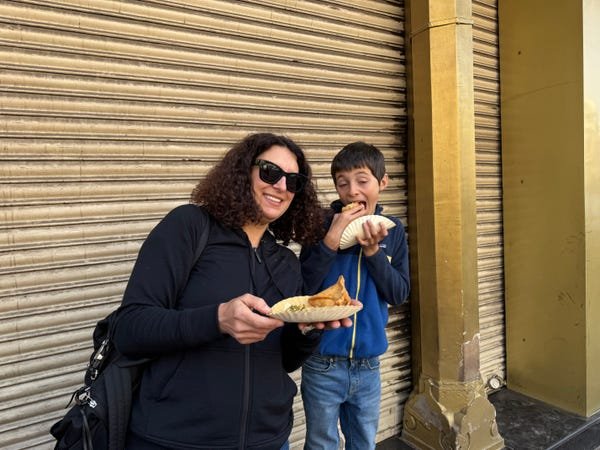
The author and her son loved eating street food in India. Courtesy of Jamie Davis Smith
Whenever possible, street food of any kind “should, at best, look piping hot,” Kwok explained. Personally, I feel safer eating street food if I see it steaming. Given how hot street food needs to be before eating it, “be careful not to burn yourself,” Kwok said.
Although it’s not exactly a scientific approach to food safety, Kwok also agreed that I’m doing the right thing by seeking out street vendors popular with locals who tend to know the places that won’t make them sick.
Following these rules, my children and I spent almost three weeks in India without getting sick even once, even though we ate street food several times a week.
I am very cautious with water and ice.
Before traveling, I always check the CDC guidelines of the country I am visiting to see if it is safe to drink water. If not, I stick with bottled water and make sure the bottle is sealed before taking that first sip. When it comes to other types of drinks, like soda, juice, or beer, I usually stick to bottles as well. “Use bottled beverages because manufacturing plants, especially large corporations and international brands, generally follow accepted best hygiene practices,” Kwok said.
However, it’s not just drinking water that worries me. If the water isn’t safe to drink where I’m traveling, I don’t ask for ice, and if they give me a glass to pour my drink in, I make sure it’s completely dry, since even small droplets of water left after washing can make me sick. Additionally, I use bottled water to brush my teeth and am careful not to drink water in the shower.
I’ve stayed at large resorts everywhere, from the Dominican Republic to Mexico to the Turks and Caicos Islands, where powerful water purification systems are used throughout the property. At these resorts, it’s usually safe to drink tap water or use it to brush your teeth, and sometimes I let my guard down when staying at these types of resorts. However, I still drink bottled water and remind myself to be careful as soon as I leave the resort.
I go with my instinct
Sometimes avoiding food poisoning comes down to trusting my gut. Even if a restaurant is popular on TikTok, if I walk in and it doesn’t look clean, I still go. Once, in Vietnam, I looked for a lunch place that everyone told me was delicious. Before sitting down, I went to the bathroom, where I saw a waitress come out of a stall and leave, without washing her hands. I may have missed a good meal, but the risk of eating contaminated food was too high.
My experience in Vietnam was a lucky (or perhaps unlucky) coincidence. If I had entered the restaurant a few minutes earlier or later, I may have missed the waiter’s failure to wash his hands and gotten sick as a result. However, I spent years working in restaurants and am always looking for other telltale signs of sanitary practices that don’t depend on being in the right place at the right time. Sticky dirty tables, chairs, and floors may not seem like a big deal, but they can also be a sign that the kitchen isn’t as clean as it could be. This is not a foolproof method, but I’d rather be safe than sorry.