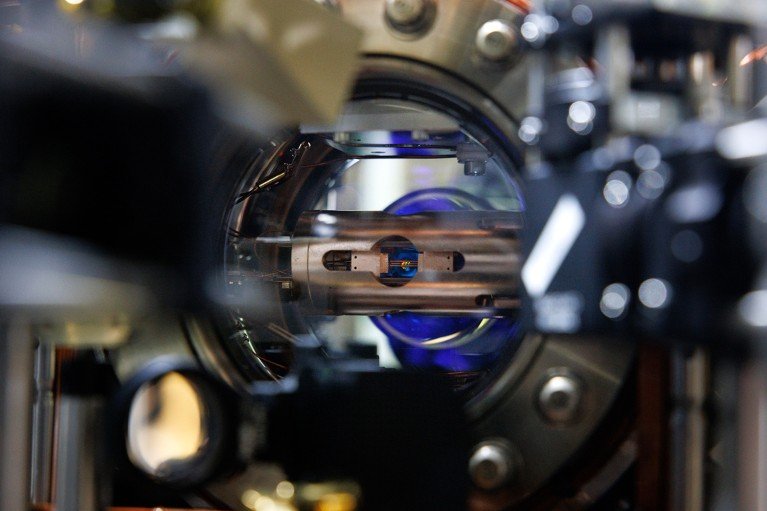
A close-up of the lutetium clock’s interior, which is the world’s most accurate timekeeper. Credit: Centre for Quantum Technologies, National University of Singapore Physicists have unveiled the world’s most accurate clock — a timepiece so reliable that it would take more than 260 billion years to lose a second. Precision clocks are used in everything
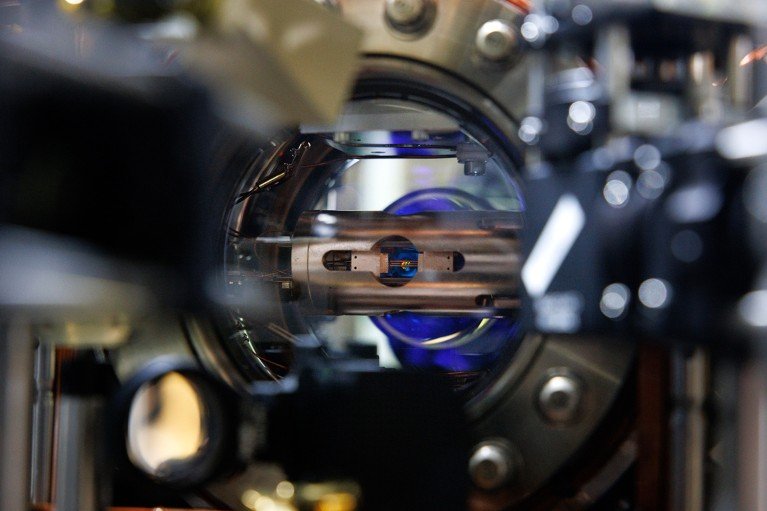
A close-up of the lutetium clock’s interior, which is the world’s most accurate timekeeper. Credit: Centre for Quantum Technologies, National University of Singapore
Physicists have unveiled the world’s most accurate clock — a timepiece so reliable that it would take more than 260 billion years to lose a second.
Precision clocks are used in everything from satellite navigation to looking for dark matter. Ever more accurate clocks open fresh opportunities, such as mapping changes in Earth’s gravitational pull with exquisite precision, and could form the basis of a new definition of the second.
The lab-based timepiece1, made by researchers at the National University of Singapore (NUS) using the rare-earth metal lutetium, is four times more accurate than the previous best clock2, which was based on calcium ions.
The device is an ‘optical’ atomic clock, which derives time using the visible-range frequency of light at which an element absorbs and emits radiation. Its accuracy is “impressive”, says David Leibrandt, a physicist at the University of California, Los Angeles, who works on ultra-precise clocks. Even more so is the fact that the team compared the outputs of their clocks to verify their accuracy, he adds.
The researchers behind the lutetium clock also say that it is robust enough that they hope to be able to miniaturize it and eventually take it out of the lab. The achievement, published1 in Nature on 23 September, is the result of more than 10 years of work, says Murray Barrett, the NUS physicist who led the team. The scientists feel jubilant “for what we have achieved, and eager to see what the future will bring”, he says.
On the road
The clock works by tapping into a natural and fixed property of lutetium ions: the frequency of light that makes an electron transition into a higher-energy, ‘excited’ state. By continuously observing a single ion, researchers locked a laser light to the exact frequency that triggers the transition, then used the laser’s oscillations as ticks to mark time.
The researchers not only calculated their estimate of the clock’s accuracy but verified it by comparing two lutetium clocks with each other, which is essential to being confident in the device’s output. “If you only have one clock — how would you know it was accurate?” says Barrett. The two clocks’ ticks matched to the 19th digit, which the team says is the most precise clock comparison ever performed.
Researchers at the National University of Singapore developed the clock, which is four times more accurate than the next-best contender. Credit: Centre for Quantum Technologies, National University of Singapore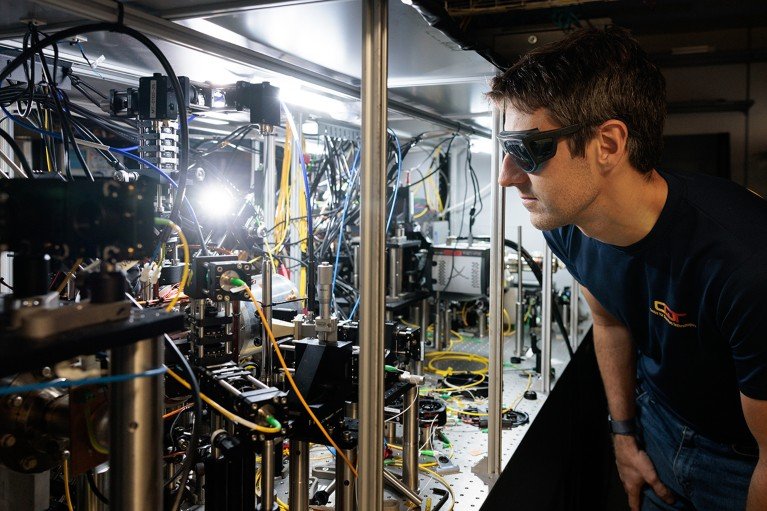
The NUS team thinks it is the only group in the world making clocks from lutetium. The element’s properties are “well suited” to the job, says NUS physicist Kyle Arnold. Compared with some atoms often used to make atomic clocks — such as ytterbium and strontium — lutetium is much less sensitive to fluctuations in temperature and magnetic fields. These environmental factors can nudge the frequency of the transition and affect the clocks’ accuracy. The lutetium clock requires only commercially available laser technology and works at room temperature.
“I think lutetium will have a leading role to play in the precision timekeeping of the future, and I hope this brings wider appreciation of its advantages for optical clocks,” says Arnold.
Keep following us for the latest insights.