WASHINGTON– The Trump administration proposes improving security around the White House by placing a fence around nearby Lafayette Park to help limit public access when law enforcement authorities determine it is necessary to do so. The proposal is scheduled to be considered Thursday by the U.S. Commission of Fine Arts, according to the meeting agenda
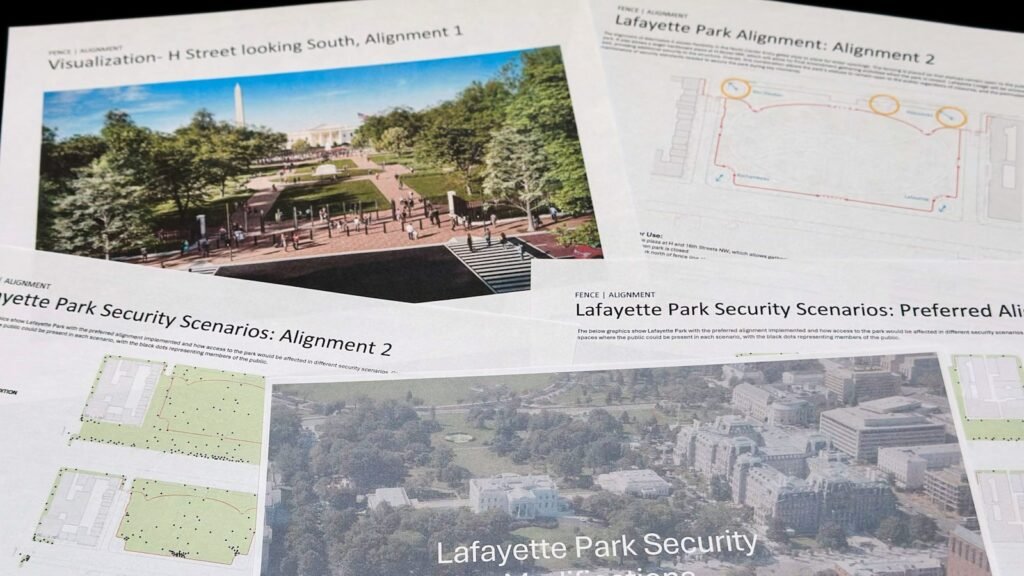
WASHINGTON– The Trump administration proposes improving security around the White House by placing a fence around nearby Lafayette Park to help limit public access when law enforcement authorities determine it is necessary to do so.
The proposal is scheduled to be considered Thursday by the U.S. Commission of Fine Arts, according to the meeting agenda and plans posted on the agency’s website. The agency oversees construction design on federal lands in Washington.
Commissioners will also re-examine the design of an underground facility to screen the thousands of tourists and others who visit or work at the White House. The seven commissioners were appointed by the Republican president.
The proposals are being considered at a time when the president’s security has become a top concern. President Donald Trump has been the target of multiple assassination attempts, including two during the 2024 campaign and a third last April while attending a dinner in Washington with White House reporters.
Those concerns increased the following month after U.S. Secret Service agents shot and killed a man who opened fire near a White House security checkpoint.
The administration says the projects will be an improvement over temporary structures that have long been used to aid perimeter security, such as barriers formed from bike racks, and to control the many guests accessing the White House and its grounds.
A look at both projects:
Trump was accompanied by Interior Secretary Doug Burgum on a recent tour of the park to see updates being made under his direction. The president has worked with the Department of the Interior and one of its agencies, the National Park Service, to restart inactive park fountains.
“We’re really doing some work on Lafayette Park, which is really the entrance to the White House, and it will be done very soon and it will be incredible,” Trump said in June.
The administration’s 79-page proposal for the 8-acre (3-hectare) park calls for completely fencing it with gates at the north and south entrances to control public access. Options include including or excluding four monuments located in each of the four corners of the park.
The proposal, which is supported by the Secret Service and the Executive Office of the President, in coordination with the Department of the Interior and the National Park Service, notes that leaving the monuments aside would expose them to vandalism.
The report says the plan’s goal is to “enhance long-term safety,” preserve Lafayette Park’s identity as an important National Park Service landscape, and “maintain public access to this nationally symbolic space.” Crowds flock to the park to protest or celebrate important events.
Lafayette Park has not had a permanent fence around it since the 19th century. The Secret Service anticipates the fence would begin going up next year.
The administration wants similar fencing along Pennsylvania Avenue on the north side of the White House complex, from the Treasury Department building on 15th Street to the Eisenhower Executive Office Building on 17th Street. The report says it will be treated as a separate proposal and presented to the committee at a later date.
The commission will review a revised design for the facility, which would be built beneath Sherman Park, federal land southeast of the White House, to support screening by public tour participants, guests attending large events, White House staff and contractors.
The original design called for locating the facility’s entrance at the south end of the park, but meetings and consultations led to a revised proposal that moved the entrance to the park’s western edge to avoid conflicts with infrastructure and minimize impact on surrounding views, according to the report submitted for commission review Thursday.
The administration said the permanent installation will eliminate the need for a series of temporary screening tents currently used for events, improve security at the White House complex and improve the experience for visitors.
The Secret Service, the Department of the Interior, the National Park Service and the Executive Office of the President want to begin construction in August on the 33,000-square-foot (3,066-square-meter) underground facility. They have set a date of July 2028 for it to be operational.
White House visitors would face an initial identification check before entering the facility through an above-ground pavilion, then proceed to a lower level and a second checkpoint. Once cleared, visitors will board the escalators that will take them to the White House grounds.
Keep following us for the latest insights.