Receive the daily Popular Science newsletter💡 Breakthroughs, discoveries and DIY tips delivered six days a week. By registering, you confirm that you are over 16 years of age, will receive newsletters and promotional content, agree to our Terms of Use, and acknowledge the data practices in our Privacy Policy. You can unsubscribe at any time.
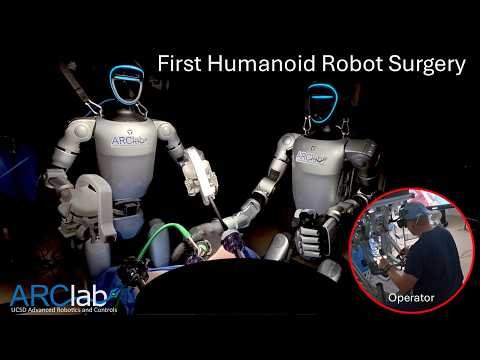
In a world first, doctors successfully completed not one, but two surgeries with the use of remotely controlled humanoid robots. The preclinical proof-of-concept trial involved removal of the gallbladder in large, non-primate mammals. A humanoid robot and a human assistant completed one procedure while a pair of robots performed the second.
Life-saving robotic-assisted surgical procedures are common in many medical centers, but they have limitations. Many of these multi-arm devices are massive systems that weigh more than 1,800 pounds and require specialized equipment to install in modernized operating rooms. They are also usually designed with only one type of procedure in mind. In comparison, humanoid robots are what their name implies. At around five feet tall and weighing just 60 pounds, the surgical robots (nicknamed “Surgie”) are comparatively small, agile, customizable, and much more affordable. With proper training and technological advancements, fleets of Surgies could one day be deployed to communities with critical resources.
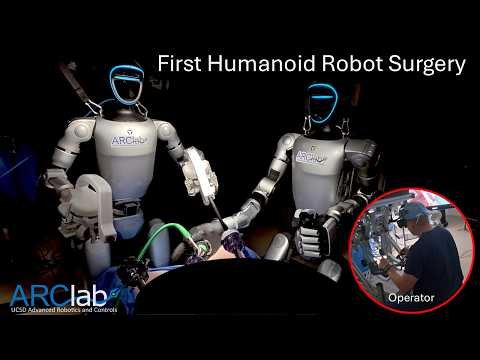
Humanoid robots used to perform the world’s first teleoperated robotic surgery.
“Autonomous, remotely operated humanoid robots have real potential to expand access to critical surgeries that patients would not otherwise have access to,” Michael Yip, an engineer at the University of California, San Diego (UC San Diego), said in a statement. “This can help address the health crisis not only in the United States, but also around the world.”
Yip and his colleagues recently detailed their groundbreaking assay in a study published in the journal Nature. Although the team needed to design adapters to allow each robot to hold surgical tools, operators said controlling them from afar seemed unexpectedly natural.
“We were surprised by how well Surgie fit into our workspace and workflow,” said Nikita Thareja, a surgeon at UC San Diego.
“It’s a fraction of the cost and takes up a fraction of the space in an operating room. Therefore, it’s easy to deploy, anywhere from rural areas to the battlefield and even in space,” added UC San Diego surgeon and study co-author Shanglei Liu.
The first teleoperated humanoid surgeries encountered some teething problems. The Surgie robots required recalibration several times, greatly slowing the overall process compared to performing them with existing surgical systems. The latency between the controller and the robot also needs to improve. However, researchers are confident that the technology will improve and cite similar advances with robotic laparoscopic surgery. The first of those procedures took six hours, while current machine-assisted examples only take about 30 minutes.
A Surgie isn’t necessarily relegated to the operating table either. The team imagines that future humanoid robots could also help by grabbing tools or cleaning up after surgery.
“One of our objectives is to develop [an] self-employed surgical assistant,” Yip said. “Many communities struggle to adequately staff the surgical team, which means patients go untreated. “Our goal is an operating room of the future, where humanoid robots and humans work side by side as an integrated team.”

2025 PopSci Best of what’s new
For more tech updates, stay tuned to our blog.