NASA astronaut Deniz Burnham will embark on her first mission to the International Space Station, serving as flight engineer for Expedition 76. Burnham will launch aboard the Roscosmos Soyuz MS-30 spacecraft with cosmonauts Dmitri Petelin and Konstantin Borisov. Launch is scheduled for March 2027, from the Baikonur Cosmodrome in Kazakhstan, and the trio will spend
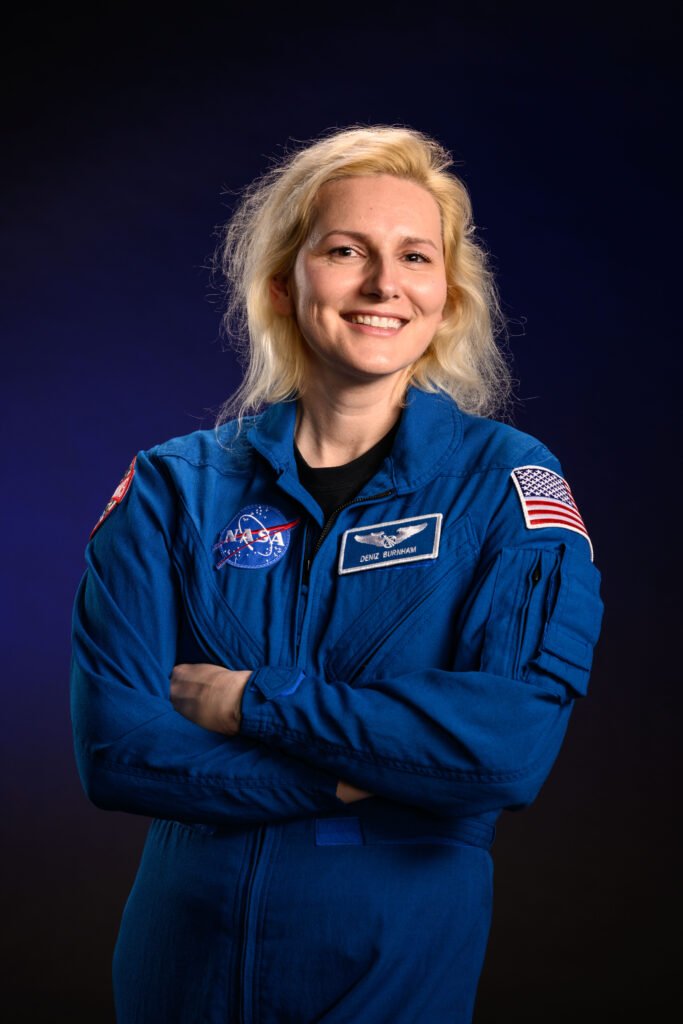
NASA astronaut Deniz Burnham will embark on her first mission to the International Space Station, serving as flight engineer for Expedition 76.
Burnham will launch aboard the Roscosmos Soyuz MS-30 spacecraft with cosmonauts Dmitri Petelin and Konstantin Borisov. Launch is scheduled for March 2027, from the Baikonur Cosmodrome in Kazakhstan, and the trio will spend about seven months aboard the orbital laboratory.
During her expedition, Burnham will conduct scientific research and technology demonstrations to help prepare humans for future exploration missions to the Moon and Mars and benefit the people of Earth.
Selected as a NASA astronaut in 2021, Burnham graduated with the agency’s 23rd class of astronauts in 2024. Born at Incirlik Air Base in Adana, Turkey, Burnham moved frequently while growing up in a military family. He lived in Wasilla, Alaska, at the time of his selection.
Burnham, a former intern at NASA Ames Research Center in Silicon Valley, California, earned a bachelor’s degree in chemical engineering from the University of California, San Diego, and a master’s degree in mechanical engineering from the University of Southern California in Los Angeles. An experienced leader in the energy industry, she spent more than a decade managing in-situ drilling operations on oil platforms throughout North America. Burnham also served in the U.S. Navy Reserves as an engineering duty officer. He is a private pilot with a license and ratings for single-engine land and sea aircraft, instrument aircraft and helicopter-copter.
For more than 25 years, people have lived and worked continuously aboard the International Space Station, advancing scientific knowledge and achieving research breakthroughs that were not possible on Earth. The space station helps NASA understand and overcome the challenges of human spaceflight, expand commercial opportunities in low-Earth orbit, and lay the foundation for long-duration missions to the Moon, as part of the Artemis program, and to Mars.
For more information about the International Space Station’s research, operations and crews, visit:
https://www.nasa.gov/station
-end-
Joshua Finch
Headquarters, Washington
202-358-1100
joshua.a.finch@nasa.gov
Anna Schneider
Johnson Space Center, Houston
281-483-5111
anna.c.schneider@nasa.gov
Check back often for more exciting news!