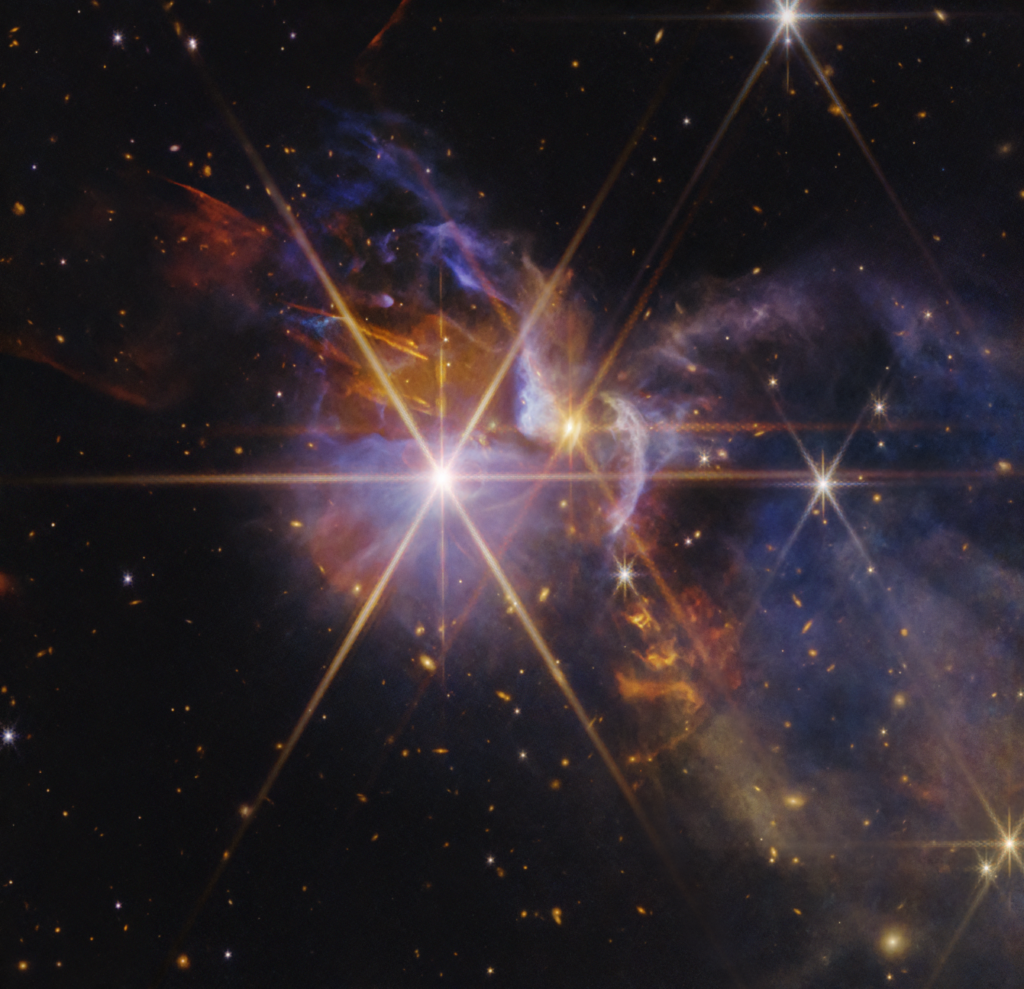
NASA’s James Webb Space Telescope has captured infrared light from numerous features that were previously impossible to see beyond the thick dust of the FS Tau star system. In addition to the countless background galaxies that come into view like fireworks for America’s 250th anniversary celebrations, this image flickers with a series of protostars, or
NASA’s James Webb Space Telescope has captured infrared light from numerous features that were previously impossible to see beyond the thick dust of the FS Tau star system. In addition to the countless background galaxies that come into view like fireworks for America’s 250th anniversary celebrations, this image flickers with a series of protostars, or young stars that form from dense pockets of gas and dust. These hot, lumpy, low-mass objects will eventually become full-fledged stars capable of burning hydrogen in their cores, like our Sun. The FS Tau protostars are between 1 and 3 million years old, which is relatively young on cosmic scales. Our Sun, on the other hand, is 4.6 billion years old.
Low-mass stars emit less radiation and have less energetic stellar winds than those with higher masses, meaning they alter their environment to a much lesser degree. This makes the FS Tau region incredibly useful for studying the evolution of low-mass stars without the same level of environmental interference seen near higher-mass stars. A pair of protostars creating the largest diffraction pattern seen slightly to the left of the center of the image, called FS Tau A, has about half the mass of our Sun.
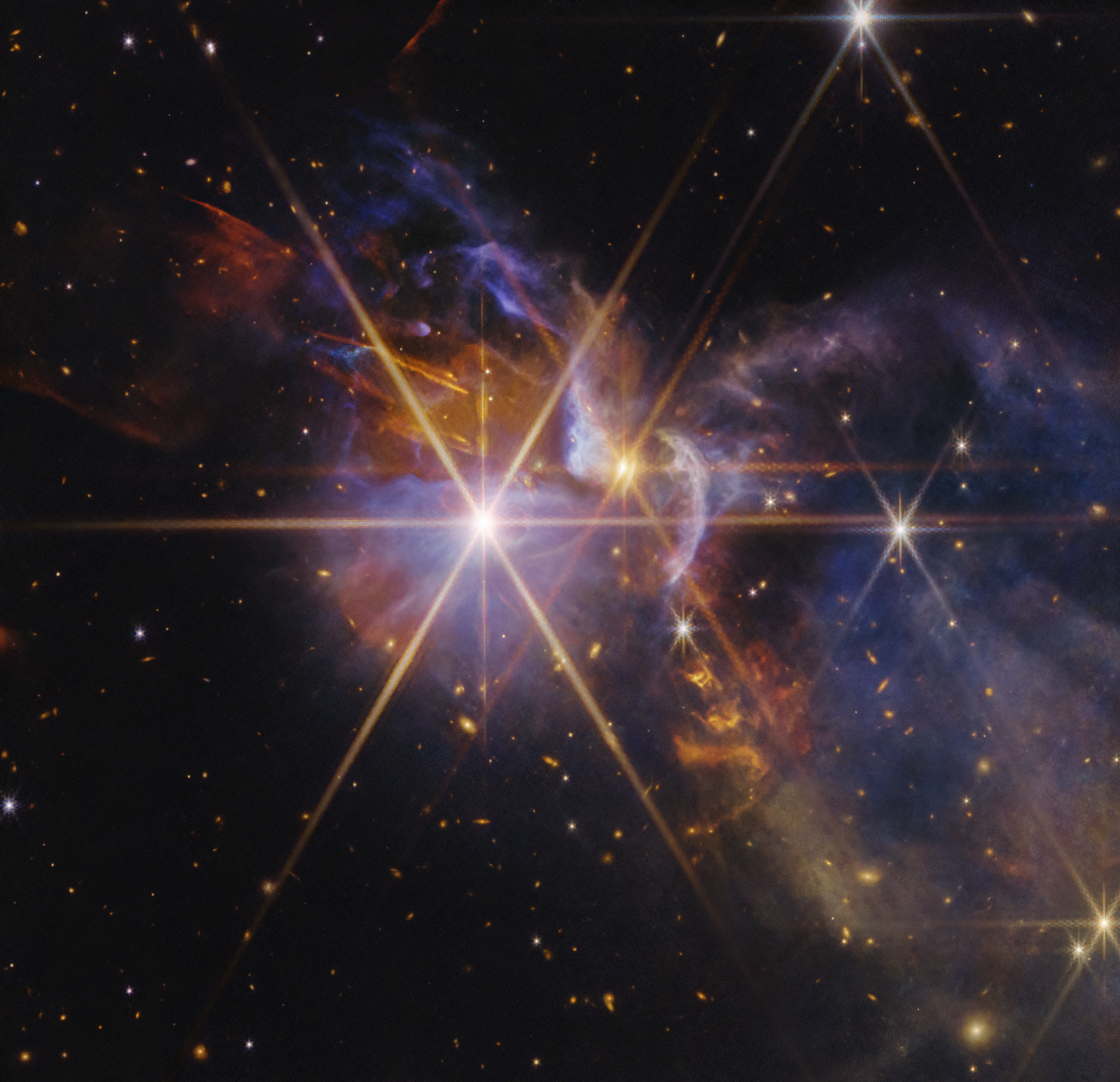
In infrared light, NASA’s James Webb Space Telescope reveals bright protostars in the FS Tau star system and a tapestry of background galaxies. FS Tau B, the orange protostar slightly to the right of center, is believed to be responsible for the orange flows in the middle of the dusty region.
Image: NASA, ESA, CSA, STScI; Image processing: Alyssa Pagan (STScI)
Although these objects are young and low mass, they can still impact their surroundings, in part due to the fluxes they emit. These outflows, seen as broad orange and red wisps and sheets, are theorized to come from FS Tau B, the protostar slightly to the right of center that has an orange diffraction pattern. As FS Tau B feeds on surrounding dust and gas to grow, it expels some of that matter outward. The broader outflows are thought to come from the interaction between the protostar’s magnetic field and the superheated matter closest to the protostar within its accretion disk. The disk looks like a dark band running through it at a 30 degree angle.
The gaps between the outflows, newly discovered in this Webb observation, add to growing evidence that protostars accumulate matter in discrete episodes. During periods when protostars accumulate material and increase mass, they also eject superheated matter in different directions. Between these episodes, they are relatively calm.
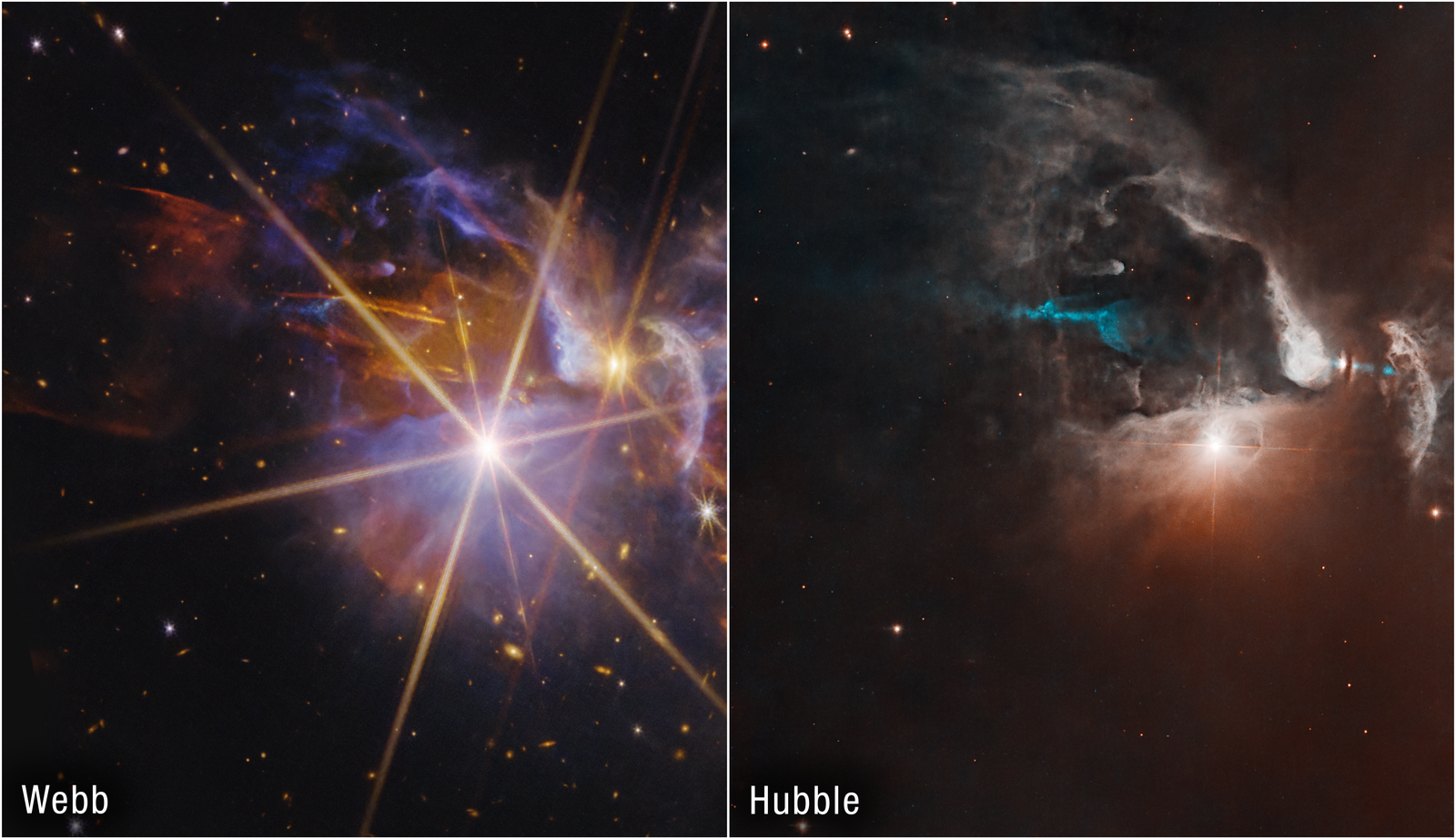
A comparison between observations of FS Tau made by NASA’s Hubble and James Webb space telescopes. Hubble’s visible light view shows the star-forming region largely obscured by thick dust. Webb sees through the dust, revealing how protostars are shaping their environment.
Image: NASA, ESA, CSA, STScI; Image processing: Alyssa Pagan (STScI)
As protostars expel these outflows, they shape their environment. This is best shown by the prominent light blue ridges of dust and gas near FS Tau B. These thicker regions were likely created when outflows collided and compressed matter. The glow of these light blue ridges shows that light from the nearby protostar is being reflected. Additionally, Webb’s sensitivity reveals the different textures of dust and gas across the region.
The range of colors seen in this observation also provides a wealth of information, specifically about where the dust is and how much it darkens the region. Light with bluer wavelengths is absorbed and scattered by dust, while light with redder wavelengths can filter out. Therefore, background galaxies behind thicker foreground dust appear redder. On the other hand, yellow galaxies have much less dust to obscure them. The few white stars visible in this image are probably in the foreground.
The James Webb Space Telescope is the world’s premier space science observatory. Webb is solving mysteries in our solar system, looking beyond it to distant worlds around other stars, and exploring the mysterious structures and origins of our universe and our place in it. Webb is an international program led by NASA with its partners, ESA (European Space Agency) and CSA (Canadian Space Agency).
For more information about Webb, visit:
https://science.nasa.gov/webb
The following sections contain links to download the images and videos in this article in all available resolutions, followed by links to related information, media contacts and, if available, links to research papers and translations into Spanish.
Keep following us for the latest insights.