
NATO on Tuesday revealed plans to quintuple the number of trained drone operators by the end of 2027, as part of efforts to prepare allies for the type of conflict unfolding in Ukraine. Mark Rutte, NATO Secretary General, announced the new “Drone Edge” initiative, which will include more than $40 billion in allied investments in
NATO on Tuesday revealed plans to quintuple the number of trained drone operators by the end of 2027, as part of efforts to prepare allies for the type of conflict unfolding in Ukraine.
Mark Rutte, NATO Secretary General, announced the new “Drone Edge” initiative, which will include more than $40 billion in allied investments in counter-drone capabilities over the next five years.
“Allies also commit to training five times more drone operators in their armed forces by the end of 2027,” Rutte said at the NATO Summit Defense Industry Forum in Ankara.
NATO will launch an anti-drone market so allies can buy new technology on a large scale and quickly. The project could resemble a Ukrainian digital platform that allows soldiers and units to purchase weapons, from drones to electronic warfare systems.
NATO said its Flight Training Europe program, which “facilitates the training of all aircrew” for 20 allies at centers across Europe, will be expanded to cover training of drone operators.
“Drones have fundamentally altered, as we all know, the character of modern warfare,” Rutte said, pointing to recent conflicts. “They have become a decisive factor on the battlefield. This is clear from what we see in Ukraine, in the Middle East and throughout the alliance.”
“The allies themselves have seen repeated drone incursions,” Rutte added. “In response, NATO is rapidly expanding our ability to deploy and operate drones at scale.” He said NATO is also focused on building strong defenses against drones.

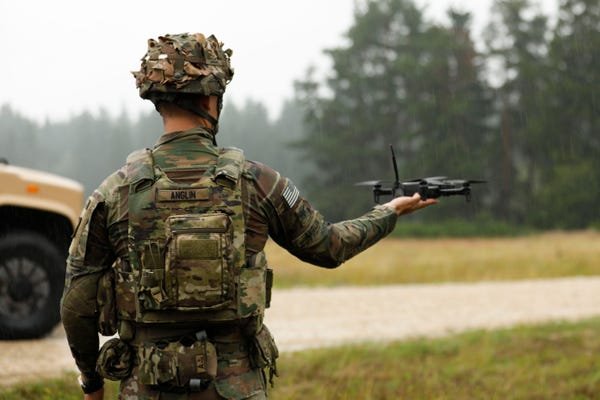
NATO’s new Drone Edge initiative will also include more than $40 billion invested in anti-drone capabilities. US Army Photo
The battlefield in Ukraine has featured a wide range of drones, from fixed-wing reconnaissance and attack aircraft to smaller quadcopters and interceptors with first-person view for air defense.
The training schedule really depends on the drone. Ukrainian operators previously told Business Insider that learning to fly an FPV drone, for example, can take up to a month. Once a pilot has that foundation, they said, learning to operate an interceptor can take only a few days. The British forces, remembering the lessons of the Ukrainians, shared that it takes at least 60 hours of hard work.
Business Insider recently visited the Killhouse Academy in Ukraine, where thousands of soldiers and civilians have been learning the basics of FPV piloting in short courses. The show highlights how drones have infiltrated entire society.
Ukrainian President Volodymyr Zelenskyy, speaking at the Defense Industry Forum in Ankara, said his country has “the largest and most advanced drone warfare capability in the world.”
Although NATO does not face the same wartime pressures as kyiv, Ukrainian officials and conflict experts have said the West must better prepare for a modern battlefield, and do so urgently.
NATO militaries are increasingly adding offensive and defensive drones to their arsenals, and the operator training program announced Tuesday could help allies prepare for future conflicts determined by these systems.
“We are building a drone-ready alliance,” Rutte said, “leveraging the latest innovative technologies, investing in our transatlantic defense industries and learning real-world lessons from the battlefield in Ukraine.”