
728 x 90

Wall Street Tells Us How It Really Feels About SpaceX As It Hits Nasdaq

Wall Street Tells Us How It Really Feels About SpaceX As It Hits Nasdaq

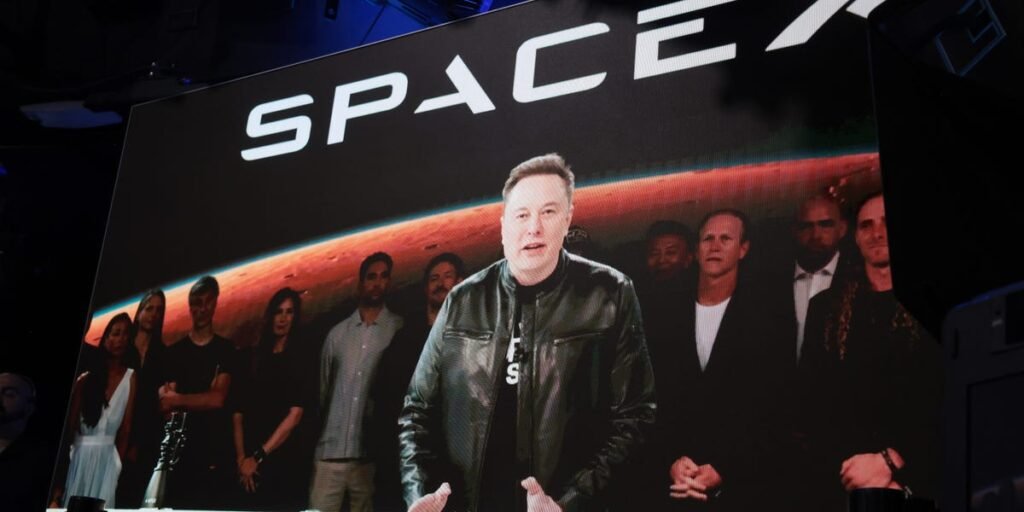
SpaceX has taken off and now Wall Street believes the stars are the limit. Elon Musk’s rocket company made its debut on the Nasdaq 100 index on Tuesday, weeks after raising $85.7 billion in the largest initial public offering in history. Joining the Nasdaq opens SpaceX to a wave of passive buying, in which investors

SpaceX has taken off and now Wall Street believes the stars are the limit.

Elon Musk’s rocket company made its debut on the Nasdaq 100 index on Tuesday, weeks after raising $85.7 billion in the largest initial public offering in history.

Joining the Nasdaq opens SpaceX to a wave of passive buying, in which investors who hold funds that track the index automatically gain exposure to SpaceX.

A post-IPO stock rally lifted SpaceX’s valuation to $2.9 trillion, but the stock price has retreated in recent weeks. SpaceX’s market capitalization fell below $2 trillion shortly after markets opened on Tuesday.

Wall Street also gave its verdict on Elon Musk’s sci-fi ambitions for the company on Tuesday.

Wall Street majors like Morgan Stanley, Goldman Sachs and UBS have been unable to make analyst calls on SpaceX stock during the so-called “quiet period” for banks that backed the IPO.

That quiet period has now expired and some banks have broken their hedge with bullish forecasts and sky-high price targets. This is what analysts say.

Morgan Stanley

In a note released Tuesday, Morgan Stanley analysts led by Adam Jonas — a Tesla bull known for his sometimes fantastical interpretations of Musk’s business deals — initiated coverage of SpaceX with an “overweight” rating with a $300 price target. SpaceX opened at $159 on Tuesday, falling as low as $150 in morning trading.

Analysts at Morgan Stanley predicted that SpaceX’s revenue would reach $319 billion by 2030 and $3.3 trillion by 2040. However, they predicted that the company would not be cash flow positive until 2035, and capital spending is expected to reach $300 billion a year by 2031.

“With an ‘X of 1’ position in space infrastructure, we believe SpaceX can convert energy into intelligence at scale with the option to monetize through a range of enterprise and consumer solutions for the next era of AI… the final frontier,” the note reads.

RBC Capital Markets

In a note published Tuesday, analysts at RBC Capital Markets initiated coverage of the company with an “outperform” rating and a $225 price target.

“We can appreciate the timing risk associated with the company’s space aspirations, but believe sentiment will benefit from a proven track record of disruption and innovation,” RBC analysts wrote.

They predicted that by 2029, SpaceX would post earnings before interest, taxes and amortization of $3 billion from space-related activities, $42 billion from Starlink and $147 billion from its artificial intelligence business. SpaceX posted a net loss of $4.9 billion in 2025.

USB

Analysts at Swiss investment bank UBS gave SpaceX a buy rating and a $210 price target.

In their note, they predicted that SpaceX’s Starship rocket would unlock a total addressable market valued at $30 trillion, adding that the company was also prepared to exploit future opportunities taken straight from science fiction, including the use of Optimus robots for manufacturing on the moon.

“Although not in our base case, SpaceX is uniquely positioned to exploit off-planet business models as they emerge, providing investors with a buying option as Elon Musk seeks to fulfill his vision of making life multiplanetary,” the UBS analysts wrote.

BTG Pactual

Latin America’s largest investment bank also initiated coverage of SpaceX on Tuesday with a buy rating and a $225 price target.

The bank’s analysts wrote that SpaceX had the “widest moat in the universe” with a total addressable market that is “literally all of space.”

They predict SpaceX’s revenue will reach $1 trillion in 2031, slightly behind Musk’s own prediction, and the billionaire said last month that SpaceX could reach that level by 2030.

Stifel

Investment bank Stifel was more restrained than some of its rivals, setting a price target of $190 when it initiated coverage of SpaceX in a note on Tuesday.

Stifel analysts said Starlink and AI would be SpaceX’s main growth drivers, but added that the company could face headwinds if Starship scales slowly. He warned investors that when it comes to Musk, it’s better to expect the unexpected.

“Love him or hate him, Elon Musk is SpaceX’s north star; as long as he is at the helm with a majority stake, he will continue the mission to Mars and occasionally surprise the market with abrupt changes in tactics and direction,” they wrote.