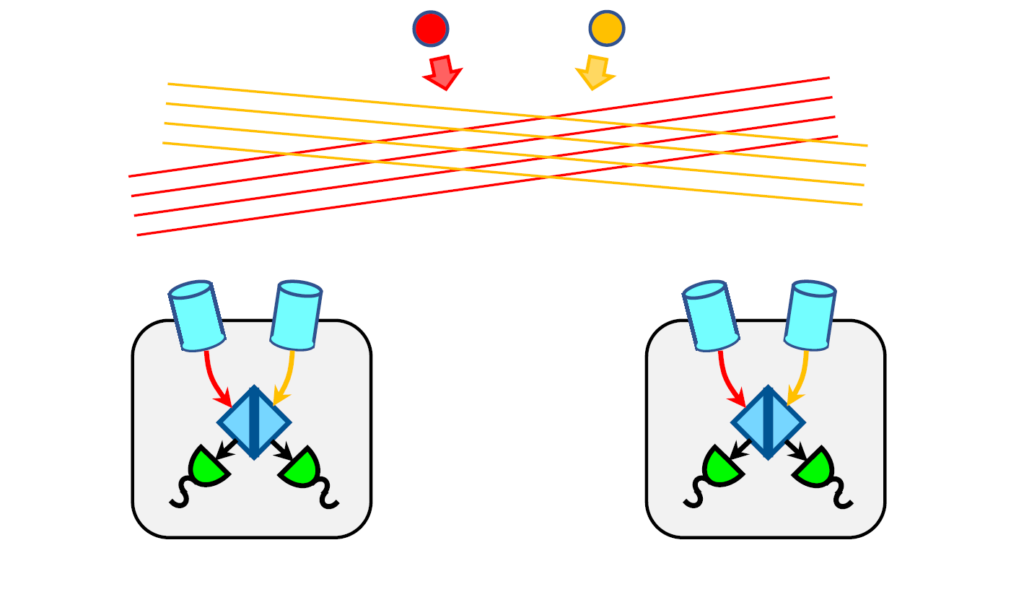
Pablo StankusBrookhaven Scientific Associates The scientific objective is to enable a new method to observe gravitational waves at low frequencies, based on the GW astrometric signature: gravitational waves passing through the Earth will cause a (very small) coordinated apparent movement of all celestial objects. Our innovation is to implement a new approach for precision astrometry
Pablo Stankus
Brookhaven Scientific Associates
The scientific objective is to enable a new method to observe gravitational waves at low frequencies, based on the GW astrometric signature: gravitational waves passing through the Earth will cause a (very small) coordinated apparent movement of all celestial objects. Our innovation is to implement a new approach for precision astrometry using two-photon quantum mechanical interference, which was recently published. This approach has the great advantage that two separate interferometric spacecraft stations can operate independently, that is, without an optical connection between them, which greatly simplifies spacecraft requirements compared to standard space interferometric designs. With this capability, we propose to be able to detect transient gravitational waves at low frequencies, in the micro-Hz to nano-Hz range, with sensitivity at an astronomically interesting level (note that there are currently essentially no alternative approaches for GW detection in this band). We show how this could be achieved with a simple mission using two modestly sized spacecraft in free fall orbits; and the detection of such GWs would be of great interest to galaxy formation and SM black hole physics, as well as exciting the public imagination.
National Teams 2026
For more tech updates, stay tuned to our blog.