David BlacksmithDuke University The growing population of space vehicles and satellites motivates increasingly powerful technologies for space situational awareness (SSA). While the US Space Surveillance Network (SSN) can monitor objects up to approximately four inches in size using, for example, the latest space fence upgrade, associated requirements limit implementation to ground-based tracking of objects in
David Blacksmith
Duke University
The growing population of space vehicles and satellites motivates increasingly powerful technologies for space situational awareness (SSA). While the US Space Surveillance Network (SSN) can monitor objects up to approximately four inches in size using, for example, the latest space fence upgrade, associated requirements limit implementation to ground-based tracking of objects in low Earth orbit (LEO) using kilometer-scale radar arrays. Beyond LEO, the prospect of cislunar traffic and the extreme distances involved make ground-based systems impractical. This limitation is critical for coherent radar systems: for a given detection performance, the required array size grows in direct proportion to the distance from the target. As a result, it may actually be easier to decrease the detection distance rather than expand the array size, and this can only be achieved by switching to a space-based SSA platform.
Although space-deployed radar systems offer clear advantages in terms of detection capabilities, the large distances associated with cislunar surveillance still require extremely large apertures for adequate performance. This poses significant practical challenges based on the limitations of modern deployable structures which, to date, cannot consistently achieve dimensions greater than 100 metres. This limitation arises because next-generation deployable antennas, including membrane, mesh, and inflatable architectures, require the entire structure to be housed within a single launch fairing. In contrast, the prospect of in-space assembly suggests the potential for scalable structures that are not constrained by launch limitations and can therefore meet the challenging requirements of long-range SSAs.
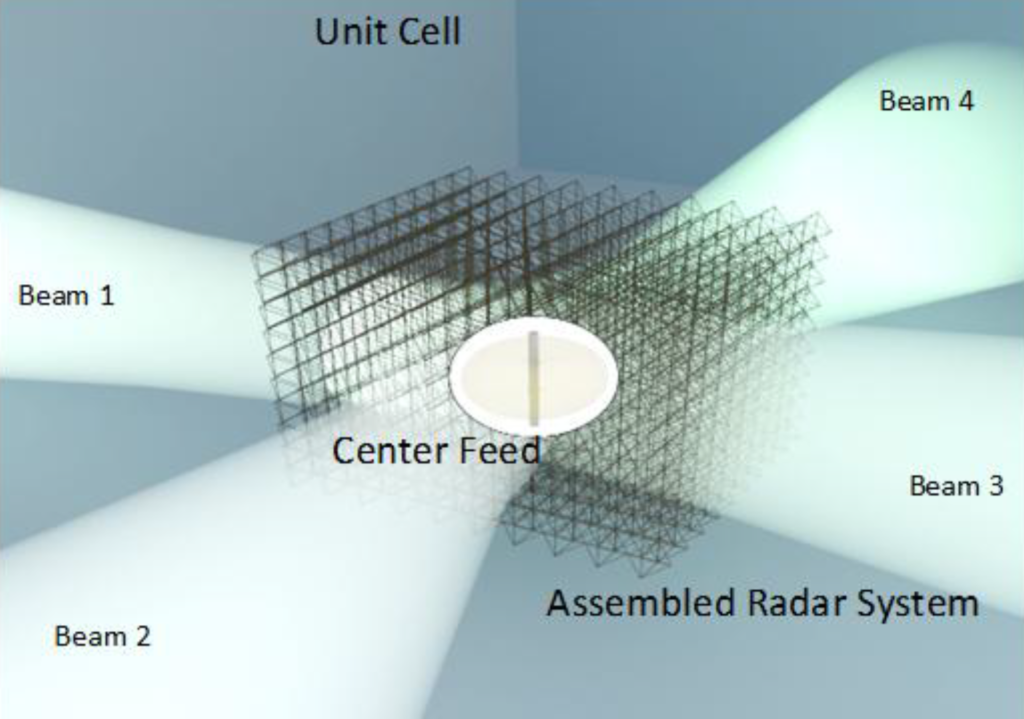
We propose a space-based radar system that combines the demonstrated performance of robotically assembled mechanically stable structures with reconfigurable volumetric electromagnetic metamaterials. The former technology enables precise, modular construction of arbitrary volumetric structures, while the latter offers a sophisticated and easily supported design platform to achieve challenging long-range SSA requirements. Both approaches exploit a unit cell-driven modular design procedure that allows near-arbitrary scaling for mechanically and electromagnetically robust antenna platforms. The ability to reliably assemble and control volumetric antenna structures in this way provides access to powerful new capabilities, including steering over wide fields of view (FOV) without the need for slow mechanical turning of the antenna.
The proposed work will demonstrate the feasibility and scalability of a volumetric and reconfigurable S-band metamaterial to achieve various beam steering capabilities. This effort will include the advancement of metamaterial design strategies for omnidirectional electromagnetic beamforming and the initial evaluation/design of a reconfigurable unit cell compatible with robotic assembly. The development of the metamaterial design procedure will leverage a numerically efficient dipole model that has been previously validated at smaller scales, while the design of the metamaterial element will be performed using established full-wave numerical methods. System design concepts will incorporate practical constraints based on successful robot assembly demonstrations conducted by the Automated Reconfigurable Mission Adaptive Digital Assembly Systems (ARMADAS) project.
While the project will focus on SSA applications, the design considerations involved are equally applicable to missions requiring large physical apertures, such as low-frequency radiometry for Earth observation and deep space communications. Since the performance (resolution, sensitivity) of all observation, radar, and beam steering missions improves with larger aperture sizes, realizing alternative electromagnetic strategies that offer reduced CSWaP may provide advantages across a wide range of NASA programs.
National Teams 2026
For more tech updates, stay tuned to our blog.