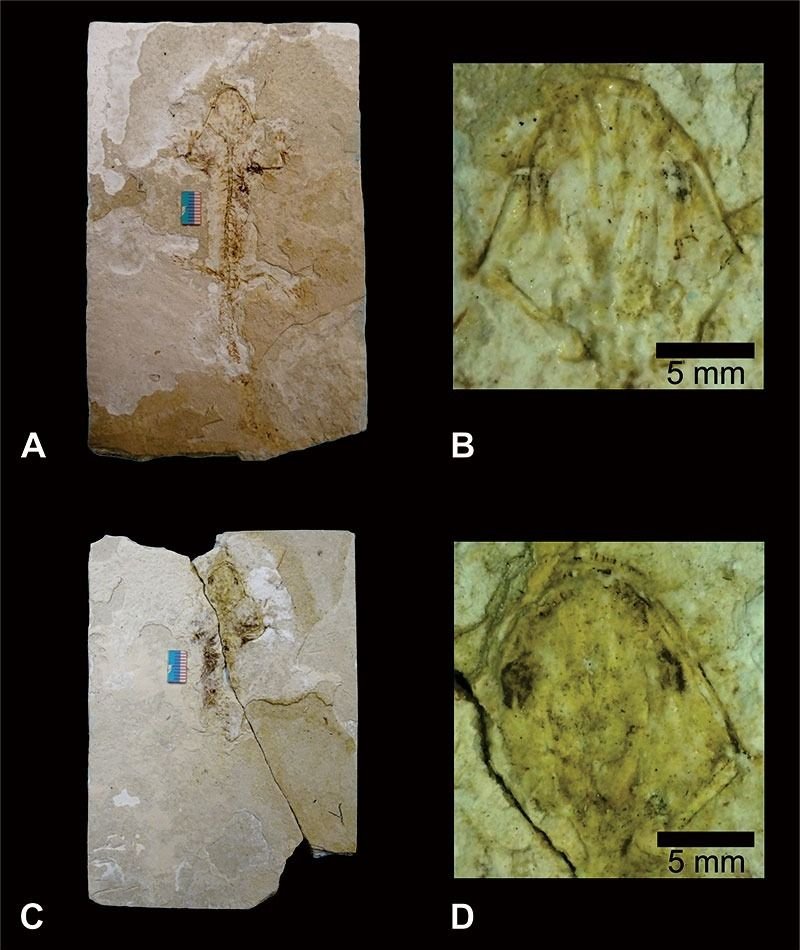
Researchers of the The School of Advanced Studies of Zaragoza (FES Zaragoza) of the National Autonomous University of Mexico (UNAM) has identified a new fossil species of axolotl in the state of Hidalgo. Named Ambystoma quetzalcoatliIt is the first fossil salamander species formally described in Mexico and the oldest known record of the genus. Ambystoma
Researchers of the The School of Advanced Studies of Zaragoza (FES Zaragoza) of the National Autonomous University of Mexico (UNAM) has identified a new fossil species of axolotl in the state of Hidalgo.
Named Ambystoma quetzalcoatliIt is the first fossil salamander species formally described in Mexico and the oldest known record of the genus. Ambystoma never documented in the country. According to the researchers, the discovery provides an important new piece of the puzzle to understand the origin and evolution of the biodiversity that characterizes modern Mexican fauna.
The fossils were discovered in the municipality of Atotonilco el Grande, in Hidalgo, a region that once housed an extensive system of freshwater lakes covering approximately 85 square kilometers. The lakes were probably formed when the course of the Amajac River was temporarily blocked. This temperate, subhumid environment has produced fossils of numerous plants, diatoms, gastropods, ostracods, beetles and fish. Until now, however, amphibian remains recovered from the site had never been formally studied or described.
The researchers examined a dozen fossil salamander specimens collected in the early 2000s by the FES Zaragoza Paleobotany Research Group. Many of the fossils were exceptionally well preserved, with complete, articulated skeletons that allowed detailed anatomical analysis and accurate assessment of their morphology.
The remains were initially identified as belonging to a species of the genus Ambystomathe group that includes modern axolotls. However, a team led by researchers Jorge Herrera Flores and María Patricia Velasco de León reviewed the material using modern techniques, including computed tomography (CT) and detailed anatomical comparisons with living species, to determine its identity more precisely.
Their analysis revealed that the fossils collected almost three decades ago belonged to an entirely new species, distinguished from modern axolotls by several significant anatomical differences.
According to the study, published in Palaeontologia Electronica, the fossils present distinctive characteristics of the skull and skeleton that are absent in living species. Among the most notable are an elongated opening at the top of the skull, a differently structured palate, variations in the arrangement of various skull bones, and the presence of 17 trunk vertebrae. This last feature is particularly significant, since modern axolotls have 16 or fewer trunk vertebrae.
To establish the identity of the fossils, the researchers compared them with 13 living beings. Ambystoma species, including several endemic to Mexico, such as the Xochimilco axolotl (Mexican Ambystoma), as well as tiger salamanders from Mexico and the United States. They were based on three-dimensional images and CT scans available in international scientific collections.

For more tech updates, stay tuned to our blog.