
A custom superyacht is among the most expensive assets anyone can own: it costs hundreds of millions of dollars and takes years to build. Therefore, when it comes to design, every square meter counts. For Bart Bouwhuis and Marnix Hoekstra, that often has less to do with the sleek profile or distinctive silhouettes that can
A custom superyacht is among the most expensive assets anyone can own: it costs hundreds of millions of dollars and takes years to build. Therefore, when it comes to design, every square meter counts.
For Bart Bouwhuis and Marnix Hoekstra, that often has less to do with the sleek profile or distinctive silhouettes that can be seen from a marina, and more to do with everyday practicalities.
The couple are co-creative directors of Vripack, a naval architecture and interiors firm that has designed superyachts for billionaires and members of the Saudi royal family.
“Ultimately, the object must meet the requirements of day, evening and night,” Bouwhuis told Business Insider. “It’s a puzzle.”
Solving that puzzle means understanding how a particular client spends their day on the water.
“The exterior could be considered more or less a dress: you can dress any design with a modern dress or a classic dress,” Bouwhuis said.
Should the yacht prioritize an open-air cinema or an extensive beach club? How much space should be dedicated to crew without compromising guest areas?
Other decisions, from stabilizers that reduce motion sickness to insulation that dampens engine noise, are less visible, though equally important to the customer’s onboard experience.
While no two superyachts designed by Bouwhuis and Hoekstra are the same, they have noticed changing priorities (or new ways of approaching old ones) in recent years.
no days off
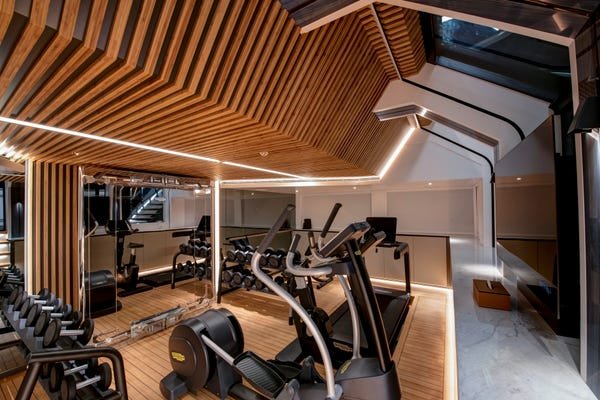
Health and fitness have become vital for the longevity-obsessed super-rich, including Vripack’s clients.
While they used to be fine with a hotel-style gym (no windows, some free weights), “those days are gone,” Hoekstra told Business Insider.

The gym on Al Waab, a 55-metre superyacht, was purpose-built, unlike those of previous eras. Courtesy of Vripack
Clients have requested Bikram-style hot yoga studios, kickboxing areas and even a hyperbaric chamber for oxygen therapy, which anti-aging gurus swear by.
“There’s not much walking on a boat,” Hoekstra said. “A treadmill or a bike, both are very good pieces of equipment to keep your muscles working.”
Building a gym on a ship comes with challenges, whether it’s finding a room with a high enough ceiling to accommodate large machines or properly enclosing and controlling the space.
WFY: Work from a yacht
The pandemic popularized the phrase “WFH,” short for working from home. For the very rich, there is also WFY.
“Life is blurring between the private and the business and between being on board and off the ship,” Hoekstra said.
Greater flexibility in the workplace has led clients to see their yachts as more than just places to relax. Additionally, as superyacht owners become younger (and less likely to be the stereotypical retiree), they are more likely to work.

Vripack’s Milky Ways Project has two office spaces, for the owner and one for his spouse. Courtesy of Vripack
There has also been a change in what technology can support. Elon Musk’s satellite internet company Starlink, for example, has made Zoom calls at sea more common.
Comfort at sea
“Since the beginning of humanity, we want to be in the sea and we don’t want to move,” Hoekstra said. “It’s a bit paradoxical.”
Superyachts have long had stabilizers to prevent seasickness, and that technology has improved in recent years.
In terms of design, computers have become more capable of modeling the movement of various points on the ship. For Bouwhuis and Hoekstra, that means designing for specific sea states: a yacht that will only sail in the Mediterranean, for example, requires specific stabilizing systems. Designers also have to think about where to place the master cabin and bed to minimize seasickness.
Consider the lobster’s habitat.
One of Vripack’s most famous works is Project Zero, an all-electric superyacht powered entirely by renewable energy that will be launched later this year.
While that yacht has a unique purpose, other clients have been interested in adopting some of its advancements.

Project Zero, launching later this year, will be the first all-electric superyacht. Courtesy of Vripack
Hoekstra said the project changed customers’ mindsets from avoiding anything related to environmentalism to looking for “the low-hanging fruit,” such as avoiding excessive motors.
“Can I get a bigger motor?” That’s so ’80s,” Hoekstra said. “Why would you choose a heavy four-by-four Jeep to drive to a meeting in Manhattan?”
They have been more intentional about outfitting yachts with better insulation and heat-reflective paint to reduce the need for energy-absorbing air conditioning. Actual air conditioning systems have been made more energy efficient, for example by turning them off when someone leaves the room.
Teak, once a popular decking material, has been phased out due to the deforestation it causes.
With alternatives available, “it really doesn’t make sense not to do it,” Hoekstra said.