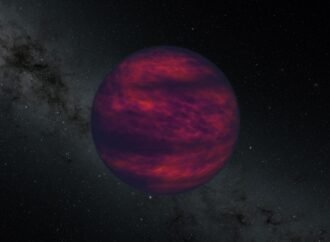
NASA’s SPHEREx (Spectro-Photometer for the History of the Universe, Epoch of Reionization, and Ices Explorer) space telescope is shedding light on brown dwarfs, celestial objects that blur the line between stars and exoplanets. New findings published in The Astrophysical Journal show that these dark and cloudy worlds have chemically rich atmospheres not unlike the giant
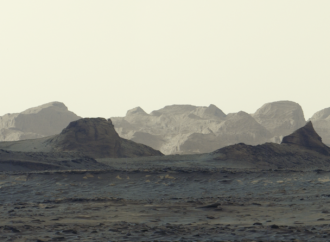
A newly released panorama captured by NASA’s Curiosity rover offers the most detailed view yet of distant, wind-carved Martian cliffs, highlighting features the mission’s scientists have long been waiting to see up close. The scene was snapped at 8:30 a.m. local Mars time, showing striking blue hues in the foreground as bright morning light illuminates
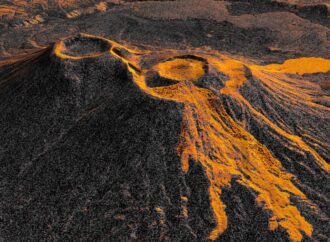
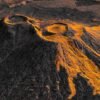
In this animation, frames of NISAR data from December 2025 to August 2026 show the spread of lava from the northern crater of Krasheninnikov, a volcano pair on Russia’s Kamchatka Peninsula. In the image, the lava field appears brighter in the foreground than the surrounding surfaces. Credit: NASA’s Scientific Visualization Studio Like tendrils on a vine,
NASA announced Wednesday a mission to explore the history and evolution of the universe, PRIMA (PRobe far-Infrared Mission for Astrophysics), is advancing to the next phase of development. This space telescope is the first in a new class of NASA astrophysics missions, called Probe Explorers, within the agency’s longstanding Explorers Program. “The PRIMA mission is
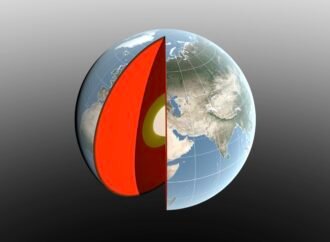
Seasonal changes redistribute enough water around Earth to shift the planet’s center of mass back and forth by fractions of an inch relative to its geometric center. NASA scientists are on the case, tracking the oscillations because Earth’s center of mass is a crucial reference point for satellite navigation and elevation measurements. A team, led
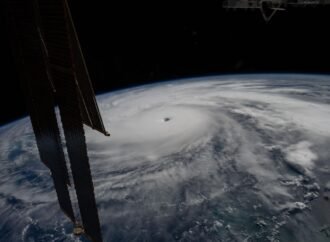
Last November, NASA and its European partners launched the Sentinel-6B satellite to improve hurricane forecasts, help protect infrastructure, and benefit commercial industries, including shipping. The satellite now is flying 30 seconds behind its predecessor, Sentinel-6 Michael Freilich. Both satellites are providing precise sea level height measurements during what oceanographers expect to be a historic El