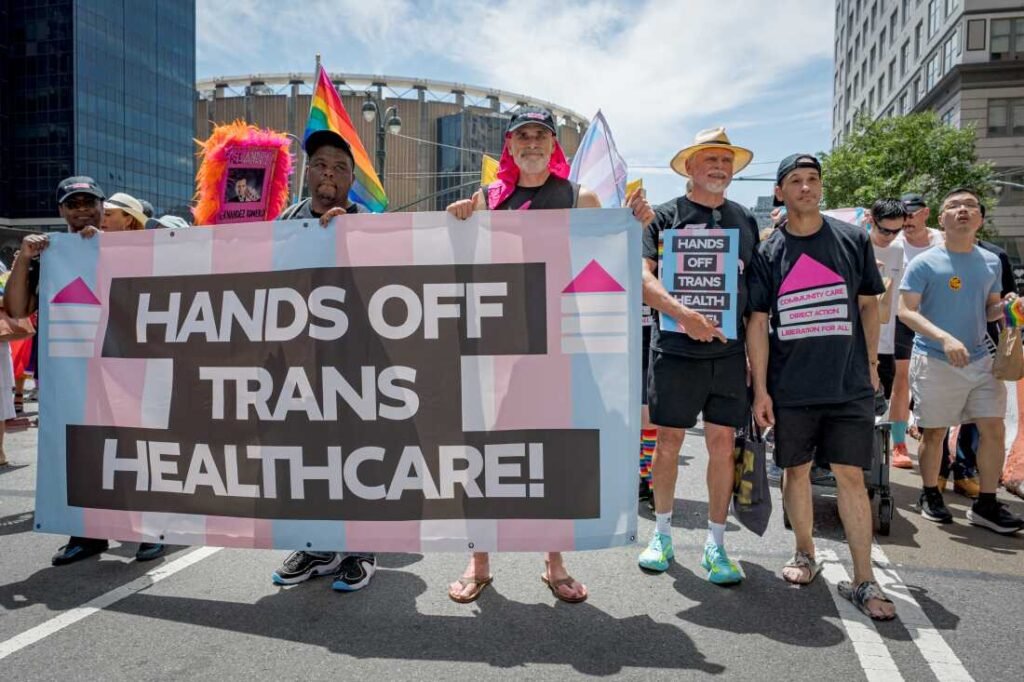
Protesters demonstrate for transgender healthcare at a June 2025 march in Manhattan. NPR has learned that the Trump administration shelved a plan to cut off all Medicare and Medicaid funding to any hospital that provided gender-affirming care to minors. Erik McGregor/LightRocket via Getty Images hide title toggle title Erik McGregor/LightRocket via Getty Images For new
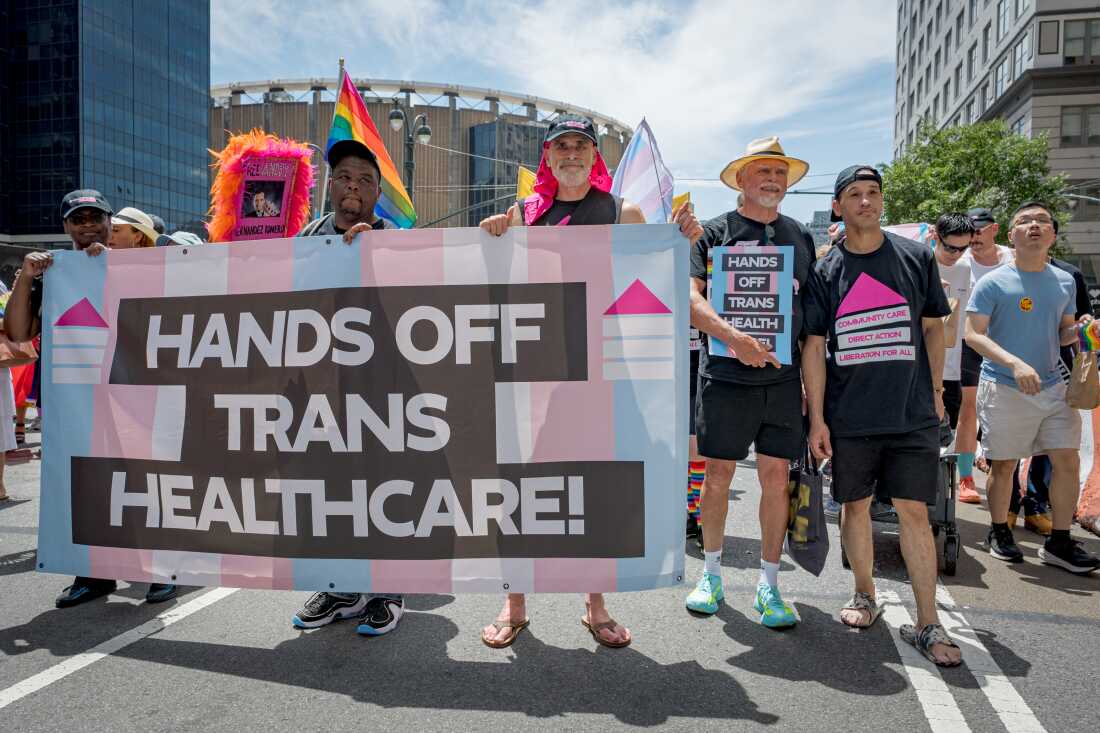
Protesters demonstrate for transgender healthcare at a June 2025 march in Manhattan. NPR has learned that the Trump administration shelved a plan to cut off all Medicare and Medicaid funding to any hospital that provided gender-affirming care to minors.
Erik McGregor/LightRocket via Getty Images
hide title
toggle title
Erik McGregor/LightRocket via Getty Images
For new discoveries, everyday mysteries and the science behind the headlines, follow NPR’s Short Wave podcast .
The Trump administration is abandoning its most aggressive attempt to end gender-affirming care for youth nationwide, according to an official document obtained by NPR.
The document shows that the Department of Health and Human Services will not finalize a proposed rule that would have blocked all Medicaid and Medicare funding for hospitals that provide gender-affirming pediatric care. The Centers for Medicare and Medicaid Services and the Department of Health and Human Services did not immediately respond to a request for comment.

Not a “retreat” from anti-trans efforts
The fact that the Trump administration is backing away from this action is “a victory for people who defend the rights and interests of trans people,” says Sam Bagenstos, a Michigan law professor who served as HHS general counsel during the Biden administration. “But I don’t think it signals a more general retreat from the Trump administration’s aggressive stance.”
Bagenstos notes that this type of leverage — a “conditions of participation” rule for the Medicare and Medicaid programs — has historically been used by HHS to force states and hospitals to meet basic health and safety standards. Things like “making sure you have stockpiles of certain types of equipment, making sure you have certain types of emergency protocols, making sure you have certain staffing ratios,” he explains.
The proposed rule was unprecedented, Bagenstos says, because it would have instead banned certain types of treatments for a certain population. He says it seemed illegal in several ways. For one, “it violates the Medicare Act, which says Medicare and Medicaid cannot be used to control the practice of medicine within the state; states can regulate the practice of medicine,” Bagenstos says.
Medical groups opposed the change.
Typically, HHS would propose a rule, accept public comments for 60 days, and then finalize the rule so it could go into effect. In this case, after proposing the rule in December and receiving more than 30,000 comments, the administration is abandoning the rule. At least for the next year, it will not be finalized and will not come into force.
The American Medical Association and the Children’s Hospital Association submitted comments urging the agency to rescind or withdraw the proposed rule. Major U.S. medical groups say puberty blockers and sex hormones are safe and can be effective for transgender youth.
Still, gender-affirming care for young people is banned in 27 states after a series of laws passed in recent years. In the remaining 23 states, many hospital clinics offering gender-affirming care have continued to operate, while others closed last year citing pressure from the Trump administration.
That pressure has manifested itself in the form of this proposed rule, another rule that would prohibit federal Medicaid reimbursement for transgender pediatric patients, and a statement from Health Secretary Robert F. Kennedy Jr. aimed at redefining the standard of care. (Interestingly, the press release issued when those actions were revealed in December is now missing from the HHS website, as is Kennedy’s statement document.)
The Medicaid rule is currently in the final stages of review and appears to be on track to take effect in the coming weeks. A coalition of Democratic-led states sued over the so-called Kennedy declaration and managed to block it in federal court in Oregon. The Trump administration has not appealed that decision so far.

Protesters against gender-affirming care for youth gathered outside Boston Children’s Hospital in September 2022.
Carlin Stiehl for the Boston Globe/Getty Images
hide title
toggle title
Carlin Stiehl for the Boston Globe/Getty Images
At the same time, the Justice Department has issued administrative and criminal subpoenas to hospitals seeking complete personal medical records for transgender youth and employment records for their medical providers, although many of those efforts have been blocked in court so far. The Trump administration also reached agreements with hospitals in Texas and Ohio that involved establishing “detransition” clinics.
And last month, when the Supreme Court allowed states to ban transgender girls from playing sports, the White House issued a press release saying the decision “reinforces President Trump’s push to eliminate transgender madness.” The statement lists actions targeting transgender people across the federal government, from passport markers to military service and research funding.
Will the hospitals that ended care for trans young people restart it?
While the Trump administration does not appear to be backing down on its anti-transgender actions overall, its decision not to end its most aggressive health care rule is significant, says Katie Keith, director of the Health Policy and Legal Initiative at Georgetown University, who also worked in the Biden administration. Those other efforts are not as durable as a finalized rule that goes into effect, he notes.

The Trump administration’s decision not to finalize this rule “should give hospitals more confidence to resume or continue offering care,” he says. Because the rule was never in effect, “I would say they should have been doing this all along anyway.”
Kellan Baker agrees. He is a senior health policy advisor at the Movement Advancement Project think tank, which focuses on LGBTQ issues. “This administration may have stopped at one of the most extreme expressions of its agenda and I think people should take solace in that,” he says. “But at the same time, this administration continues to demonstrate that its ultimate goal is to eliminate health care for trans people and that it is apparently prepared to use almost any means necessary to achieve this.”
In theory, the Medicare and Medicaid rule could be revived at some point, since it has not been formally withdrawn. An entry in the Trump administration’s recent unified agenda sets a final action date for the proposed rule in December 2028, just before President Trump leaves office.
{For more tech updates, stay tuned to our blog.|Keep following us for the latest insights.|Check back often for more exciting news!}