HOPKINTON, R.I. — At Ashawaug Farm in southwestern Rhode Island, Dawn and Cassius Spears preserve their indigenous knowledge of agriculture by growing and maintaining three traditional Narragansett crops: white corn, succotash beans, and crookneck squash. They would like to expand the reach of their farm beyond their stand, but it is a challenge. Like many
HOPKINTON, R.I. — At Ashawaug Farm in southwestern Rhode Island, Dawn and Cassius Spears preserve their indigenous knowledge of agriculture by growing and maintaining three traditional Narragansett crops: white corn, succotash beans, and crookneck squash.
They would like to expand the reach of their farm beyond their stand, but it is a challenge. Like many small food producers, the Spears have sought financial assistance through federal programs. Some have been cut or significantly reduced under the Trump administration, including U.S. Department of Agriculture programs that helped tribal farmers.
Tribes relied on these programs to locally grow and distribute culturally significant foods.
“When we go into these federal programs, we hope they last long enough,” Cassius Spears said. “Usually they start with a good song and dance. And they’re going to last a long time. And then something happens that cuts them off.”
The Biden administration started two programs during the pandemic to help states and tribes purchase local foods from nearby farmers for food banks and schools: the Local Food Purchasing Assistance Cooperative Agreement (LFPA) Program and the Local Foods for Schools (LFS) Cooperative Agreement Program. These programs offered farmers, including tribal farmers, reliable markets for their products. Tribal governments received assistance to purchase food from local producers for distribution to tribal members.
This allowed tribes to bring federal dollars directly to small producers, said Carly Griffith Hotvedt, executive director of the Indian Food and Agriculture Initiative and a member of the Cherokee Nation. The Spears farm provided food for a tribal farm in nearby Connecticut that used LFPA funds, after an agreement was signed in August 2022.
In some cases, tribes used those dollars to obtain foods of cultural significance to tribal members, such as bison meat, certain types of berries, and wild rice, which were included as part of the food box distribution. For some low-income tribal members, it was the best way to access this type of food, Hotvedt said.
“It wasn’t just staple foods in that box. Highly local, traditionally relevant, culturally relevant foods were included,” Hotvedt said.
In March 2025, under the Trump administration, the Department of Agriculture ended two programs that provided more than $1 billion for schools and food banks, saying they no longer aligned with the agency’s goals.
U.S. Sen. Jack Reed, D-Rhode Island, and Sen. Jim Justice, R-West Virginia, have introduced a bill they say takes the best of both programs and creates a permanent grant program. It would allow state and tribal governments to purchase local foods from local and regional producers for distribution to nearby schools and hunger relief programs.
Reed said he feared that when USDA programs were cut, families across the country would have a harder time accessing food. And, he said, access would not be to nutritious, freshly grown produce.
Reed said he hopes the legislation will pass as part of the Farm Bill, the massive, multi-year law that governs farm and food programs. The House passed its version of the bill in April and a Senate committee released its draft in late June. The House version also includes a bipartisan proposal for a permanent program modeled after the Local Food Assistance program. It would allow states, through the USDA, to establish cooperative agreements that connect local farmers and producers with local food distribution organizations.
Both proposals would reserve 10% of the program’s funding for tribes.
For a new program to be successful, Congress must include mandatory funding to help farmers plan, purchase supplies and hire staff better because they know they will sell products through those programs, said Hannah Quigley, policy specialist at the National Sustainable Agriculture Coalition. The House version would require Congress to agree to funding annually, he added.
Reed said he is advocating for mandatory funding in the Senate because without it very little is funded these days and because farms are under a lot of economic pressure. An opt-in program wouldn’t help them as much, he said.
“We really want to overcome existing obstacles for small farmers and Native American farmers,” he said.
Dawn and Cassius Spears would like to see indigenous producers prioritized when tribal entities purchase food. And they said they believe having specific programs that Indigenous producers can access outside of their tribal government would help more Indigenous producers.
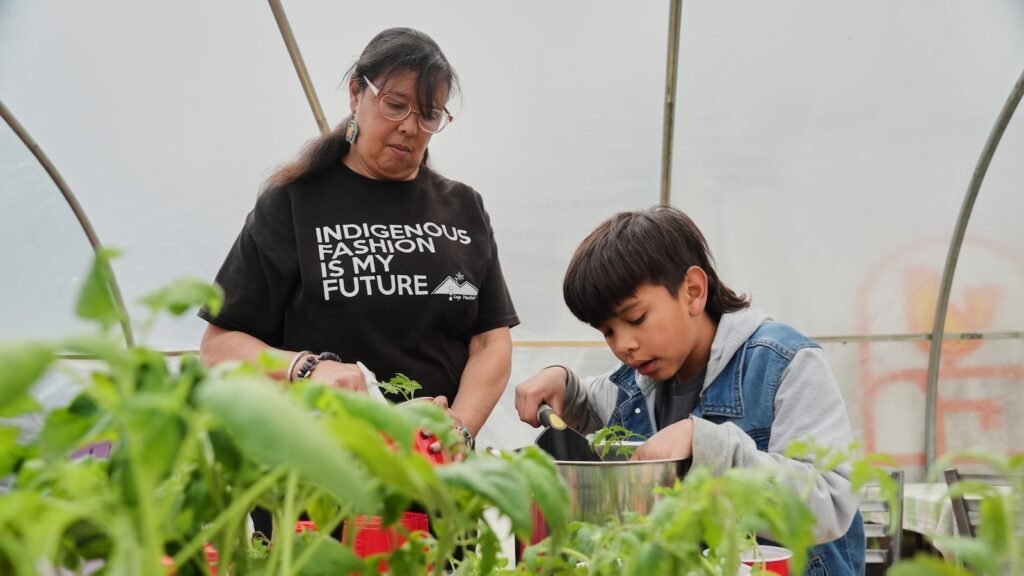
Under the canopy of one of her farm’s high tunnels at the start of this year’s planting season, Dawn Spears carefully organized her tomato crop, separating the small plants before moving them to an outside field. The name of the 6-acre farm is an homage to the Narragansett name of the river that runs through town. It started as a small community garden and food sovereignty project.
One of her grandchildren, Giizhig, 9, came in to ask if she needed help.
“Only if you want,” Spears responded. “It’s always good to know how to do it, right?”
Teaching the next generation about where food comes from and how to grow it responsibly is key for her. But their culture is not just about farming. It’s also about collecting wild foods that they eat and being able to preserve and access the land where those foods are found.
She is working to protect the land around her farm as development grows in hopes of introducing native plants to that area that can be used for food. Federal funding programs can also help ensure access to land, he said.
“If you take a person out of the land where they come from, then it’s like they’re not whole,” he said. “We have to eat the foods that come naturally from that space we come from.”
___
McDermott reported from Providence, Rhode Island.
___
Follow Joshua A. Bickel on Instagram, Bluesky and X @joshuabickel.
___
The Associated Press’ climate and environmental coverage receives financial support from multiple private foundations. AP is solely responsible for all content. Find AP’s standards for working with philanthropic organizations, a list of supporters and funded coverage areas at AP.org.
Keep following us for the latest insights.