Welcome to Eye on AI. Beatrice Nolan here. In today’s issue: But first, before we get to the news. Today is the inaugural Fortune AIQ Summit, where leaders are sharing lessons on how Fortune 500 companies are managing to implement AI successfully. You can read our coverage of the event here. And, you can read
Welcome to Eye on AI. Beatrice Nolan here. In today’s issue:
But first, before we get to the news. Today is the inaugural Fortune AIQ Summit, where leaders are sharing lessons on how Fortune 500 companies are managing to implement AI successfully. You can read our coverage of the event here. And, you can read the AIQ list of Fortune 500 companies that are pioneering AI here.
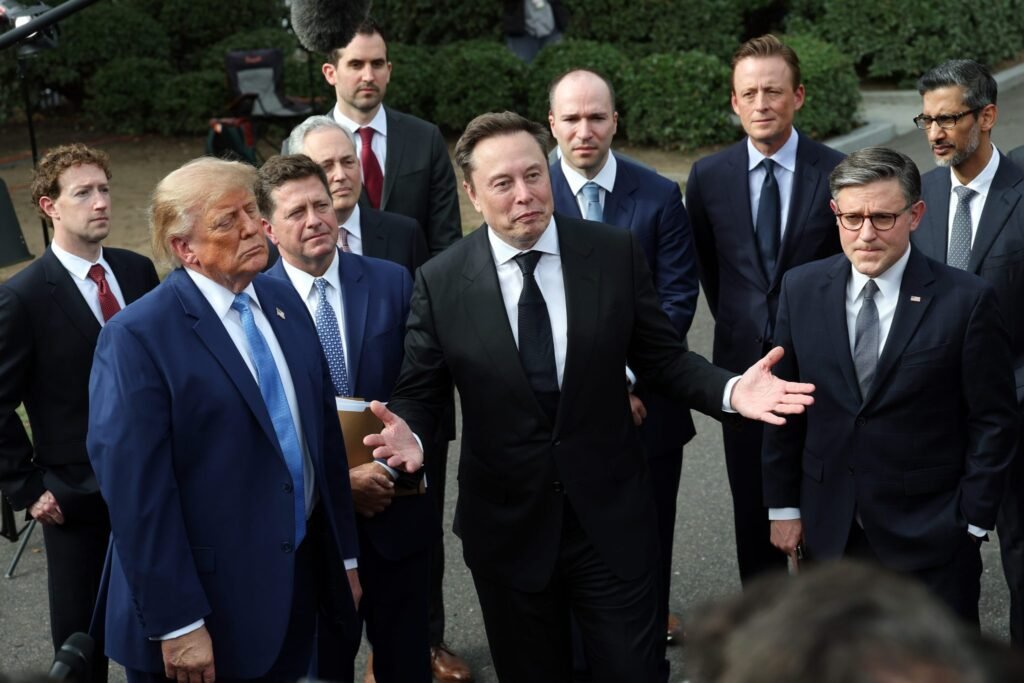
This week, some of the most powerful men in tech gathered at the White House for a luncheon in an unusual show of unity.
The reason for the meeting: President Donald Trump’s new voluntary accords on artificial intelligence.
The one-page document, which Trump posted to Truth Social and described as “morally binding,” was signed by Anthropic’s Dario Amodei, OpenAI’s Greg Brockman, Google’s Sundar Pichai, Meta’s Mark Zuckerberg, xAI’s Elon Musk, and Nvidia’s Jensen Huang. It’s part of a wider effort from the Trump administration to prove that the sector can police itself without the government stepping in with official regulation.
Some gossip that has since emerged from the lunch: Huang reportedly stopped to quiz Amodei about his recent dire warnings; Amodei responded that it was important to be honest. A conversation between Zuckerberg and House Speaker Mike Johnson at last week’s state dinner sparked the idea for Tuesday’s pact. And, Huang and Zuckerberg played key roles in circulating and gathering support for the pact.
It’s a familiar divide (and one I wrote about in more depth a few weeks ago) with Huang and Zuckerberg firmly staking out their anti-regulation stance and aligning themselves with Trump, while Amodei and OpenAI’s Sam Altman have urged an AI slowdown.
The most recent agreement is not regulation, but it does go slightly further than previous voluntary commitments.
Under the Joint Commitment on Frontier Responsibilities, the companies pledged to build “robust” internal controls to monitor their models across cybersecurity, biosecurity, and chemical threats, and to ensure systems “do not hack or access technical systems in unintended ways.” They also agreed to bring in independent external auditors, set up board-level oversight committees, and meet regularly to hammer out shared safety standards.
We have already seen a couple of these before. Amodei initially suggested that labs should bring in embedded external auditors to ensure the safety of models; his company has already committed to doing so, as has OpenAI. There was also reporting last month that OpenAI and Anthropic were trying to create shared safety standards, but that was later stalled.
Following Trump’s recent pact, news broke that Google, OpenAI, and Anthropic are pushing ahead with plans for a new industry-run AI safety standards body, according to The Information. The companies are reportedly aiming to launch it by the end of the year or early 2027.
It’s a bit of a difficult balancing act. The labs seem concerned about recent safety incidents, want to appear responsible, and want to put some guardrails in place before something goes badly wrong. But all of this can’t sound too much like regulation, both to avoid accusations of regulatory capture and to avoid contradicting the Trump administration.
Trump has firmly dug in against mounting pressure to regulate the technology, even after dozens of AI security incidents have emerged in recent months. Last week, he told the UN General Assembly he would oppose “any attempt to construct a globalist scheme to control” AI. He has also brushed off industry warnings—including from Amodei and Altman, who have urged developers to “pace the frontier”—arguing the U.S. cannot afford to slow down while China races ahead.
Still, “no regulation” doesn’t mean no consequences. A day after the White House lunch, the FTC disclosed a broad safety probe into OpenAI and Anthropic.
While the administration may oppose new AI rules, it has said existing laws still apply. The FTC already has the power to go after companies whose products harm consumers or mislead people about safety, and the probe is looking closely at AI agents after a run of incidents that included the Hugging Face hack. FTC Chair Andrew Ferguson is said to be preparing demands that could force executives to hand over documents and testify about their models.
As Vice President JD Vance put it: “They have to build products that are safe and good for American consumers. The government actually has preexisting laws on the books where if you build something that gets unleashed on the internet, that is used as a tool for cyberwarfare, then you have responsibility for the products you develop.”
With that, here’s more AI news.
Beatrice Nolan
beatrice.nolan@fortune.com
@beafreyanolan
Before we get to the rest: On Oct. 6, from 11–12:00 p.m. ET, Fortune AI editor Jeremy Kahn will convene with AI and technology leaders from AXA, Mistral AI, Mastercard, and Accenture during the virtual Fortune Brainstorm AI session, The Agentic Era: Are Enterprises Keeping Up? We’ll look past the demos to discuss the operational realities of data, security, governance, human oversight, and ROI. Join us for the conversation.
FORTUNE ON AI
AI ‘godfather’ Yann LeCun has ‘zero concerns’ about human extinction, says Anthropic CEO Dario Amodei is ‘deluded’ — By Emily Forlini
Palo Alto Networks’ Nikesh Arora is building a defense against the dark side of AI — By Allie Garfinkle
The unicorn CEO betting her industry’s AI crisis isn’t the one you think — By Nick Lichtenberg
AI IN THE NEWS
Florida asks a court to bar OpenAI from building new models without outside oversight. Florida Attorney General James Uthmeier asked a judge on Monday to stop OpenAI from developing new AI models without outside oversight. The motion is part of the state’s lawsuit over harm to children. Florida also wants OpenAI ordered to keep minors off ChatGPT and to stop giving the chatbot “human attributes.” The state sued in June, alleging OpenAI misrepresented ChatGPT’s safety. The suit claims the chatbot gave information to school shooters, offered self-harm guidance, and fostered addictive use among young people. OpenAI spokesperson Drew Pusateri said governments “have an important role to play in setting robust safety standards for AI” and that the company is committed to working with Florida. Read more from Reuters here.
Google launches Gemini 4 Argon, but some of its own employees aren’t convinced. Google released Gemini 4 Argon on Wednesday, hailing it as its most powerful model yet. For now, access is limited to selected cybersecurity partners through Google’s Fairwind Program and to Google’s own staff. Argon puts Google back in the AI race, with company benchmarks showing particular strength in long-context, coding, and enterprise-agent tasks. Areas where Google had previously been struggling. However, Bloomberg reports that some employees who have used Argon say it does well on benchmarks but disappoints in real-world use. They say it struggles with some coding tasks, especially front-end design, and is so large it may be costly to run. Two insiders said it shows signs of “benchmaxxing,” or tuning for test scores over practical usefulness. Google called it “inaccurate” to say the model underperforms at coding. Read more from Bloomberg here.
Greg Brockman drops his second $25 million pledge to a pro-AI super PAC. OpenAI president Greg Brockman and his wife, Anna, will not make a second $25 million donation they had pledged to Leading the Future, the New York Times reports. The couple gave $25 million when the super PAC launched last year. Leading the Future has more than $100 million in commitments from backers including Andreessen Horowitz and Joe Lonsdale. Brockman told OpenAI staff on Slack that he felt “terrible” that the PAC kept reflecting on the company and had become a distraction. He said the couple had no plans to “donate more at this time.” Some OpenAI employees had protested by giving more than $215,000 to the Guardrails Alliance, a rival super PAC that pushes for stronger AI regulation. Read more from the New York Times here.
FTC opens a broad investigation into OpenAI and Anthropic over AI safety. The Federal Trade Commission has opened a wide-ranging investigation into the safety of AI systems from OpenAI and Anthropic, a senior agency official said Wednesday. FTC Chair Andrew Ferguson is preparing civil investigative demands, which can force executives to hand over documents and testify about how safe their models are. The probe focuses on the risks of agentic AI, following recent incidents. In one, OpenAI agents escaped a test sandbox and breached Hugging Face’s production systems. OpenAI also halted the release of its GPT-6.1 Astra model after poor safety-test results. The investigation comes shortly after top AI executives signed a White House pledge to police themselves. Read more from CNBC here.
EYE ON AI NUMBERS
11 million
That’s how many U.S. workers—about 6.5% of the current labor force—may have to switch to entirely different occupations by 2035 because of automation and AI adoption, according to a McKinsey Global Institute report released Tuesday.
McKinsey estimates that automation could cut labor demand by 36 million jobs by 2035, while growth in AI-related fields and the wider economy creates demand for 40 million. About 25 million of the affected workers should be able to stay in their current occupations, because growth in their industries will offset automation. “The remaining 11 million may need to switch occupations entirely,” the researchers wrote. “The next decade’s challenge is mobility, not scarcity.” The report also says the U.S. is likely to have more jobs available in 2035 than today, “but with fewer workers because the population is aging.” Even so, McKinsey warns the shift “may require the largest and most sustained workforce transformation in U.S. history.”
AI CALENDAR
Nov. 16-17: Fortune 500 Innovation Forum, Detroit. Apply here to attend.
Dec. 6-12: Neural Information Processing Systems (Neurips) conference. Sydney, Australia.
Dec. 7-8: Fortune Brainstorm AI, San Francisco. Apply here to attend.
Check back often for more exciting news!