
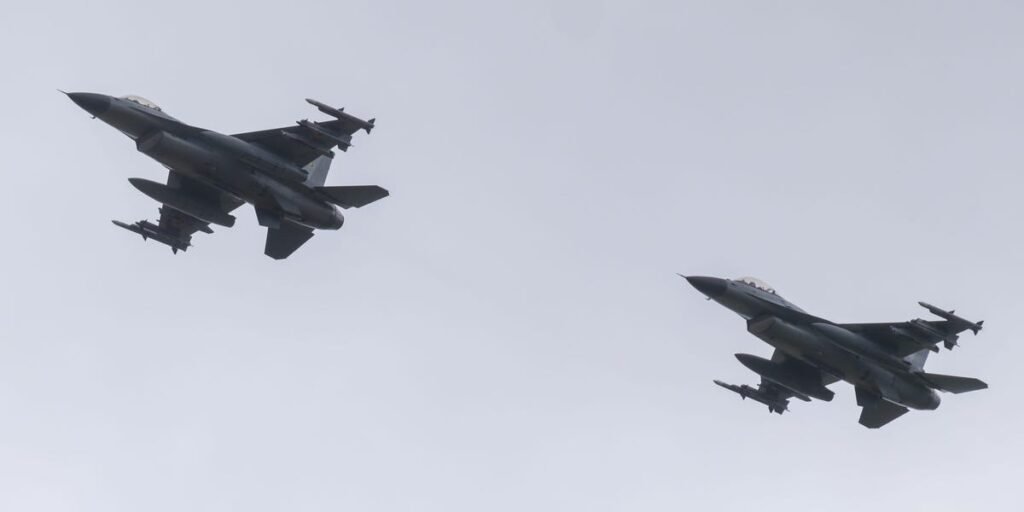
Ukraine’s F-16 fighter jets achieved their first air-to-air kill by shooting down a Russian fighter jet, a top US general said, calling the engagement a sign of Ukraine’s improving air defenses. U.S. Air Force Gen. Dan Caine, chairman of the Joint Chiefs of Staff, said during a congressional hearing on Tuesday that “we recently had
Ukraine’s F-16 fighter jets achieved their first air-to-air kill by shooting down a Russian fighter jet, a top US general said, calling the engagement a sign of Ukraine’s improving air defenses.
U.S. Air Force Gen. Dan Caine, chairman of the Joint Chiefs of Staff, said during a congressional hearing on Tuesday that “we recently had the first air-to-air attack in which a Ukrainian F-16 shot down a Russian fighter.”
He described it as a test of Ukraine’s growing air defense capability.
“I think your ability to expand your tiered defense has come a long way in the last two years with the help and assistance of many,” he said at a Senate Appropriations Committee hearing.
An effective layered defense employs different sensors and weapons, placed at different distances and altitudes, to counter various threats. It requires not only having enough sensors and weapons deployed, but also the ability to connect them, share information, and assign the appropriate weapon to each threat.
Ukraine has expanded those defenses during Russia’s full-scale invasion, combining locally developed technology and Western weapons with Soviet-era systems already in service.
Caine did not provide details about the confrontation, including where it occurred or what type of Russian plane was shot down. Some observers have speculated that he may have been referring to a claim by the Ukrainian Air Force on July 8 that its forces shot down a Russian Su-35. However, that remains unclear.
The general cited the growth of Ukraine’s defense industry and said he wanted to “highlight the incredible work that Ukraine’s industrial base is doing as they expand their own capabilities. It spans from their ground-to-air capabilities to their air-to-air capabilities.” He spoke in response to a question about what impact a possible suspension by the United States of air defense funding to Ukraine for three years would have.
Although it has significantly improved its defenses since the start of the war, including through internal developments such as interceptor aircraft, Ukraine continues to call for all the air defense support it can get as Russian drone and missile bombing worsens and continues to threaten both military and civilian infrastructure.
Ukraine received its first batch of F-16s in the summer of 2024 after a long debate among Western militaries over whether the supply of these fighter jets could be perceived as an unnecessary escalation and how quickly Ukraine could integrate them and build the training, maintenance, logistics and operational systems necessary to use them effectively.
Ukraine has managed to integrate these assets into its air force, using them to intercept Russian drones and missiles, conduct strikes against ground targets, and now engage hostile manned aircraft.
And Western partner countries are now studying how Ukraine combines cheap sensors, interceptor drones, dispersed operations and older flight techniques to strengthen its defenses and air operations.
Partner countries are providing other advanced Western aircraft to Ukraine, including Swedish Gripens and French Mirages, framing them as a result of both Ukraine’s competition and the Allied desire to integrate Ukraine into the future of Western defense, not just to survive this war.