
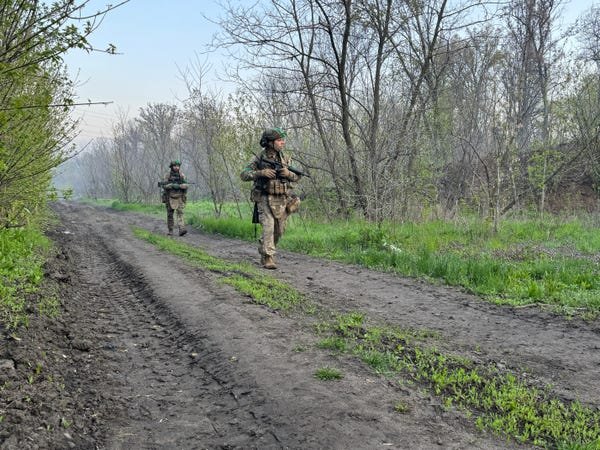
Elite Ukrainian special operators are carrying out more infiltration missions into Russian-controlled territory as the drone-infested kill zone continues to grow, making larger maneuvers difficult. Infiltration operations typically involve small groups of soldiers sneaking behind enemy lines to complete a mission, which can range from taking a key position to conducting ambushes, raids, and assaults.
Elite Ukrainian special operators are carrying out more infiltration missions into Russian-controlled territory as the drone-infested kill zone continues to grow, making larger maneuvers difficult.
Infiltration operations typically involve small groups of soldiers sneaking behind enemy lines to complete a mission, which can range from taking a key position to conducting ambushes, raids, and assaults.
For Ukraine’s Special Operations Forces, “the number of missions has increased over the past year,” an operator from the 4th Ranger Regiment told Business Insider in a recent interview.
The expansion of the kill zone sees the Ukrainians not only executing more infiltration-style missions but also tasking operators with meeting the challenges posed by similar Russian activities.
The 4th Ranger Regiment operator, who is second in command of a small unit and asked to be identified only by his call sign “Gur” for security reasons, said he tends to receive “specific, targeted missions.”
“We might be tasked with destroying a particular enemy position. We go in, destroy it and come out again,” Gur said, according to a translation of his comments. “That could take two days, four days or a week. We don’t necessarily have to stay in the area for a fixed period of time.”
To manage the increased pace, Ukrainian special operators will rotate teams for these missions, allowing soldiers to rest, train and prepare.
Ukrainian soldiers and officials often describe the front line as a “death zone,” an area highly saturated with drones that can quickly attack troops and military vehicles, making any movement very dangerous. Drones are responsible for approximately 90% of all battlefield attacks.

The rise of drones has created a miles-wide death zone around the front lines. Alex Nikitenko/Global Images Ukraine via Getty Images
The kill zone varies in width across the battlefield, although it typically extends approximately 10 to 20 kilometers in any direction from the line of contact. However, Ukrainian soldiers and officials have said it is expanding, forcing commanders to make tactical adjustments.
Gur attributed the expansion of the kill zone to the increased proliferation of first-person view (FPV) drones, cheap quadcopters equipped with explosives to carry out precision strikes. Ukrainian infiltration missions have increased alongside similar Russian operations.
“They are using our tactics too,” the operator said. “They infiltrate in groups of two to four soldiers and can reach our rear. Then that becomes another task for us. We have to go in and eliminate them.”
Ukrainian soldiers said last year that Russian infiltration had become increasingly problematic during the war. The missions varied; some focused on holding positions, while others targeted key defenses. But they were largely designed to distract and cause chaos.
A senior Ukrainian defense official told Business Insider in late 2025 that small Russian infiltration teams were taking advantage of bad weather to sneak into Ukrainian-controlled territory and sow trouble. These missions are high risk and can be deadly for those who participate.
Ukrainian front-line units do not always have sufficient numbers to effectively cover all the territory they control, Gur said. Then, when the Russians infiltrate, your group can be assigned to man the breach.
“Basically,” he said, “the Russians are our task.”
The growing kill zone has also pushed Ukrainian special operators to start using ground robots for logistics closer to the front lines and to evacuate victims, which has become too dangerous for soldiers with the current presence of drones.
“War creates its own conditions. FPV drones appeared, so we have to react to that,” Gur said. “We have to adapt somehow if we want to survive and continue operating.”