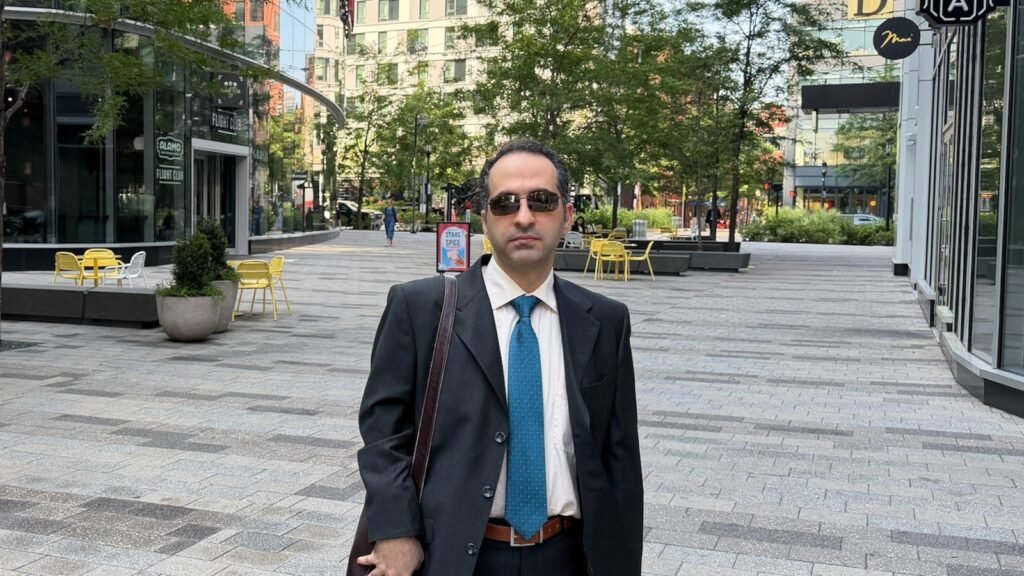
BOSTON– A Massachusetts man was found guilty Monday of conspiring to illegally export electronic components to Iran in violation of U.S. sanctions. Mahdi Mohammad Sadeghi, who worked at global electronics company Analog Devices, was accused of helping an Iranian business partner circumvent U.S. export control laws. U.S. prosecutors say the Tehran-based business partner’s company makes
BOSTON– A Massachusetts man was found guilty Monday of conspiring to illegally export electronic components to Iran in violation of U.S. sanctions.
Mahdi Mohammad Sadeghi, who worked at global electronics company Analog Devices, was accused of helping an Iranian business partner circumvent U.S. export control laws. U.S. prosecutors say the Tehran-based business partner’s company makes navigation systems for Iran’s Revolutionary Guard’s military drone program. Authorities say the plan included creating a front company in Switzerland.
The second defendant, Mohammad Abedininajafabadi, called Abedini in court documents, was not at the trial. He is believed to be in Iran after an apparent prisoner swap for an Italian journalist.
Sadeghi was found guilty on three of the five charges. He showed no visible reaction to the verdict, which came early on the jury’s fourth day of deliberations. He and his lawyers made no comment as they left court and will remain free until sentencing on October 13.
Sadeghi, a 43-year-old naturalized U.S. citizen, decided not to testify. A father of two lost his job at Analog Devices because of the charges. Although he was arrested in December 2024, long before the current war with Iran, his trial took place during the conflict.
“At its core, this case is simple. You cannot ship goods, especially the goods at issue in this case, to Iran. Period. Full stop,” Assistant U.S. Attorney Alathea Porter told the jury. “The defendant knew this and conspired with Mr. Abedini to do it.”
Assistant U.S. Attorney Jared Dolan, in his closing comments, said the documents, text messages and photographs demonstrated that the illegal acts were “fruits of this relationship” between Sadeghi and Abedini.
“The evidence established that he knew what Abedini was doing because he told him in writing,” Dolan said. “He helped him anyway.”
Sadeghi’s attorney, William Fick, told jurors that the plan presented by the prosecution “makes no sense” and was full of holes. He said Sadeghi was only offering advice to an old friend on how to do business with the semiconductor company and was not responsible for procuring the parts for Abedini.
Fick said there was no evidence the parts ended up in Iran and questioned whether the Swiss company was a front.
“If you look at the world through dirty glasses, everything looks dirty,” Fick said. “That’s fundamentally what the prosecution is asking you to do here.”
Fick also said prosecutors had not proven that Sadeghi gained anything from the alleged scheme, although prosecutors said they did not need to prove a motive.
“I had nothing to gain and everything to lose,” Fick said. “He has lived in the country for decades. He was a respected and well-regarded employee as he rose through the company.”
Prosecutors hoped to present evidence during the trial related to an Iranian drone used in a 2024 attack that killed three American soldiers at a remote base in Jordan.
However, before the trial, defense lawyers attempted to exclude any evidence related to Abedini’s role in manufacturing drones or attacks on US troops.
The judge agreed, ruling that prosecutors could only present general evidence about Abedini’s Iranian company and how its technology had potential military applications, including for drones. During a hearing in February, prosecutors acknowledged they had no evidence that Sadeghi “knew anything” about the technology he was accused of exporting and that was allegedly used in the drone involved in the Jordan attack.
Both defendants have been charged with export control violations. Abedini is separately charged with conspiring to provide material support to a foreign terrorist organization that resulted in the deaths of three service members.
Abedini was arrested at an airport in Italy on a US warrant in December 2024, but was released a month later and returned to Iran. Three days after her arrest, Italian journalist Cecilia Sala was detained while reporting in Iran. Sala, believed to be held as bargaining chip for Abedini’s release, returned home in January 2025.
Keep following us for the latest insights.