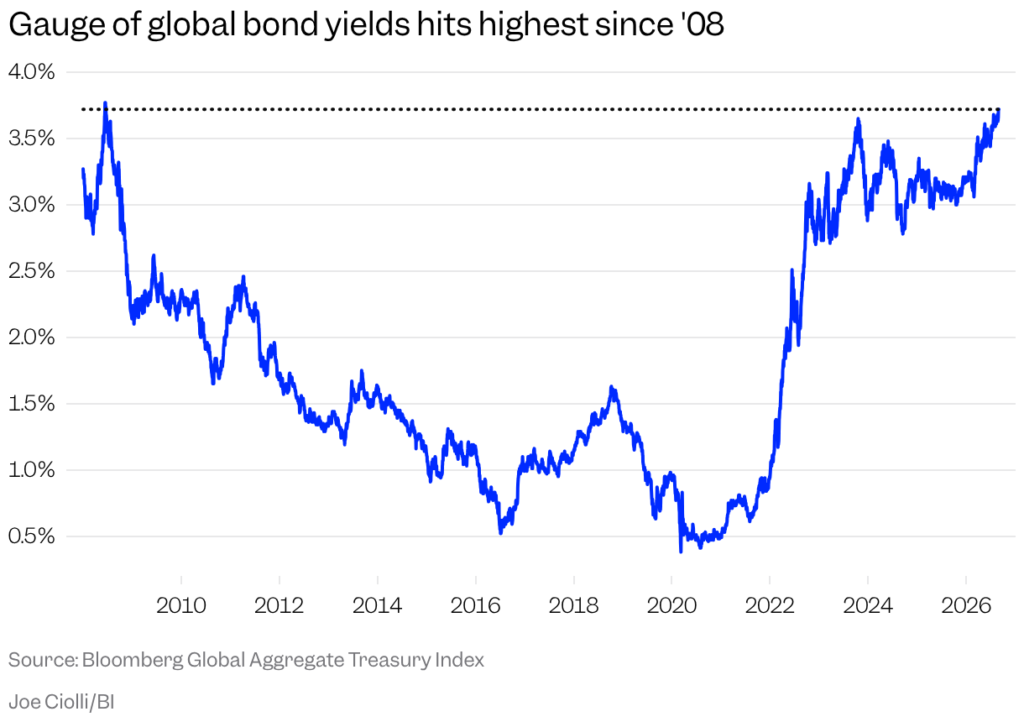
The pros said “let the bond market speak.” But investors don’t like what it’s saying on Tuesday. After an unusual intervention by the Treasury Department in August did little to tamp down bond-market jitters, US Treasury yields are spiking again, but the latest sell-off isn’t confined to the US. A host of macroeconomic fears is
The pros said “let the bond market speak.” But investors don’t like what it’s saying on Tuesday.
After an unusual intervention by the Treasury Department in August did little to tamp down bond-market jitters, US Treasury yields are spiking again, but the latest sell-off isn’t confined to the US. A host of macroeconomic fears is rippling through global fixed income, causing yields on government bonds to rise from the UK to Germany to Japan.
Here were the big moves in global yields on Tuesday:
- US 10-year Treasury: 4.78% (+2 bps) — highest since Jan. 2025
- US 30-year Treasury: 5.27% (+2 bps)
- UK 10-year bond: 5.21% (+5 bps)
- UK 30-year bond: 5.86% (+7 bps) — highest since 1998
- German 10-year bond: 3.33% (+1 bps)
- Japan 10-year bond: 2.99% (+4 bps) — highest since 1996
- Japan 30-year bond: 4.19% (+5 bps)

The 10-year Treasury yield hit its high level since 2025, and the move is already being felt in consumer-facing lending markets like mortgages. The 30-year mortgage rate has jumped over 11bps since last Thursday, hitting 6.77% this week.
Following Kevin Warsh’s Jackson Hole speech last Friday, markets were already boosting the odds of a rate hike at the Fed meeting this month. On Tuesday, the odds rose further, to nearly 70% for a 25bps increase to the Fed’s short-term borrowing rate when officials meet on September 15-16.
Fed Governor Michael Barr was the latest official to sound off on higher rates on Tuesday. Barr said that he would support a rate hike if inflation doesn’t edge back down to the Fed’s 2% target. “If inflation appears not to be moderating sufficiently, then I think we should act decisively to raise rates,” he said in prepared remarks.
In Japan, the 10-year government bond rose the highest yield since 1996. The fresh burst of volatility followed comments from Treasury Secretary Scott Bessent that suggest Japan could do more to boost its currency, raising the fears of a rate hike from the country’s central bank.
US stocks dropped amid the bond sell-off. However, some argue that investors shouldn’t be spooked by the bond rout, as the fundamental backdrop for equities remains strong as earnings and economic strength continue to hold up.
“We do not expect the rise in bond yields to derail what we continue to view as a constructive backdrop for equities,” Brock Weimer, an analyst at Edward Jones, said Tuesday. “Accordingly, we recommend that investors consider overweighting stocks relative to bonds.”
Here’s where major indexes stood at the closing bell:
• Nasdaq 100: 29,077.22, down 1.29%
The bond moves on Tuesday are broadly related to fears of higher global inflation and a worsening fiscal picture for many governments, which are funding themselves with more debt and higher deficit spending. In Japan, Prime Minister Sanae Takaichi’s plans for greater fiscal stimulus to boost the economy has led to investor concern. In Europe, too, heavy borrowing and rising deficits are under the microscope after years of geopolitical crises have driven spending higher for many countries.
In the US, the Iran war was thrust back into focus with renewed strikes by both sides over the weekend, sending oil prices higher and raising the specter of sticky inflation. Treasury Secretary Bessent’s announcement last month that the US would step up its bond buying to quell yields at the long-end of the maturity curve rattled investors already nervous about the government’s ability to rein in borrowing and improve the fiscal picture.
Meanwhile, an explosion of corporate borrowing, particularly by companies funding big AI projects, is weighing on government bonds. High-grade corporate issuance has surged this year, offering investors credit exposure to a hot investment theme that some say is crowding out US Treasurys.
According to data from SIFMA, US corporate bond issuance hit $1.68 trillion year to date through July, up 27% year over year. Bank of America predicts companies will issue $190 billion of investment grade bonds this month, up from $164 billion in August.
For more tech updates, stay tuned to our blog.