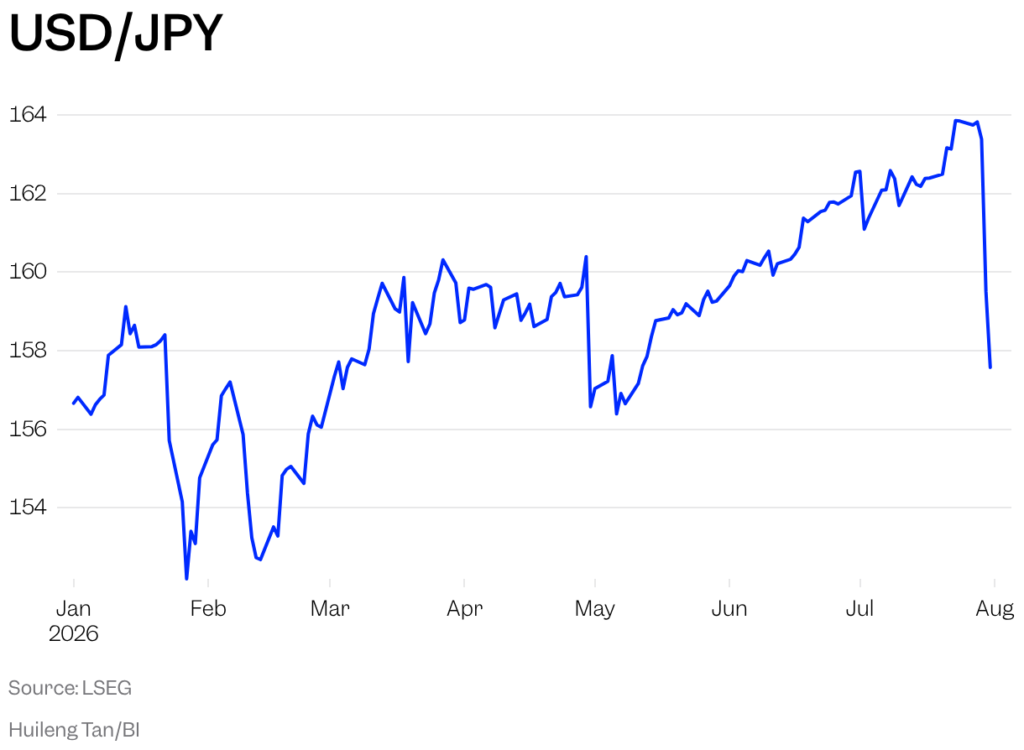
The US and Japan carried out their first coordinated yen-buying intervention in nearly three decades on Friday, stepping into currency markets after the yen weakened to a 40-year low against the dollar. Japanese Finance Minister Satsuki Katayama confirmed the operation on Monday and warned that the two countries could intervene together again if needed. The
The US and Japan carried out their first coordinated yen-buying intervention in nearly three decades on Friday, stepping into currency markets after the yen weakened to a 40-year low against the dollar.
Japanese Finance Minister Satsuki Katayama confirmed the operation on Monday and warned that the two countries could intervene together again if needed.
The Japanese yen traded around 156.5 per dollar early Monday after strengthening from above 163 before the intervention. Japan’s Nikkei 225 fell as much as 2.5% as the stronger currency weighed on exporters.

The coordinated action has traders watching one trade above all others: the yen-funded carry trade, in which investors borrow cheaply in Japan to buy higher-yielding currencies and assets overseas.
The focus recalls the summer of 2024, when a Bank of Japan intervention, a surprise BOJ rate hike, and expectations for lower US interest rates combined to drive a sharp rally in the yen.
The move contributed to the unwinding of leveraged carry trades that rippled across global markets, fueling a sell-off in US equities and a surge in volatility.
Carry trade still matters, but so do rates
The carry trade remains attractive because US interest rates are still well above Japan’s. But the coordinated intervention may have changed the risks of betting against the yen.
The coordinated operation has “profoundly upped the ante on deterrence — for speculative JPY bears and (JPY-funded) ‘carry trades’ alike,” Vishnu Varathan, Mizuho’s Asia-Pacific head of macro strategy, wrote in a note Monday.
Unlike in 2024, the intervention this time hasn’t been accompanied by a major shift in expectations for US or Japanese interest rates.
The carry trade, therefore, still makes sense, leaving investors to watch whether the Bank of Japan raises rates again, making it more expensive to borrow yen and less attractive to fund investments overseas.
Bank of America expects the Bank of Japan to raise rates again in October, while acknowledging a growing risk of a September move.
Its strategists said a sustained break below the 155 yen level could prompt investors to rethink long-held bets on a weaker yen.
A lasting rally in the yen will likely require more than intervention. Investors also are watching whether the BOJ follows up with more rate hikes, which would narrow the interest-rate gap with the US and reduce the appeal of borrowing cheap yen.
“Overall, while we think that the joint intervention is certainly historic and significant, and could certainly play an important role in the short-term in clearing out Yen shorts, the fundamentals likely still need to change for a more durable move lower in USD/JPY,” wrote Michael Wan, a senior currency analyst at MUFG, on Monday.
Keep following us for the latest insights.