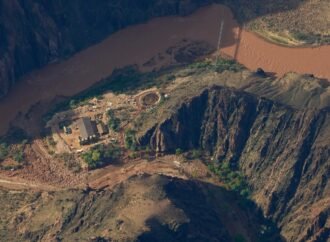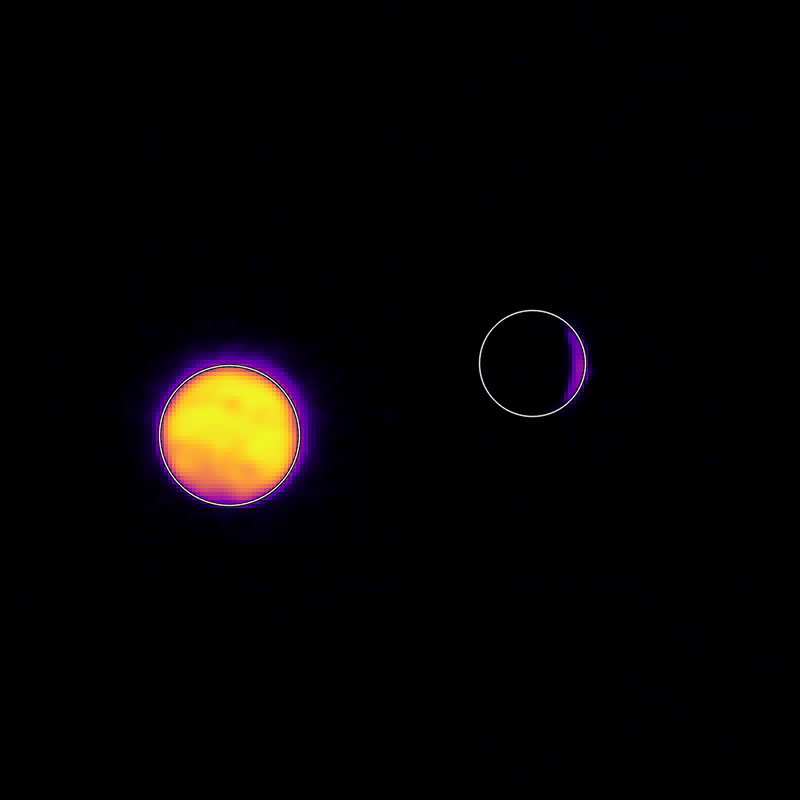
On July 3, one of NASA’s two Mars-bound ESCAPADE (Escape and Plasma Acceleration and Dynamics Explorers) spacecraft captured photographs of the Earth and Moon in visible and thermal infrared light. At the time, the spacecraft was 584,600 kilometers (363,250 mi) from Earth and 186,100 kilometers (115,600 mi) from the Moon, making the Moon appear relatively
On July 3, one of NASA’s two Mars-bound ESCAPADE (Escape and Plasma Acceleration and Dynamics Explorers) spacecraft captured photographs of the Earth and Moon in visible and thermal infrared light. At the time, the spacecraft was 584,600 kilometers (363,250 mi) from Earth and 186,100 kilometers (115,600 mi) from the Moon, making the Moon appear relatively large.
Taken with the Sun only partially illuminating the Earth and Moon, the visible light image shows the two bodies as half-moons, with only about 8% of each side illuminated by the sun. However, in the infrared thermal image, Earth’s shadowed hemisphere is illuminated by its own heat from both the atmosphere and the surface, glowing between minus 10 and minus 44 degrees Fahrenheit (250 to 280 kelvin). Without the insulating blankets of the oceans and atmospheres, the far side of the Moon remains at a much colder temperature of -280 degrees Fahrenheit (100 kelvin).
The ESCAPADE mission used Visible and Infrared Observing System cameras, provided by Northern Arizona University in Flagstaff, to capture the images, which are more than just snapshots from road trip photo albums.
“We are delighted that ESCAPADE was able to accommodate these excellent space-qualified cameras that will search for the visible Martian aurora and investigate the thermal properties of the Martian surface and atmosphere,” said Rob Lillis, principal investigator for the mission at the University of California, Berkeley. “Since the Earth and Moon are well-known targets, imaging them provides an important calibration check for the ESCAPADE cameras.”
The ESCAPADE spacecraft, which was built by Rocket Lab, is currently in a “loose” orbit around Lagrange point 2, a location in space about a million miles from Earth. In November 2026, the spacecraft will fly by Earth to use the planet’s gravity to make its way to Mars. When the spacecraft arrives in September 2027, they will study how a million-mile-per-hour stream of material flowing from the Sun, known as the solar wind, interacts with the Martian environment and how that drives atmospheric loss on the Red Planet.
The ESCAPADE mission is funded by NASA’s Heliophysics Division and is part of NASA’s Small Innovative Missions for Planetary Exploration program. UC Berkeley’s Space Sciences Laboratory is leading the mission with key partners: Rocket Lab; NASA Goddard Space Flight Center in Greenbelt, Maryland; Embry-Riddle Aeronautical University; Advanced Space; and Blue Origin.
By Mara Johnson-Groh
NASA Goddard Space Flight Center, Greenbelt, Maryland.
Keep following us for the latest insights.