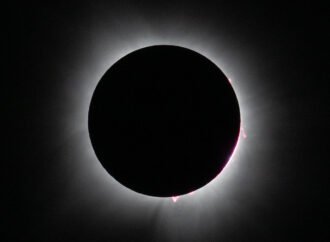
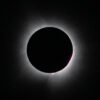
On Wednesday, August 12, a total solar eclipse will be visible in parts of Greenland, Iceland, northern Russia, the Atlantic Ocean, Spain and a small corner of Portugal. NASA will broadcast the eclipse live with views from the path and interviews with experts in the field through a variety of platforms. Learn where to watch
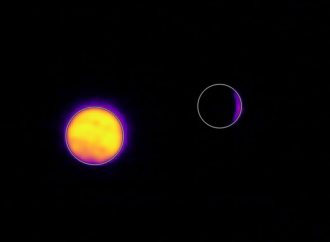
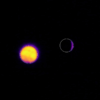
On July 3, one of NASA’s two Mars-bound ESCAPADE (Escape and Plasma Acceleration and Dynamics Explorers) spacecraft captured photographs of the Earth and Moon in visible and thermal infrared light. At the time, the spacecraft was 584,600 kilometers (363,250 mi) from Earth and 186,100 kilometers (115,600 mi) from the Moon, making the Moon appear relatively
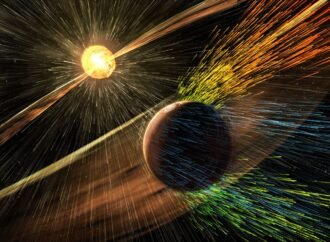
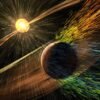
Scientists on NASA’s MAVEN (Mars Atmosphere and Volatile Evolution) mission have discovered a key piece of the puzzle in understanding certain types of auroras on Mars, discovering that they form similarly to terrestrial auroras.Results published Thursday in Nature Communications show that the same mechanism that circulates and catapults charged particles into Earth’s atmosphere is happening
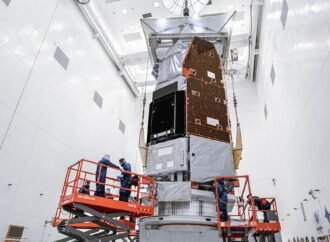
Media are invited to join NASA for a virtual press conference at 2 p.m. EDT, Wednesday, July 29, to preview the Nancy Grace Roman Space Telescope mission, scheduled to launch Sunday, August 30 from the agency’s Kennedy Space Center in Florida. NASA will broadcast this event live across a variety of platforms. Learn where to
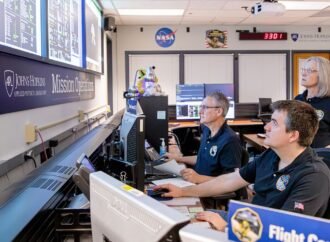
After its longest hibernation period of nearly a year, NASA’s New Horizons spacecraft has emerged in good health and is ready to begin transmitting scientific data collected in the distant Kuiper Belt, far beyond Pluto. On June 23, flight controllers at the Johns Hopkins Applied Physics Laboratory (APL) in Laurel, Maryland, confirmed that New Horizons,