After its longest hibernation period of nearly a year, NASA’s New Horizons spacecraft has emerged in good health and is ready to begin transmitting scientific data collected in the distant Kuiper Belt, far beyond Pluto. On June 23, flight controllers at the Johns Hopkins Applied Physics Laboratory (APL) in Laurel, Maryland, confirmed that New Horizons,
After its longest hibernation period of nearly a year, NASA’s New Horizons spacecraft has emerged in good health and is ready to begin transmitting scientific data collected in the distant Kuiper Belt, far beyond Pluto.
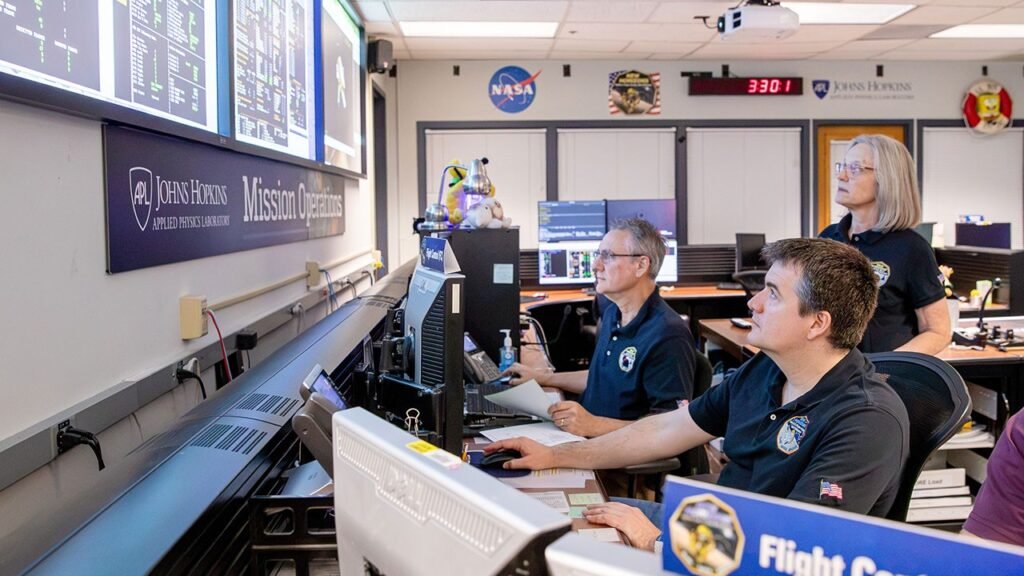
On June 23, flight controllers at the Johns Hopkins Applied Physics Laboratory (APL) in Laurel, Maryland, confirmed that New Horizons, acting through stored commands connected to its main computer last July, had safely awakened from a 321-day hibernation period that began on August 7. With the spacecraft now approximately 5.9 billion miles (9.5 billion kilometers) from Earth, the radio signals carrying that confirmation took about 8 hours and 52 minutes to reach Earth. APL Mission Operations Center via NASA’s Deep Space Network station near Madrid, Spain.
The mission team typically places New Horizons into hibernation mode to save resources during long cruise periods. While the spacecraft is hibernating, operators do not send commands or retrieve data, but the spacecraft continues to collect and store data 24 hours a day from its heliospheric plasma sensors, the Solar Wind on Pluto and the Pluto Energetic Particle Spectrometer Scientific Investigation, as well as its space dust detector, the Venetia Burney Student Dust Counter.
Alice Bowman, New Horizons mission operations manager at APL, said the spacecraft reported back to Earth, via the Deep Space Network, with a weekly status beacon. “All status reports during this hibernation period were ‘green,’ meaning everything was fine aboard New Horizons each and every week,” he said.
As New Horizons resumes active operations, Bowman said, the team will begin transmitting health and safety data from the spacecraft, followed by data from the three science instruments. In about three weeks, the Alice ultraviolet spectrograph aboard the spacecraft will observe the distribution of hydrogen gas in the outer heliosphere, while the Solar Wind instruments on Pluto, the Pluto Energetic Particle Spectrometer and the Venetia Burney Student Dust Counter continue their measurements, and the ground team carries out a series of spacecraft and instrument checks.
The team is also completing ground system software upgrades that will facilitate maintenance of spacecraft operations. Testing is already underway and is expected to continue throughout the year.
New Horizons is operating with updated autonomy logic designed for operations farther from the Sun and to accommodate expected power reduction and natural increase in travel time of radio signals.
NASA spacecraft’s exploration of this distant region of the solar system marks the latest step in a journey that began in January 2006 with the fastest launch on record; a flyby of Jupiter in February 2007 that included stunning views of the gas giant and its moons; the first exploration through the Pluto system in July 2015; the first exploration of a Kuiper Belt object, Arrokoth, in January 2019, and unique studies of the Sun’s outer heliosphere and dozens of additional Kuiper Belt objects since then.
For more information about NASA’s New Horizons mission, visit:
https://science.nasa.gov/mission/new-horizons/
Keep following us for the latest insights.