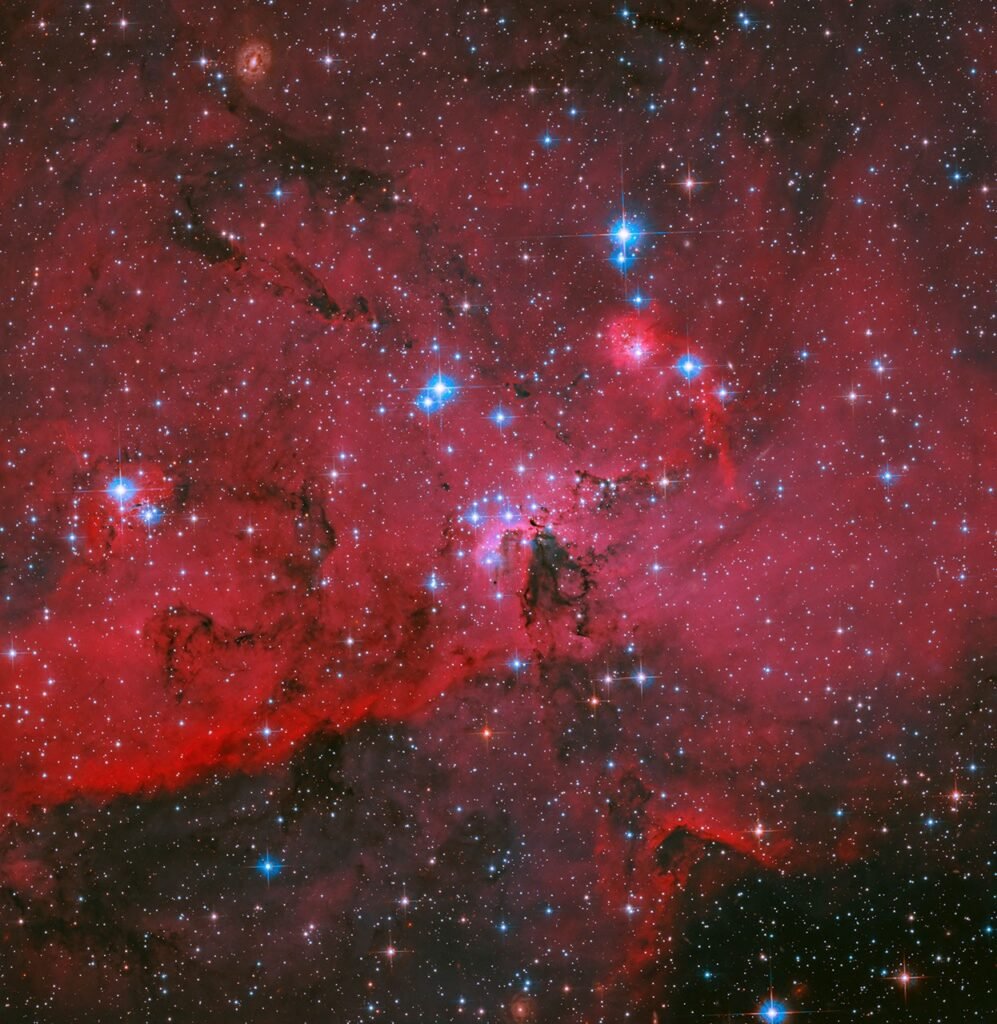
Like new fireworks launched against a background of dissipating smoke, blue and white stars shine brightly against a crimson background of glowing gas in this image of the LH 95 stellar nursery from NASA’s Hubble Space Telescope. LH 95 is a region of the Large Magellanic Cloud, a dwarf galaxy orbiting the Milky Way. Low-mass
Like new fireworks launched against a background of dissipating smoke, blue and white stars shine brightly against a crimson background of glowing gas in this image of the LH 95 stellar nursery from NASA’s Hubble Space Telescope.
LH 95 is a region of the Large Magellanic Cloud, a dwarf galaxy orbiting the Milky Way. Low-mass child stars live alongside massive blue giant stars in what is known as a stellar association, one of many in the Large Magellanic Cloud.
The most massive stars in the LH 95 region, which have at least three times the mass of the Sun and are visible here as the largest and brightest blue stars, expel ultraviolet radiation and stellar winds that heat and shape the surrounding hydrogen gas. The dark filaments stand out in stark contrast to the bright hydrogen where denser dust lanes resist erosion.
In this image, blue indicates the shorter wavelengths of visible light, while red represents the longer wavelengths of visible light, as well as some near-infrared light. Colors in Hubble images are chosen based on standard image processing techniques to best represent the wavelengths of light passing through the filters used in the observation. The nebula’s gas glows crimson due to alpha hydrogen emissions.
Alpha hydrogen is an excellent indicator of star formation, allowing astronomers to identify very young stars embedded in this bright gas. The researchers found that developing stars are still accreting material from the disks of gas and dust that surround them. In fact, LH 95 is home to an extraordinary 2,500 stars that have accumulated almost all of their critical mass but have not yet “ignited” by initiating fusion reactions. These stars, called “pre-main sequence stars,” formed from the collapse of gas clouds and are still contracting. They will soon begin burning hydrogen in their cores to become full stars.
By studying these forming stars, the researchers confirmed that the stars’ accretion rate (the rate at which they accumulate matter) decreased with age, as expected. However, they also learned that accretion can persist for several million years, longer than is sometimes assumed. This information helps refine our understanding of how young stars continue to grow and how their disks evolve.
The researchers observed that different generations of stars in LH 95 coexist, indicating that instead of forming stars in a single event, the region produces multiple stellar generations over an extended period.
The most massive star in LH 95 (top center, slightly left) is 60 to 70 times the mass of the Sun and is about a million years younger than the rest of the stars in the system, which appear to be about 4 million years old. Massive stars like these burn their fuel quickly and die in supernova explosions.
With its rich stellar population, LH 95 is valued by astronomers for providing a way to observe forming stars at a relatively close distance in an environment with less obscuring dust than similar regions of the Milky Way.
As one of NASA’s flagship observatories, Hubble has produced a wealth of scientific discoveries during more than 30 years in orbit. Its observations are expanded and improved by observations made with other NASA missions, including the infrared-sensing Webb Space Telescope and the upcoming Nancy Grace Roman Space Telescope, scheduled to launch in late summer.
Explore more
Media contact:
Claire Andreoli
from NASA Goddard Space Flight Center, Greenbelt, Maryland, USA
claire.andreoli@nasa.gov
For more tech updates, stay tuned to our blog.