“Landing, we have touchdown!” At 5:12 a.m. PDT on July 20, 1976, mission controllers at NASA’s Jet Propulsion Laboratory erupted in cheers upon learning that the Viking 1 lander had survived its descent through the thin Martian atmosphere. Forty minutes later, the first image of the lander began to appear on their monitors, slowly forming
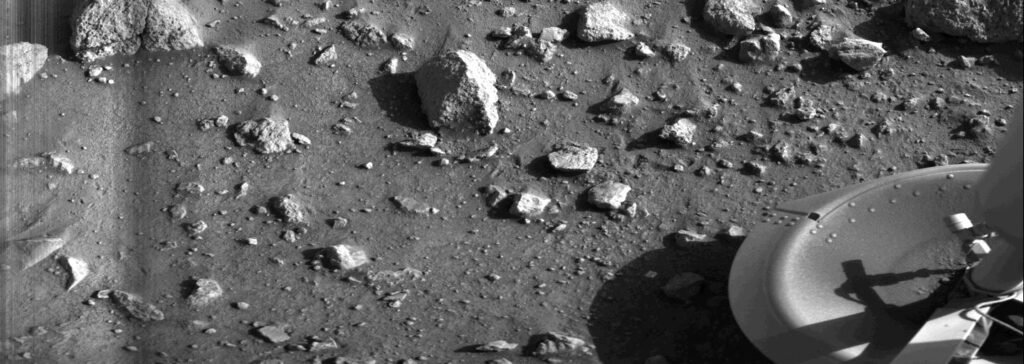
“Landing, we have touchdown!” At 5:12 a.m. PDT on July 20, 1976, mission controllers at NASA’s Jet Propulsion Laboratory erupted in cheers upon learning that the Viking 1 lander had survived its descent through the thin Martian atmosphere. Forty minutes later, the first image of the lander began to appear on their monitors, slowly forming line by line from left to right. For the first time, humans were able to see the rocky terrain of Mars from its surface.
Dr. Thomas Mutch, leader of the Viking lander imaging team, described the moment: “I studied the black screen, waiting for that narrow strip that will mark the first lines of the first image. And it appeared. A hint of electronic magic. Areas of brightness and darkness. The image begins to fill the screen. You see rocks and sand and, finally, at the far right, one of the spacecraft’s foot pads, a symbolic artifact that marks our achievement with the sign of reality. Again and again I repeat: ‘It’s incredible.’”
Fifty years ago today, the Viking 1 lander became the first NASA robot to explore the surface of Mars and begin the search for signs of life in our solar system. Viking 1 was joined six weeks later by its twin lander, Viking 2, which explored a different region of Mars, while two mission orbiters that carried the landers to the Red Planet continued collecting data from space and helped transmit communications to Earth.
Learn more about what Viking found and NASA’s legacy of discovery on Mars in Viking: 50 Years on Mars.
Image credit: NASA/JPL
Keep following us for the latest insights.