The video opens with a man in his 80s slumped in a hospital bed, his face hollow as he scrunches his eyes. A jump cut advances the scene three days: the man is alert now, words gathering as he identifies his son. Six months later, he is pictured sitting upright, engaged in conversation. His gaze
The video opens with a man in his 80s slumped in a hospital bed, his face hollow as he scrunches his eyes. A jump cut advances the scene three days: the man is alert now, words gathering as he identifies his son.
Six months later, he is pictured sitting upright, engaged in conversation. His gaze is animated. At eight months, the man walks briskly down a hospital corridor. He recites a near-century-old Maoist military anthem from memory. He is practically unrecognizable from the withered figure in the opening frame.
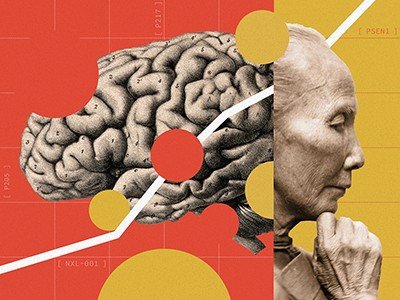
China is waging war on Alzheimer’s. What can its approach teach the rest of the world?
The footage records the recovery of a man who, in September 2020, became the first person in the world to undergo a surgery known as deep cervical lymphatic-venous anastomosis (dcLVA) to treat Alzheimer’s disease. The procedure involves connecting tiny lymphatic vessels in the neck — part of the drainage system that carries waste away from the brain — to nearby veins, creating a route that, in theory, allows fluid and waste proteins to flow more easily into the bloodstream.
The treatment was first reported1 in 2022 in a Chinese-language journal by microsurgeon Qingping Xie, president of the Qiushi Hospital in Hangzhou, China. At the time, it drew little notice. But that changed the following year, when Wei Chen, a lymphatic microsurgeon at the Cleveland Clinic in Ohio, began showing the footage (with consent from Xie and the man’s family) at surgical meetings around the world.
“A lot of jaws dropped,” recalls Chen. “It basically started a frenzy of this surgery being performed left and right.”
Almost all of the surgeries took place in China, where hundreds of hospitals were soon offering the experimental procedure. Propelled by viral testimonial videos and aggressive marketing campaigns on social-media platforms such as Douyin and WeChat, it was sought out by thousands — with many people paying more than 200,000 yuan (US$30,000) for a chance of recovery.
The rapid adoption, in the absence of hard evidence, prompted Chinese regulators to intervene. Last year, they restricted the procedure to more-formalized clinical research settings, rather than the ad hoc use that had proliferated previously. And Xie, the pioneer of the technique, has been in detention since September for undisclosed reasons.

The great brain clearance and dementia debate
Now, as controlled studies get under way around the world, the scientific community remains divided over whether or not the procedure actually alters the course of the disease. Mechanistic explanations for why the surgery might work remain hard to square with how quickly some individuals seem to improve, clinicians say. And many researchers remain concerned about the risks, including infection, bleeding and injury to nearby nerves.
Nature spoke to more than two dozen researchers in the field, revealing a mix of qualified enthusiasm and deep scepticism.
“The concept is scientifically valid and biologically plausible,” says Young-Kwon Hong, a lymphatics researcher at the Beth Israel Deaconess Medical Center in Boston, Massachusetts. But he worries that the excitement has outpaced the evidence. “The hope is high,” he says, “and whenever hope is high, the hype also follows.”
Medical maverick
Xie did not set out to reinvent Alzheimer’s treatment. He trained as a reconstructive microsurgeon, and is more at home with reconnecting severed vessels than with troubleshooting brain drainage. But according to interviews Xie gave before his detention, and corroborated by his daughter Angela, who spoke to Nature, a stray case of tinnitus set him on a different path.
In 2019, while performing surgery to relieve pressure on nerves that carry sound signals to the brain, Xie noticed abnormalities in lymphatic structures deep in the neck of a middle-aged woman with persistent ringing in her ears. To bypass the problem area, he connected lymph vessels to nearby veins, adapting a technique first developed in the 1960s to treat painful swelling in the arms and legs that can happen when lymph nodes are removed or damaged during cancer treatment.
After the surgery, the woman reported not only that her tinnitus improved, but so had her mental acuity. Intrigued, Xie dug into the literature and found research that seemed to explain the phenomenon. In 2015, a team led by neuroimmunologist Jonathan Kipnis identified a network of lymphatic vessels in the protective membranes that encase the brain, overturning the long-held idea that the brain lacked a conventional lymphatic system2. Three years later, Kipnis and his colleagues showed that disrupting these vessels in mice impaired clearance of toxic amyloid-β proteins and accelerated cognitive decline3.
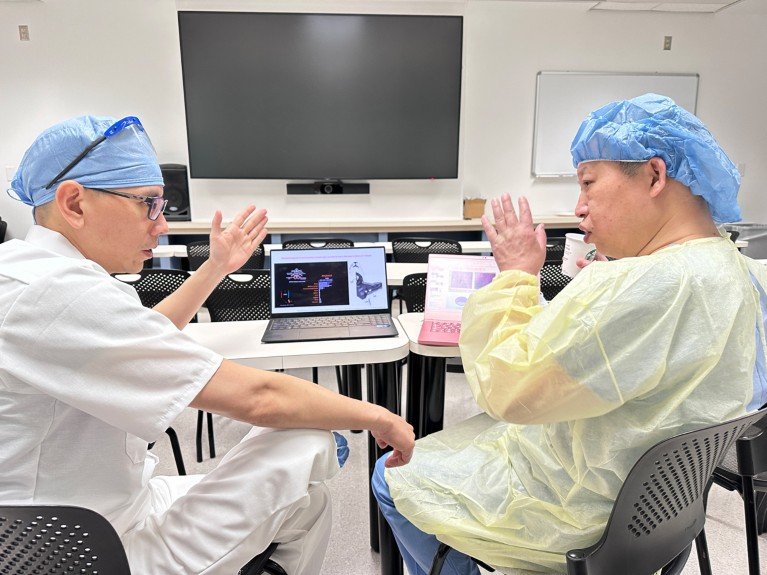
Qingping Xie (right) talks with Wei Chen (left) at the Cleveland Clinic.Credit: ANQI XIE
Together, the findings pointed to a kind of hidden plumbing keeping the brain clean. This echoed earlier work by neuroscientists Jeff Iliff and Maiken Nedergaard at the University of Rochester Medical Center in New York. In 2012, they described an array of fluid-filled channels, distinct from true lymphatic vessels, that run alongside blood vessels and move fluid through brain tissue to flush out waste4.
For Xie, the pieces clicked: if the brain’s waste ultimately drains through these fluid-clearing pathways into lymphatic vessels in the neck, he reasoned, then improving the outflow there might enhance clearance upstream. And if clogs in that plumbing contribute to disease, then fixing the flow might even help to treat neurodegenerative conditions such as Alzheimer’s. The 84-year-old man in Xie’s video was his first test case.
Weifeng Zeng first stumbled on Xie’s work in February 2023, buried in a China Medical News bulletin listing the “Seven major advances in microsurgery in 2022”; Xie’s dcLVA technique ranked sixth. By then, Xie had performed it on more than 60 people, the bulletin noted.
Keen to learn more, Zeng, a reconstructive microsurgeon at the University of Wisconsin–Madison, tracked down Xie’s report and cold-called the mobile number listed for the corresponding author. Xie picked up on the first ring. He was eager to share his surgical experiences, Zeng recalls, and excited to learn that Chen and Zeng had been considering similar ideas about lymphatic surgery for Alzheimer’s for more than a decade — although they had not performed such an operation at that point.

How to avoid dementia — what the science really says
A formal collaboration ensued. Xie was soon on a plane to Cleveland, demonstrating his dcLVA technique on cadavers for Chen’s team. Chen folded Xie’s clinical findings into his own conference talks, and then the two (with Zeng and others) co-authored a brief report laying out the surgical technique and its early results — the video of the first person Xie treated included — in the official journal of the American Society of Plastic Surgeons5.
Word spread fast, both in China and abroad. Surgeons around the world made pilgrimages to Hangzhou to witness the operation first-hand. Among them was J Mocco, a cerebrovascular neurosurgeon now at Weill Cornell Medicine in New York City, who travelled to Qiushi Hospital in August 2025. “I had never seen anything like it,” Mocco recalls.
“My first thought was: am I seeing a revival-tent preacher experience here?” he says. “But I came away from the visit to China saying: I don’t know if this is real, but it should be investigated in a rigorous and meaningful way to determine if it is.”
Burden of proof
The evidence base so far mainly consists of small studies from China. Most were done at a single site, lacked a comparison group and offered little mechanistic evidence as to how the treatment might produce benefits.
More than a dozen such reports, involving a few hundred participants in total, have been published so far. Collectively, they suggest that the surgery can reduce levels of toxic amyloid-β and tau proteins in the fluid that bathes the brain and spinal cord, and sharpen memory and attention on objective cognitive tests. The gains are typically modest when averaged across large cohorts. But drastic turnarounds like the one in Xie’s original study continue to surface — in China and elsewhere.
“We are seeing some incredibly encouraging data,” says Joon Pio (JP) Hong, a plastic surgeon at the University of Ulsan College of Medicine in Seoul. He has worked with Xie directly, co-authoring another striking report last year involving a 58-year-old woman with severe Alzheimer’s who could barely walk before surgery and was able to move unaided afterwards6. Hong is now running his own trial in South Korea and says that he is finding the same spectacular gains in some individuals, although not in everyone.

Brain’s drain
That echoes what is emerging in larger, more-rigorous studies. In February, clinicians published a study involving more than 100 people — the largest cohort so far — with severe Alzheimer’s, who underwent dcLVA at the First People’s Hospital of Zunyi, in southwestern China. Over several months of follow-up, participants, on average, showed modest improvements in cognitive and functional scores alongside declines in amyloid-β and tau levels in cerebrospinal fluid7.
Independent imaging studies reveal some preliminary backing for those gains. MRI scans taken before and after surgery show increased post-treatment connectivity in the brain’s default mode network, a key hub for memory-related activity8. Ultrasound scans reveal increased blood flow through the neck’s jugular veins and carotid arteries9 — evidence, albeit preliminary, of restored circulation and brain connectivity underlying the clinical and behavioural benefits.
But even those signals leave considerable ambiguity about whether the observed changes reflect true disease modification or just a temporary reprieve — and interviews with caregivers, conducted as part of a formal study10 in China’s Henan province, offer little clarity. If anything, such accounts suggest that perceived benefits are often subtle and inconsistent, shaped as much by expectation and emotional investment as by objective clinical change. And, anecdotally at least, several clinicians say they’ve heard from colleagues in China that the majority of individuals backslide within a year of surgery, echoing broader concerns that any gains might not last.
Lasting impressions
The question of durability now hangs over the entire field.
Kipnis, for one, isn’t convinced that the improvements will last. Just as a road detour doesn’t fix a traffic jam — it only reroutes cars for a while — dcLVA might improve the flow of brain waste for a time. But without addressing whatever caused the blockage in the first place, he says, congestion will inevitably build back up. “The system will get clogged again and again,” warns Kipnis, who is based at Washington University School of Medicine in St. Louis, Missouri.
Still, for families watching a loved one disappear into severe dementia, and with few other treatment options, short-term benefits could be meaningful, notes JP Hong: “If the patient is able to improve even for a year, that’s a whole freaking miracle for the patient and their family.” (Both he and Kipnis consult for Medical Microinstruments (MMI), a surgical robotics company based in Jacksonville, Florida, that is behind a 15-person study of dcLVA now under way in the United States.)
Another thing that is giving scientists pause is the speed with which symptoms begin to shift after the surgery. “The thing that doesn’t fit for me is the fact that the effects seem relatively immediate,” says Iliff, now at the University of Washington School of Medicine in Seattle and a paid consultant for MMI. “I have a hard time understanding how those kinetics work.”

The future of Alzheimer’s treatment
It could be that, by improving drainage from the brain, the surgery simply relieves pressure in fluid-filled spaces, easing stress on surrounding tissue and improving cognitive function. Or it might help to flush out inflammatory molecules and other toxic metabolites that stress neurons and drive synaptic dysfunction. It might even have a rapid effect on amyloid-β and tau, clearing soluble forms of the proteins that can harm neurons, even though the plaques and tangles that define Alzheimer’s pathology are left behind.
For more tech updates, stay tuned to our blog.