xAI’s Grok Bot can now spend your money! That sentence will induce one of two reactions.. either you’re excited about the opportunity to automate more of your life, or invokes fear that the robots are about to spend all your money. By connecting your Stripe’s Link wallet, Grok then has access to money and that
xAI’s Grok Bot can now spend your money!
That sentence will induce one of two reactions.. either you’re excited about the opportunity to automate more of your life, or invokes fear that the robots are about to spend all your money.
By connecting your Stripe’s Link wallet, Grok then has access to money and that provides a world of opportunities.
This year we’ve see LLM chat become agents that have access to browsers and computers to take on bigger tasks with bigger outcomes, but there’s been a pretty hard limit to their capability.. money.
The idea of a bot shopping for you could be scary at first, but when you understand the safe guards in place, it’s a lot easier to see how this can work safely.
Grok Bot can now complete a purchase on your behalf, but it will prompt you to approve every spend request. While this stops short of the magical fully automated end-to-end process, it’s an important safety mechanism as we gain trust it’s not going to go rogue and spend the entire limit at once.
Another key aspect of the financial safety is the Bot receives a secure, single-use card for that payment only. This is great, and actually makes you wonder why this isn’t the case for all online transactions.
Today, the feature is live for users in the United States, with a mobile rollout described as coming soon, unfortunately this means Australians cannot use the shopping rail yet.
What shipped
Grok Bot can now buy things on the internet using the payment layer Link wallet for agents, which Stripe launched in late April.
Stripe says the agent never sees the raw card or bank details sitting in the wallet. After approval, Link can issue either a one-time virtual card that works in a standard checkout form, or a Shared Payment Token for merchants that accept machine-native payments.
The virtual card matters most here. Grok Bot does not need every retailer to build a special AI checkout. It can attempt the same card fields a person would use. This layer feels even more secure than PayPal, which was originally designed to avoid giving your card details to every website under the sun.
Grok versus Grok Bot
If you’re new to all this, you may not immediately understand the difference between Grok itself and Grok Bot, these two things are related, but are very different.
Grok is the chatbot, home at grok.com, and available on X via the web or mobile app, and in places like Tesla vehicles. You ask a question, it answers. It can search the web, write, generate images and video, and reason through a problem. When you close the tab, the work stops.
Grok Bot is a separate product that launched in early beta around 11 August alongside Grok 4.6. xAI describes Bots as AI teammates you can give real work to.
Each account gets a persistent cloud computer with a browser, files and a terminal. You create named Bots, give each a job, and they keep working after your laptop is shut. They can sign into the same tools you use, learn a workflow after you demonstrate it once, save that path as a routine, and hand work between Bots.
Jason Calacanis asked Grok bot users to share their bots
What does it cost?
Access is not free. While Grok Bot is made by Cursor, a recent acquisition by xAI, there are other ways to pay for it.
Pricing is available on https://x.ai/bot, today that cost is listed as US$20/month for Cursor Pro, which is where Grok Bot starts, but does have limited weekly usage.
You can also go down the Grok subscription route, but those of us who have X Premium that includes Grok, doesn’t count, you need SuperGrok which starts at US$30/month. If you find yourself limited, you can pay up to US$200pm for more AI tokens.
If you find yourself limited, you can pay up to US$200pm for more AI tokens.How to set it up
The shopping piece sits on top of a normal Grok Bot install.
You’ll need the Grok Bot Desktop app installed for macOS or Windows, you can get started, noting there’s also an option for the iOS app (although Link is not yet available there), with Android in development and hopefully available shortly.
Head to the Plugins section in the lower-left and find Link, add and your Grok Bot, will have the skill.
Create a shopping focused Bot by entering a short name, detailing the task description of how it should behave. A shopping Bot should be told what it is allowed to buy, which sites it may use, the budget ceiling, shipping address rules, and what it must never do.
For sites that require a login, the Bot asks you to take over the Agent Computer so you can enter the password, passkey, two-factor code or CAPTCHA yourself. Sessions persist on the shared computer after that. An important security consideration is to avoid pasting passwords into the chat.
Once the agent is connected, it can raise a spend request that shows merchant, amount and context. You approve it in Link on the web or in the Link mobile apps. Only then does Link mint the single-use card the Bot uses at checkout.
xAI says you approve every spend request. Stripe’s agent wallet is built the same way. The credential can be scoped by merchant, amount and currency, and a stolen one-use number is useless for a second charge. That is a stronger model than dropping your real Visa into a chatbot. It is not magic. If you approve a bad cart, the money still leaves the account.
A few setup rules are easy to miss. All Bots on one account share the same cloud computer, including browser sessions and logins. Connecting Link once is an account-level decision, not a per-Bot toy. Treat that grant with the same care you would give a shared work laptop. Keep the Bot’s shopping brief tight: preferred retailers, size and brand rules, a hard cap, and a standing instruction to stop and ask when a product is new, substituted, or above a set price.
On first jobs, watch the Agent Computer. Checkout pages are messy. Some will throw CAPTCHAs. Some will demand a one-time passcode to the phone tied to your retailer account. Some will refuse a virtual card. The Bot can do a lot of the clicking. You still own the exceptions.
What it is actually good for
The feature only improves a life if it removes work you already resent, without creating a new mess of impulse buys and returns.
Restocking is the cleanest use. A Bot that already knows the exact paper towels, coffee pods or printer ink you buy can put the same SKU in the cart and ping you for a yes. That is the job a Subscribe and Save list does badly when brands change pack sizes. The Bot can check the live page, flag a substitution, and wait.
Price hunting is the second honest use. People already ask Grok which laptop or heat pump is the better buy. The gap has always been the hour between the answer and the paid order. A Bot can hold the shortlist, watch stock, apply a known coupon, and only bother you when the number is right. You still approve the spend. You do not have to keep seven tabs open for three days.
Time-poor households get a third use that has nothing to do with novelty. School shoes, a birthday present, a replacement part for a bike, a last-minute costume. The cognitive load is not the payment. It is finding a size that exists, a seller that will ship, and a moment in the day to finish the form. An agent that works while you are in the car or after the kids are in bed is useful if the approval lands on your phone as a clear total, not a mystery charge.
Small businesses can treat it as a controlled purchasing clerk. Toner, cables, sample products, a one-off software seat, a replacement webcam before a client call. The approval trail is the feature. A Bot can assemble the cart and quote. A person still signs the spend. That is closer to how a good assistant already works, minus the email tennis.
There are weaker uses. Sending a Bot out with “surprise me” or “maximise shareholder value” is a joke with a card attached. Vague briefs produce vague carts. High-consideration purchases such as a sofa, a phone plan or a used car still need human judgement on fit, warranty and local support. And any Bot shopping from US storefronts for an Australian household will collide with shipping, GST, duties and returns. A cheap gadget that is a bargain in Texas is often not a bargain landed in NSW.
The honest limit is the same one xAI put in the announcement. The Bot shops. You pay. If that split holds, this is a useful close-the-loop feature rather than a way to outsource your judgement. If the approval flow gets lazy, or if the US-only rail stays US-only for months, it is a demo with a nice video.
For Australian readers the near-term value is preparation, not a shopping trip this afternoon. Get clear on the Grok versus Grok Bot split. Decide whether an eligible plan is worth it for the rest of the agent work, not just checkout. Write the rules you would actually want a shopper to follow. When Link and Grok Bot shopping open outside the United States, the people who already run tight Bots will be ready. The people who connect a wallet to a vague assistant will learn the hard way.
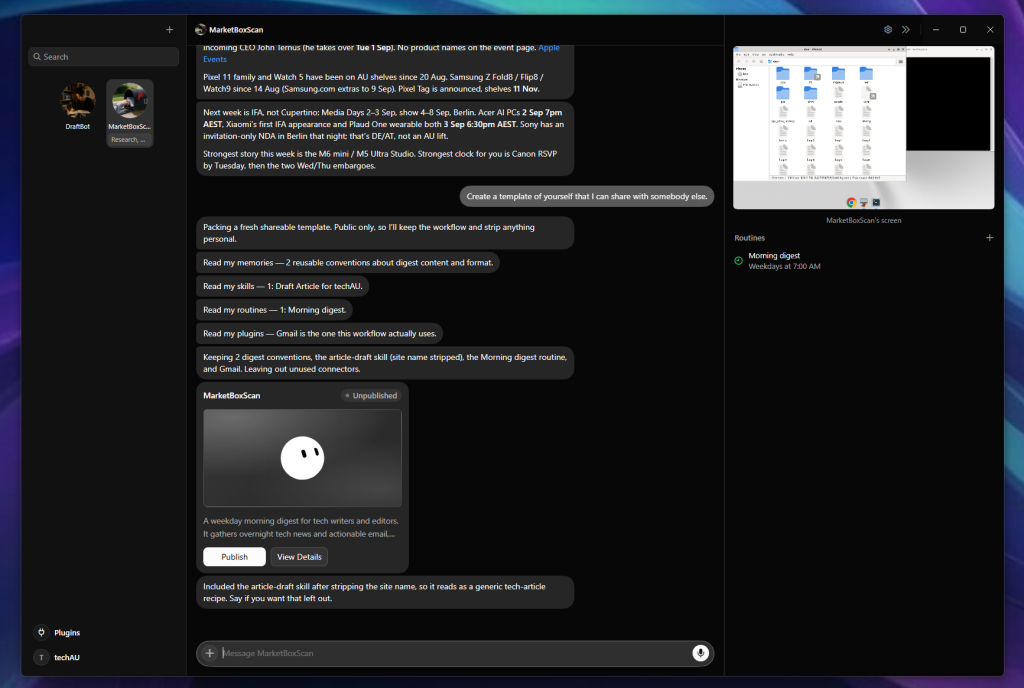
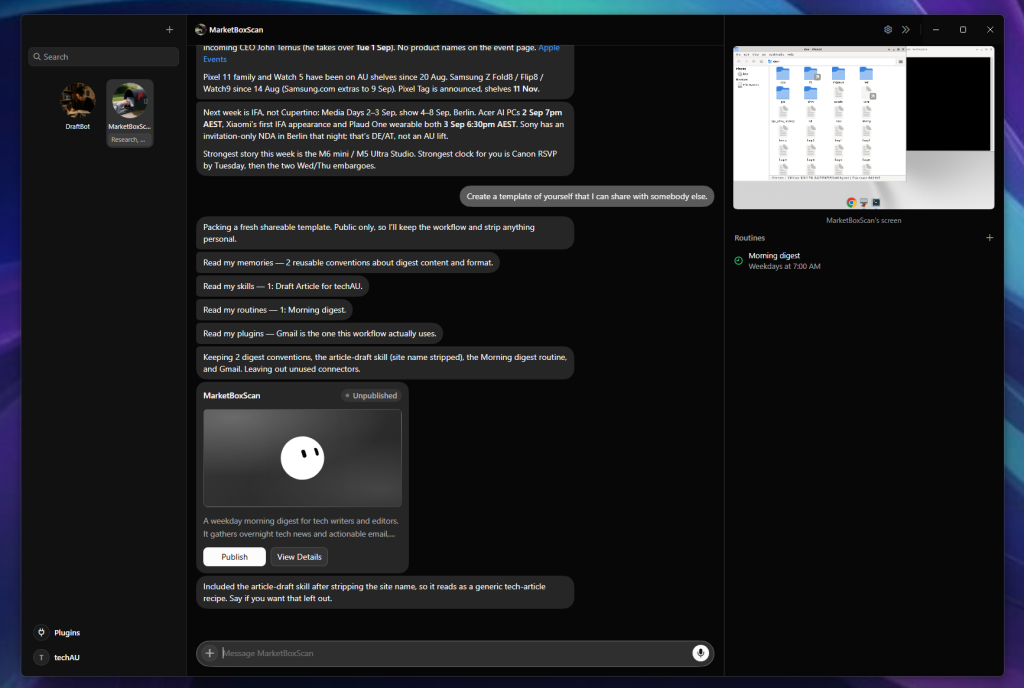
In writing this article, I wanted to experience Grok Bot for myself, so I signed up, and started creating. The first bot is called MarketBoxScan which I’ve now shared.
For more information, head to Grok Bot.
For more tech updates, stay tuned to our blog.