NASA’s Curiosity Mars rover captured this sand-covered hill, nicknamed “Miraflores,” estimated to be about 20 feet (6 meters) high, with its Mast Camera, or Mastcam, on June 11, 2026, the 4,923rd Martian day, or sol, of the mission. The hill was left behind when the surrounding rock eroded over time, deepening the wide valley Curiosity
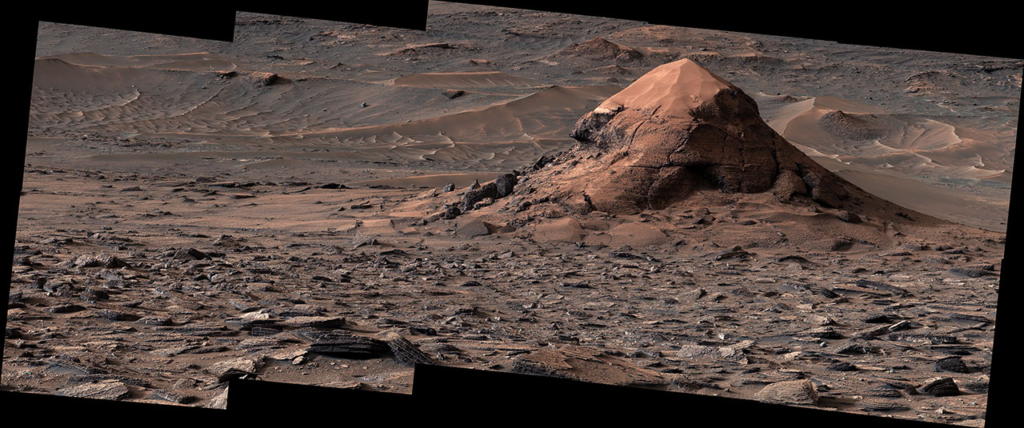
NASA’s Curiosity Mars rover captured this sand-covered hill, nicknamed “Miraflores,” estimated to be about 20 feet (6 meters) high, with its Mast Camera, or Mastcam, on June 11, 2026, the 4,923rd Martian day, or sol, of the mission. The hill was left behind when the surrounding rock eroded over time, deepening the wide valley Curiosity is ascending through.
The surrounding area includes an expanse of land covered in surface features called polygons.
The panorama is made up of 11 individual images that were sent to Earth and stitched together. The color has been adjusted to match lighting conditions as the human eye would see them on Earth.
Curiosity was built by NASA’s Jet Propulsion Laboratory, managed by Caltech in Pasadena, California. JPL is leading the mission on behalf of NASA’s Science Mission Directorate in Washington as part of NASA’s Mars Exploration Program portfolio. Malin Space Science Systems in San Diego built and operates Mastcam.
For more information about Curiosity, visit:
science.nasa.gov/mission/msl-curiosity
For more tech updates, stay tuned to our blog.