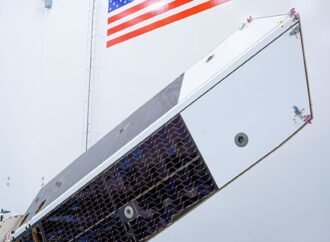
The large sunshade of NASA’s Near-Earth Object (NEO) Surveyor is mounted on an assembly ring during inspections in a clean room at BAE Systems Space & Mission Systems in Boulder, Colorado, in July 2026. The sunshade structure stands 20 feet (6 meters) tall and measures 8 feet (2.4 meters) wide at its base. Its two flat panels,
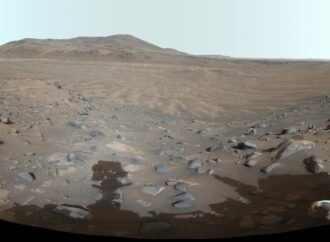
Over 1,645 Martian days, NASA’s Perseverance Mars rover measured the fine and ultrafine Martian dust particles found clinging to samples of spacesuit materials that are carried aboard the rover, including some that are small enough to penetrate the lungs and enter the bloodstream. The findings will be published Tuesday, Oct. 27, in the Proceedings of
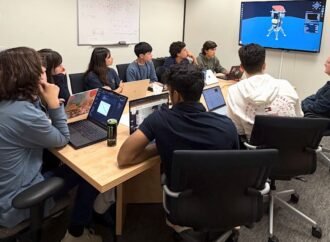
The NASA STEM (Science, Technology, Engineering, and Mathematics) Enhancement in Earth Science (SEES) Internship Program at the University of Texas Center for Space Research places high school students on small, mission-focused research teams mentored by NASA, academic, and industry experts. During summer 2026, the SEES Mission Architecture Tool for Research, Integration, and eXploration (MATRIX) team
Members of the media are invited to tour a new lunar landing simulation at NASA’s Ames Research Center in California’s Silicon Valley on Thursday, Oct. 29, and Friday, Oct. 30. Using a combination of in-house and partner motion-based simulators, NASA is giving astronauts and engineering support teams simulated experiences before crew members pilot commercial human
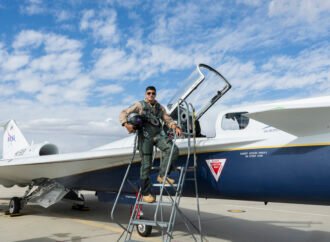
NASA test pilot Mike Lippert poses for a photo ahead of his first time flying the agency’s X-59 quiet supersonic research aircraft on Oct. 21, 2026. The X-59 has flown numerous times since its inaugural flight in November 2025; its first supersonic flight was on June 5, 2026. Lippert took off from NASA’s Armstrong Flight
NASA and the U.S. Department of Agriculture (USDA) have signed a Memorandum of Understanding expanding cooperation in Earth observation, geospatial analytics, and advanced data technologies, supporting USDA’s data modernization plan for United States agriculture. “NASA develops some of the most advanced sensing, computing, and analytical capabilities in the world, and we should put those tools