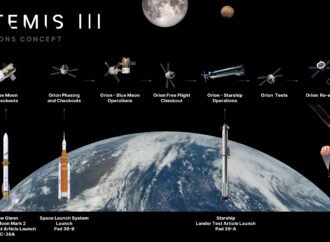
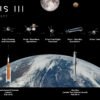
Before astronauts return to the lunar surface, NASA will first conduct one of the most ambitious and complex test missions in the agency’s history. Launching in 2027, Artemis III will send NASA astronauts Randy Bresnik, Frank Rubio, Andre Douglas, and ESA (European Space Agency) astronaut Luca Parmitano aboard the Orion spacecraft into low Earth orbit
As the supercooled propellant flowed into the core stage, and NASA’s SLS (Space Launch System) rocket roared to life, Allison Mjoen and her family watched with awe and pride. Mjoen, NASA’s operations manager for the agency’s Exploration Ground Systems program, helped shape the systems and ground operations that will one day send humans back to
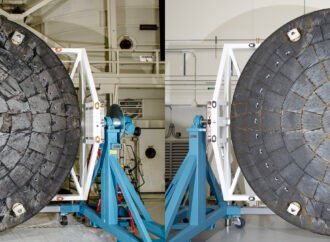
NASA’s Artemis II mission sent four astronauts around the Moon and brought them safely back to Earth, laying a foundation for crewed flights to the Moon’s surface. Additional engineering data analysis of the Orion spacecraft’s heat shield confirmed initial data showing the heat shield performed as expected. In particular, NASA measured whether the thermal protection
Organizations interested in launching CubeSats on future Artemis missions should respond to NASA’s request for information (RFI) by Monday, June 1, for initial consideration. “The SLS (Space Launch System) rocket and the Artemis missions provide great opportunities for teams to conduct important, science and technology investigations that contribute to the expansion of human space exploration,” said
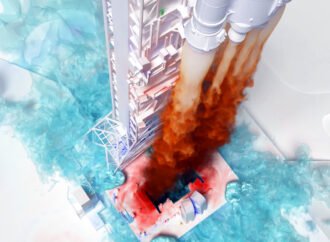
Airflow around rockets as they travel from Earth into space can have a dramatic impact on a mission, which is why NASA used advanced simulations to provide the best possible launch conditions for the Artemis II test flight around the Moon. To better understand the Artemis Space Launch System (SLS) rocket’s flight environment, engineers turned to a NASA-developed tool called the Launch, Ascent, and Vehicle Aerodynamics
Lee esta historia en español aquí. To achieve the national goal of landing American astronauts on the surface of the Moon and maintaining U.S. superiority in exploration and discovery, NASA announced Feb. 27 it is increasing its cadence of missions under the Artemis program, standardizing the SLS (Space Launch System) rocket configuration, and adding a new